When 'Zirconia Bridge' Is No Longer a Sufficient Answer
A 2025 in vitro study in the Journal of Prosthodontics by Diken Turksayar and colleagues fabricates 32 three-unit monolithic Y-TZP bridges across four manufacturing routes — CNC milling, SLA, DLP, and LCM — and finds that DLP produces marginal gaps of 154 µm, well above the 120 µm clinical threshold, while SLA matches CNC milling in trueness across most measured regions.
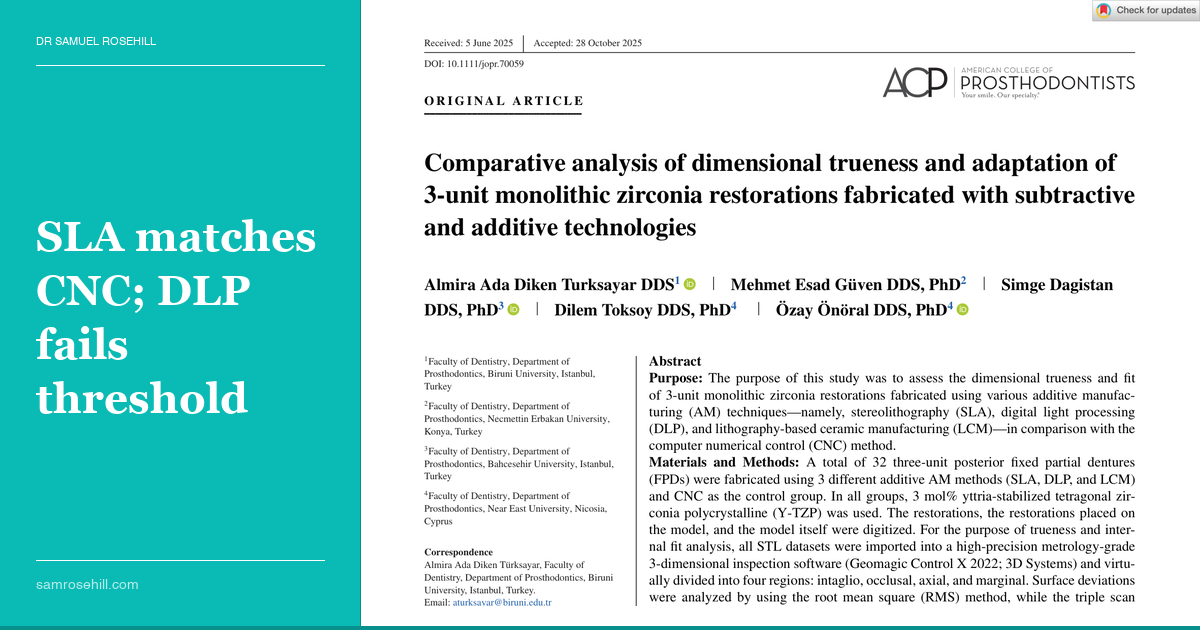
SLA matches CNC; DLP fails threshold
Source Paper
Comparative analysis of dimensional trueness and adaptation of 3-unit monolithic zirconia restorations fabricated with subtractive and additive technologies
The material on the prescription pad reads “3 mol% Y-TZP zirconia,” and it is the same material regardless of whether the bridge arrives from a CNC mill or from any of three competing additive manufacturing processes. Same chemistry. Same sintering temperature, more or less.
The assumption lurking behind that consistency is that the clinical result will also be consistent — that “zirconia bridge” is a sufficient specification. It is not, and a 2025 paper in the Journal of Prosthodontics supplies the data to make that case precisely.
“Comparative analysis of dimensional trueness and adaptation of 3-unit monolithic zirconia restorations fabricated with subtractive and additive technologies,” by Diken Turksayar, Güven, Dagistan, Toksoy, and Önöral, put four fabrication routes head to head: CNC milling, stereolithography (SLA), digital light processing (DLP), and lithography-based ceramic manufacturing (LCM). Three of the four produced clinically acceptable fits. One did not.
The Data Anchor
Thirty-two three-unit posterior fixed partial dentures were fabricated from 3 mol% Y-TZP across four groups (n = 8 per group), using a standardised typodont model with a missing maxillary first molar and conventional abutment preparation parameters (10-12° convergence angle, 1.5-2.0 mm occlusal reduction, 1.0 mm chamfer margin, 50 µm cement gap).
Dimensional trueness was assessed by superimposing each restoration’s STL file against the reference design in Geomagic Control X 2022, using root mean square (RMS) deviation across four surface regions: marginal, intaglio, occlusal, and external. Internal fit was measured via the triple scan method, generating gap values from approximately 7,400 reference points per specimen. Statistical analysis used two-way repeated-measures ANOVA with Greenhouse-Geisser correction, Bonferroni and Tukey post hoc tests at α = 0.05.
Key Findings
- SLA matched CNC on marginal fit. Mean marginal RMS: SLA 35.17 µm ± 5.97; CNC 39.22 µm ± 6.28 (p = 1.000). SLA also outperformed CNC on external surfaces (37.43 µm vs 56.58 µm; p < 0.001).
- DLP failed the clinical threshold. Mean marginal gap for DLP was 154.15 µm ± 45.37, well above the 120 µm ceiling. Internal fit was 218.29 µm ± 11.88, significantly higher than all other groups (p < 0.003). The authors attribute this to pixelation from voxel-based layer curing, anisotropic sintering shrinkage, and a pronounced staircase effect at layer interfaces.
- LCM performed acceptably on marginal and internal fit (marginal gap 35.66 µm, statistically indistinguishable from SLA and CNC; p = 1.000), but showed significantly higher deviation on occlusal and external surfaces (p < 0.001), likely from distortion during manual support-structure removal.
- Occlusal surfaces need attention for DLP and LCM. Colour-deviation maps showed orange and red zones (> 50 µm material excess) at occlusal contact points in both groups.
- Limitation: in vitro only, typodont model, standardised 150° build angle, one material per process. Results may not generalise to different printers, slurry formulations, or clinical settings.
The DLP result is not a verdict on the technology in general; other studies have found clinically acceptable DLP crowns. Print parameters, equipment, and postprocessing protocols all determine where a specific lab lands on the deviation curve.
💡 The Clinical Bottom Line
For clinicians prescribing three-unit posterior zirconia bridges, the practical question this study raises is simple: ask your laboratory which fabrication route they use. If the answer is DLP, ask what adjustment protocol they apply post-sintering. SLA and CNC milling are broadly equivalent on fit; LCM warrants close attention to occlusal contacts at try-in.
Zirconia built its reputation on CNC-milled restorations. The additive routes now competing with CNC carry the same brand name but not always the same precision. The prescription pad may need an extra line.
Dr Samuel Rosehill is a general dentist with a prosthodontic focus, practising at Ethical Dental in Coffs Harbour, NSW. He holds a BDSc (Hons) from the University of Queensland, an MBA, an MMktg, and an MClinDent in Fixed & Removable Prosthodontics (Distinction) from King’s College London.
Clinical Relevance
Not all Y-TZP bridges are made equal — the fabrication route matters clinically. SLA and CNC milling produced comparable marginal gaps (35 µm and 39 µm respectively), both comfortably within the 120 µm clinical threshold. DLP produced marginal gaps averaging 154 µm, exceeding that threshold and requiring adjustment before clinical use. LCM performed similarly to CNC and SLA on marginal and internal fit but showed higher deviation on occlusal and external surfaces. If your lab is using DLP-printed zirconia for bridge frameworks, this data warrants a conversation about their post-sintering adjustment protocol.
Disclosure: The author has no financial conflicts of interest related to the products or topics discussed in this review. This is an independent summary prepared for educational purposes.
Continue the conversation
This review is also published on Substack, where you can leave comments and join the discussion.
Read on Substack →