The Anterior Implant That Stayed Put While Everything Else Moved
A 14-year retrospective follow-up of anterior maxillary implants in adults over 40 finds that adjacent teeth can continue erupting around fixed implant crowns, especially in Class II division 1 occlusion, creating infra-occlusion and measurable marginal bone implications.
Adults still erupt
Source Paper
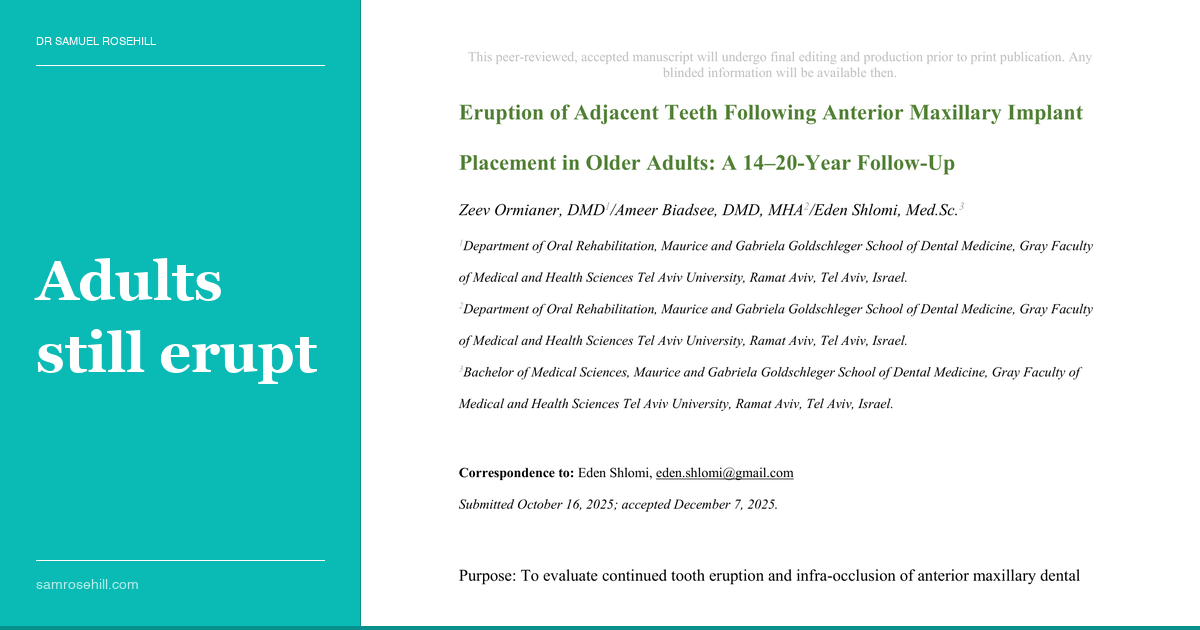
Eruption of Adjacent Teeth Following Anterior Maxillary Implant Placement in Older Adults: A 14–20-Year Follow-Up
Buildings settle. Children grow. Teeth, inconveniently for anyone who has ever promised that a central incisor implant will behave itself forever, keep conducting their small private migrations long after adulthood has allegedly begun. “Eruption of Adjacent Teeth Following Anterior Maxillary Implant Placement in Older Adults: A 14–20-Year Follow-Up,” by Ormianer, Biadsee, and Shlomi from Tel Aviv University, is a long reminder that the implant stays fixed while the neighbouring dentition keeps moving.
That is not implant failure. It is, in some ways, more annoying: the restoration succeeds biologically and slowly becomes aesthetically out of date.
The Data Anchor
This retrospective study began with 877 single implants placed in the anterior maxilla and ended with a very specific cohort: 30 patients over 40 years old at implant placement, carrying 32 anterior maxillary implants, with complete long-term records and no periodontal tooth-loss confounder. Mean age at placement was 47.07 years, median age 45, and mean follow-up was 14 years (range 10-26). No implant failures were recorded.
The authors measured marginal bone loss on standardised periapical radiographs and vertical discrepancy between implant crowns and adjacent teeth using digital imaging. In plain terms, they asked whether the teeth beside the implant kept erupting while the implant crown remained where osseointegration had bolted it.
Key Findings
- Class II division 1 was the standout risk signal. Angle occlusion classification correlated significantly with tooth eruption above the occlusal plane (χ² = 15.000, P = .000).
- Every Class II division 1 patient crossed the 1 mm line. All six Class II division 1 cases showed overeruption exceeding 1 mm, with a mean of 2.167 mm, compared with 1.063 mm in 24 Class I patients.
- Bone loss tracked with eruption. Mean marginal bone loss was 1.76 mm (SD 1.01), and greater eruption correlated with higher bone loss (P = .003; R² = 0.349).
- Implant length was not the explanation. Although implant length differed in the t-test, correlation analysis found no significant association between implant length and eruption.
- Limitation: only 30 of the original 877 anterior implant patients met inclusion criteria, and this was a retrospective study without periodontal biotype data.
💡 The Clinical Bottom Line
For Monday morning, the adult anterior implant conversation should include time as a material. A 45-year-old Class II division 1 patient is not exempt from vertical change simply because growth charts are no longer involved.
Photographs, incisal-edge records, and long-term review are not decorative admin in these cases; they are part of the prosthetic risk record. The implant may be made of titanium, but the adjacent teeth are still voting.
Dr Samuel Rosehill is a general dentist with a prosthodontic focus, practising at Ethical Dental in Coffs Harbour, NSW. He holds a BDSc (Hons) from the University of Queensland, an MBA, an MMktg, and an MClinDent in Fixed & Removable Prosthodontics (Distinction) from King’s College London.
Clinical Relevance
Adult anterior implant crowns can become infra-occluded over long follow-up because adjacent natural teeth continue erupting while the implant remains ankylosed. In this cohort, every Class II division 1 case showed more than 1 mm of adjacent tooth eruption, and greater eruption correlated with higher marginal bone loss. For clinicians, adult age alone should not remove vertical change from the consent and maintenance conversation.
Disclosure: The author has no financial conflicts of interest related to the products or topics discussed in this review. This is an independent summary prepared for educational purposes.
Continue the conversation
This review is also published on Substack, where you can leave comments and join the discussion.
Read on Substack →