Your Implant Crown Will Win the Occlusal Arms Race. Eventually.
A systematic review of eight prospective studies finds that implant-supported crowns, initially set light on purpose, progressively increase in occlusal force, contact area, and contact duration until they match or exceed adjacent natural teeth — often within months, sometimes years.
Light contact never stays light
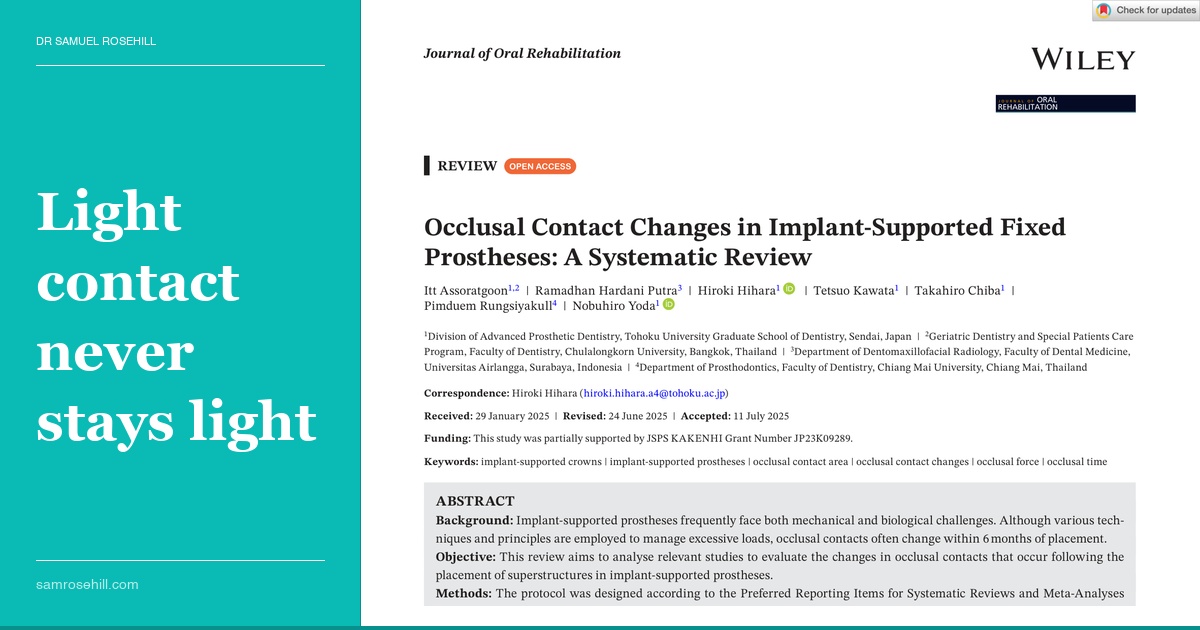
Source Paper
Occlusal Contact Changes in Implant-Supported Fixed Prostheses: A Systematic Review
“You’ll need to adjust the occlusion at the six-month review.” Every implant surgeon has said it. Fewer can explain, in precise biomechanical terms, exactly why the crown set with a 30-micrometre gap in January is reliably hammering its neighbours by July.
The answer is embedded in something fundamental: the implant has no periodontal ligament, and the opposing tooth does not know that. Assoratgoon and colleagues at Tohoku University have assembled the available evidence in “Occlusal Contact Changes in Implant-Supported Fixed Prostheses: A Systematic Review,” published in the Journal of Oral Rehabilitation in 2025. What they find is both reassuring and faintly alarming. Reassuring because the pattern is entirely consistent. Alarming because it appears to be essentially unstoppable.
The principle of implant-protected occlusion (IPO) recommends crowns be placed with deliberately light contact, ideally that 30 µm gap, to shield the bone-implant interface during osseointegration. The logic is sound. The execution is almost universally excellent. And then time happens.
The Data Anchor
The review followed PRISMA methodology, registered with PROSPERO (CRD42024527043). From 1,867 articles screened across PubMed, Scopus, Web of Science, and Cochrane, eight prospective cohort studies were included. Patient ages ranged from 16 to 78 years; sample sizes were 10 to 50 patients with 12 to 50 posterior implants each. Newcastle-Ottawa Scale assessment returned four studies at good quality and four at fair, with a mean score of 6.63 out of 9.
The T-Scan computerised occlusal analysis system (Tekscan) was the predominant measurement tool, alongside the Dental Prescale pressure film (Fuji Film Corp.). Follow-up ranged from one month to five years.
The consensus across all eight studies is unambiguous: implant crowns set light at delivery do not stay light. Occlusal force increased progressively; contact area expanded; occlusion duration lengthened. In Zhang et al.’s 2023 comparison (n = 50 zirconia crowns), both normal and light-contact groups ultimately surpassed natural control teeth force levels, with the light-contact group simply taking longer to arrive.
Key Findings
- The 30 µm gap does not hold. Initial infraocclusion was not maintained in any included study. Changes typically appeared between three and six months, with some studies showing continued increase out to 48 and 60 months.
- The opposing tooth’s continuous eruption is a principal driver. Once osseointegrated, the implant is stationary; the opposing natural tooth is not. It continues erupting in response to light contact, closing the intended gap, with 0.1–0.2 mm of mesial drift compounding the effect.
- Conventional assessment tools are inadequate. Articulating paper, shim-stock, and diagnostic casts cannot quantify these changes; no correlation exists between paper mark size and occlusal force magnitude.
- Limitations: All included studies are cohort designs; no RCTs exist in this domain. Most samples were concentrated in the molar region, and the T-Scan has documented reproducibility constraints.
💡 The Clinical Bottom Line
The message is not that implant-protected occlusion is wrong — it is that IPO is, by design, temporary. Setting light contact at delivery is the correct clinical decision; assuming that contact will remain light is not. Scheduled occlusal review belongs in implant aftercare protocols, not as an optional extra.
Articulating paper cannot tell you how much force a crown is bearing, nor whether that force is climbing month by month. Digital occlusal analysis at review appointments is the appropriate tool; this review makes the limitation clinically concrete rather than merely theoretical.
The deeper implication is almost architectural: we design implant occlusion at a single moment, and the stomatognathic system redesigns it on its own schedule. Monitoring, not one-time adjustment, is the clinical posture this evidence demands.
Dr Samuel Rosehill is a general dentist with a prosthodontic focus, practising at Ethical Dental in Coffs Harbour, NSW. He holds a BDSc (Hons) from the University of Queensland, an MBA, an MMktg, and an MClinDent in Fixed & Removable Prosthodontics (Distinction) from King’s College London.
Clinical Relevance
Implant-supported posterior crowns set with light occlusal contact at delivery progressively increase in force, contact area, and contact duration over time, often matching or exceeding adjacent natural teeth within months. This systematic review of eight prospective cohort studies confirms the instability of initial occlusal adjustments and highlights the need for longitudinal monitoring. Articulating paper and shim-stock are inadequate for tracking these changes; digital occlusal analysis is the recommended approach.
Disclosure: The author has no financial conflicts of interest related to the products or topics discussed in this review. This is an independent summary prepared for educational purposes.
Continue the conversation
This review is also published on Substack, where you can leave comments and join the discussion.
Read on Substack →