When the Patient Ticks Every Box: Full-Arch Implants, Risk Stratification, and the 46% Nobody Mentions
A retrospective study of 256 immediately loaded full-arch implants in 50 patients identifies smoking, maxillary placement, female sex, and age over 65 as significant risk factors for marginal bone loss — while reporting a 98% implant survival rate and a mechanical complication rate that should prompt a frank preoperative conversation with every full-arch candidate.
Risk factors confirmed, 98% survival
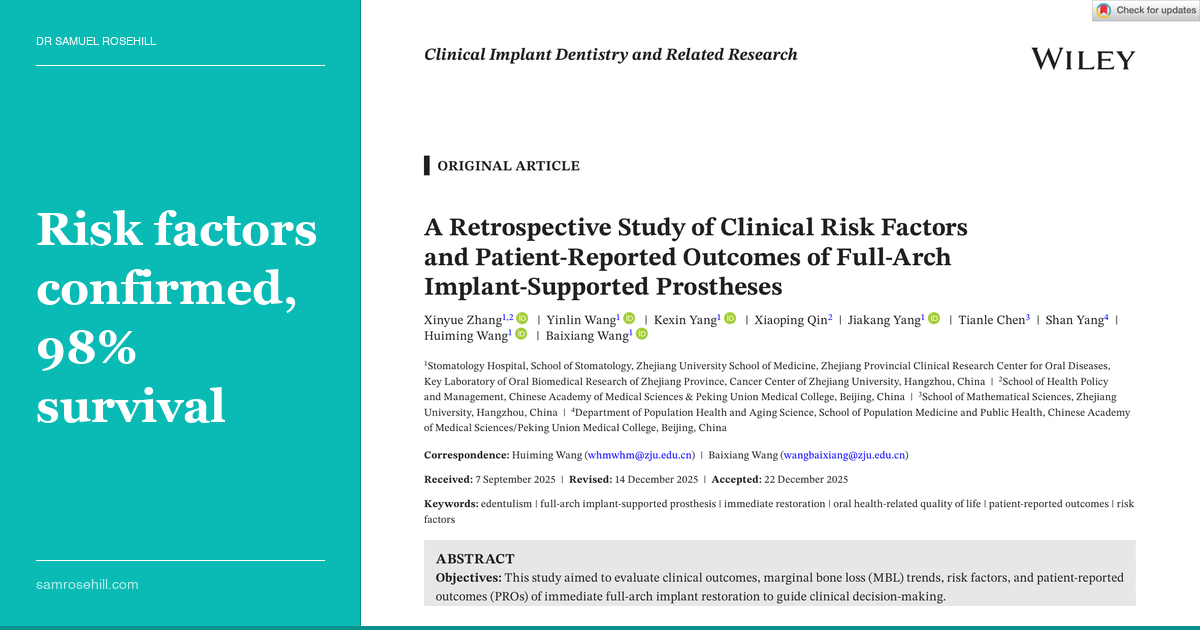
Source Paper
A Retrospective Study of Clinical Risk Factors and Patient-Reported Outcomes of Full-Arch Implant-Supported Prostheses
Picture a patient who would make any implant surgeon pause mid-consent form. She is 67, smokes (moderately, she says; she quit three months ago, mostly), presents for full-arch rehabilitation of an atrophic maxilla, and wants the same-day teeth she saw advertised online. Tick every risk factor from the recent literature. She is precisely the patient this study was designed to describe.
Zhang, Wang, Yang, and colleagues at Zhejiang University have published “A Retrospective Study of Clinical Risk Factors and Patient-Reported Outcomes of Full-Arch Implant-Supported Prostheses” in Clinical Implant Dentistry and Related Research (2026, 28:e70119). It is a methodologically careful retrospective analysis that asks the question every full-arch surgeon privately answers during treatment planning (which patients will lose more bone, and by how much?) and provides a multi-factor statistical answer that belongs in preoperative counselling conversations.
The implants largely held. The complications are where the story gets interesting.
The Data Anchor
The study analysed 256 NobelParallel Conical Connection implants (plus 6 Ankylos) in 50 patients who received immediately loaded full-arch prostheses between 2012 and 2018, with an average follow-up of 42 ± 16.36 months. The cohort was 30 males and 20 females, mean age 56.32 years; 17 patients were smokers, 9 of whom had quit before surgery.
MBL was measured at five time points using CBCT, a step up from periapical radiographs, capturing mesial, distal, buccal, and lingual bone heights. A linear mixed-effects model examined candidate risk factors simultaneously. The cumulative survival rate was 98% at the implant level and 94% at the patient level; all five early failures occurred in patients who were smokers, over 65, and carried comorbidities.
Key Findings
- Smoking significantly increased MBL (p = 0.017). Patients who had quit showed no significant difference from non-smokers.
- Maxillary implants lost more bone than mandibular (p = 0.040), consistent with differences in cortical bone density and stress distribution.
- Female sex was an independent risk factor (p = 0.003), likely reflecting post-menopausal oestrogen decline and its effect on osteoclast activity.
- Age over 65 years was significant (p = 0.007); the 46-55 and 56-65 brackets were not, suggesting a reasonably well-defined inflection point.
- 30° angled abutments at distal sites were associated with greater MBL (p = 0.010); 17° were not. A modifiable planning decision.
- Bone loss was front-loaded: most resorption occurred in years 1-2; incremental loss from years 2-5 was not statistically significant.
- Mechanical complications in 46% of patients: 24% veneering cracking, 18% prosthesis fractures, 2% screw issues.
- Patient-reported outcomes were strongly positive: OHIP-14 improved significantly; EQ-VAS rose from 84.94 to 87.38 (p < 0.001).
- Limitation: single-centre retrospective design, no control group, n = 50 patients, CBCT susceptible to metal artefact.
💡 The Clinical Bottom Line
The 98% implant survival rate confirms the procedure’s efficacy. The 46% mechanical complication rate is the figure that deserves equal billing in the preoperative discussion: not as a reason to decline treatment, but as a reason to plan maintenance accordingly and to set expectations honestly.
The risk stratification is actionable. Smoking, maxillary arch, female sex, and age past 65 each independently predicted more bone loss; when they cluster, the effect is cumulative. The first two years are the critical monitoring window, and when distal angulation demands correction, 17° is preferable to 30° wherever anatomy permits.
Clinical pearl: the authors found no significant MBL difference between quitters and non-smokers. The cessation window matters. “Quit at some point” is not equivalent to “quit before surgery.”
The patient who ticks every box can still achieve excellent outcomes. She just needs a surgeon who read the footnotes.
Dr Samuel Rosehill is a general dentist with a prosthodontic focus, practising at Ethical Dental in Coffs Harbour, NSW. He holds a BDSc (Hons) from the University of Queensland, an MBA, an MMktg, and an MClinDent in Fixed & Removable Prosthodontics (Distinction) from King’s College London.
Clinical Relevance
Smoking, maxillary placement, female sex, and age over 65 years are independently associated with greater marginal bone loss in immediately loaded full-arch implant-supported prostheses. In a cohort of 256 implants followed for an average of 42 months, bone loss was most rapid in the first two years and stabilised thereafter. The 46% mechanical complication rate is a realistic benchmark for preoperative counselling. Clinicians should use this risk profile to counsel patients before treatment, schedule bone monitoring during the first two post-operative years, and consider 30° angled abutments a modifiable risk factor at distal implant sites.
Disclosure: The author has no financial conflicts of interest related to the products or topics discussed in this review. This is an independent summary prepared for educational purposes.
Continue the conversation
This review is also published on Substack, where you can leave comments and join the discussion.
Read on Substack →