The Cantilever Was Not the Villain
Bakopoulos and colleagues followed 21 implant-supported fixed partial prostheses with cantilever extensions for a mean 13.3 years and found 100% implant survival, modest bone change, and no extra radiographic penalty beside the cantilever, although the prostheses still generated a fair amount of mechanical commentary.
Implants survive; prostheses grumble
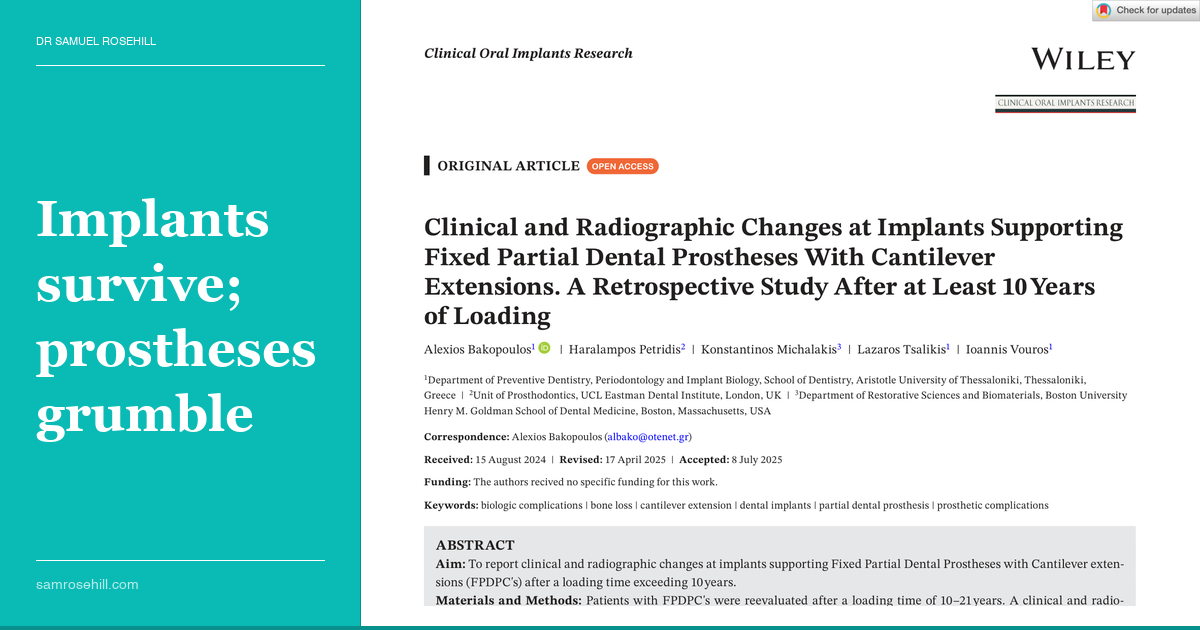
Source Paper
Clinical and Radiographic Changes at Implants Supporting Fixed Partial Dental Prostheses With Cantilever Extensions. A Retrospective Study After at Least 10 Years of Loading
Architecture has always had a weakness for the cantilever: the elegant little trick of sending structure out into empty space and trusting the hidden support to keep its nerve. Dentistry borrowed the idea and then spent years regarding it with the sort of suspicion usually reserved for charismatic new materials and old colleagues with strong opinions. In “Clinical and Radiographic Changes at Implants Supporting Fixed Partial Dental Prostheses With Cantilever Extensions. A Retrospective Study After at Least 10 Years of Loading,” Alexios Bakopoulos and colleagues report something quietly reassuring. The implants did very well. The complaints, where they arose, were mostly prosthetic.
That is an important distinction. The cantilever has often been discussed as though it were one occlusal contact away from moral collapse. These data suggest a more adult reading: biologically acceptable, technically demanding, and entirely capable of punishing optimism when the prosthetic design gets ambitious.
The Data Anchor
This retrospective cohort reevaluated 19 patients with 21 fixed partial dental prostheses with cantilever extensions, supported by 47 implants, after a mean loading period of 13.3 ± 2.9 years (range 10-21 years). The restorations were metal-ceramic FDPs carried by two or three implants, with mesial, distal, or bilateral cantilevers. Clinical review included probing depth, clinical attachment level, bleeding on probing, plaque, biologic complications, and prosthetic events. Radiographic assessment measured marginal bone level change from implant placement to re-evaluation.
It was, in other words, a real-world long follow-up rather than a laboratory fable. The implants were placed in a private periodontal practice, but the prostheses were fabricated by nine different restorative clinicians, including prosthodontists. That makes the dataset slightly messier, which is also why it is interesting.
Key Findings
- Implant survival was flawless, but success was not perfect. All 47 implants survived, while implant success was 91.5% because 4 implants (8.5%) presented with peri-implantitis at review.
- Soft tissue trouble existed, but it was not catastrophic. Twelve implants (25.5%) showed peri-implant mucositis, and mean probing depth at re-evaluation was 3.9 ± 1.6 mm.
- Marginal bone behaved rather sensibly. Mean marginal bone level change from placement to review was 0.99 ± 1.11 mm. Implants adjacent to the cantilever lost 0.83 mm, versus 1.04 mm for implants further away; the difference was not significant (P = .29).
- The prosthesis did the complaining. Prosthetic survival was 86% and prosthetic success 81%. Three restorations needed replacement because of cantilever tooth fracture, and one prosthesis suffered abutment screw fracture that was corrected.
- Some feared complications never arrived. There were no implant fractures, no framework fractures, and no loss of retention in this cohort.
- Limitations are real. This was a small retrospective sample, radiographs from prosthesis delivery were unavailable, patient attrition over long follow-up was considerable, and the restorative workflow was heterogeneous by design.
💡 The Clinical Bottom Line
If the alternative to a cantilevered implant FDP is more grafting, more sinus manipulation, or more morbidity than the patient sensibly wants, this paper supports the cantilever as a legitimate compromise. The biological price was modest, and the implant nearest the cantilever did not seem to carry a special radiographic punishment for its proximity.
The warning light belongs elsewhere. The prosthetic events clustered around fractures and screw complications, and the authors note that all three major fractures occurred in patients with lengthy molar cantilevers. That is a useful clinical correction. The cantilever is not a villain. It is a structure with a long memory for shortcuts, particularly when connector dimensions and span length are asked to behave more heroically than they ought.
Dr Samuel Rosehill is a general dentist with a prosthodontic focus, practising at Ethical Dental in Coffs Harbour, NSW. He holds a BDSc (Hons) from the University of Queensland, an MBA, an MMktg, and an MClinDent in Fixed & Removable Prosthodontics (Distinction) from King’s College London.
Clinical Relevance
For selected posterior cases where sinus lift or major augmentation would add morbidity, cantilevered implant-supported fixed partial prostheses remain a defensible option. In this 10- to 21-year retrospective cohort, implants adjacent to the cantilever did not lose more bone than more distant implants, but long molar cantilevers and connector design still looked like the real prosthetic weak points.
Disclosure: The author has no financial conflicts of interest related to the products or topics discussed in this review. This is an independent summary prepared for educational purposes.
Continue the conversation
This review is also published on Substack, where you can leave comments and join the discussion.
Read on Substack →