The Fractured Crown's Second Chance: What 126 Studies Say About Ceramic Repair
A scoping review of 126 studies maps the repair protocol landscape for fractured ceramics — hydrofluoric acid plus silane wins for glass ceramics, while air abrasion with MDP-containing primers leads for zirconia.
126 studies, one rule
Source Paper
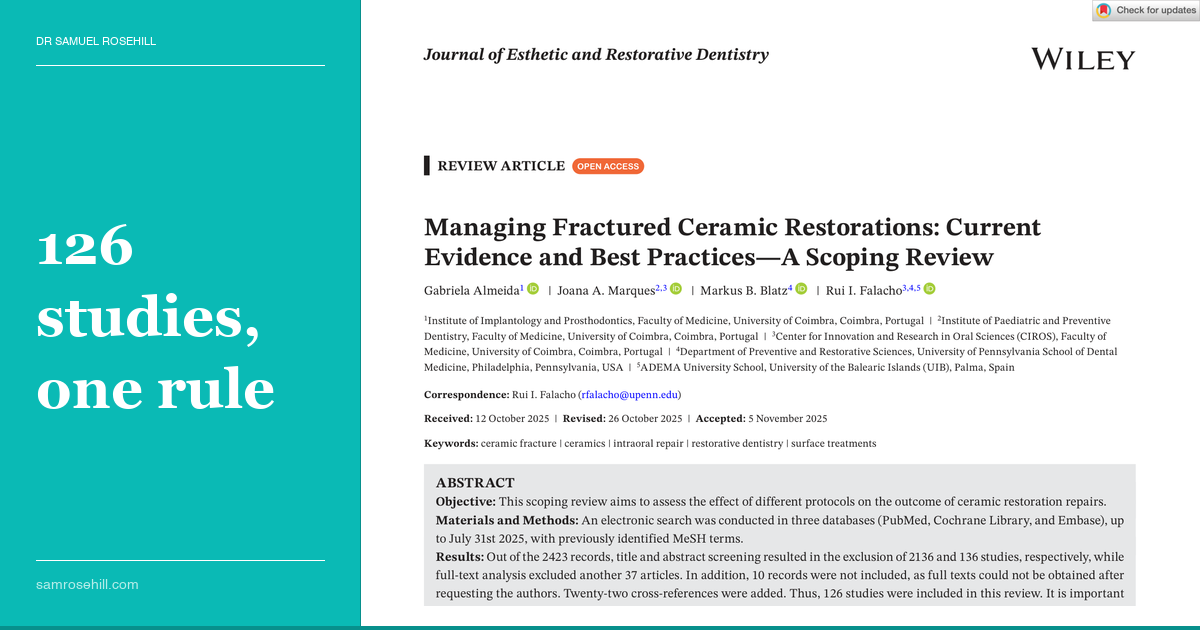
Managing Fractured Ceramic Restorations: Current Evidence and Best Practices — A Scoping Review
The word “ceramic” comes from the Greek keramos — potter’s clay — which is a charmingly modest ancestry for a material that now costs several hundred dollars a unit and occasionally fractures under forces its manufacturer’s brochure assured you it could handle. When it does fracture, the profession’s collective response has been curiously disorganised: some clinicians replace the entire restoration, some reach for whichever bonding agent happens to be in the drawer, and a surprising number simply hope nobody notices. Almeida et al.’s scoping review — Managing Fractured Ceramic Restorations: Current Evidence and Best Practices — in the Journal of Esthetic and Restorative Dentistry (2025) has done the considerable favour of reading 126 studies on ceramic repair protocols so the rest of us don’t have to, and the headline is reassuringly clear: intraoral repair works, but only if you match the protocol to the substrate.
The Data Anchor
The team at the University of Coimbra and the University of Pennsylvania searched PubMed, Cochrane Library, and Embase for studies published from 2004 to July 2025, screening 2,423 records after duplicate removal and ultimately including 126 publications — overwhelmingly in vitro, with bond strength as the most frequently measured outcome (assessed by shear or microtensile testing in 77.7% of included papers). Composite resin served as the repair material in 97.5% of studies, confirming its dominance as the chairside repair medium. The ceramics tested most frequently were feldspathic, zirconia, lithium disilicate, and leucite-reinforced varieties; a smaller subset examined zirconia-reinforced lithium disilicate and alumina. Long-term evaluation using ageing methods — thermal cycling, water storage, or both — featured in 63.9% of publications, though methodological heterogeneity across studies was substantial enough that the authors caution against drawing definitive quantitative conclusions.
The quiet limitation worth noting: not a single randomised clinical trial exists on this topic. Every protocol recommendation rests on laboratory evidence. The bench has spoken; the mouth has not yet replied.
Key Findings
- For glass ceramics (feldspathic, lithium disilicate, leucite), hydrofluoric acid etching followed by silanisation consistently produced the strongest composite-to-ceramic bond — the acid dissolves the glass phase, exposes the crystalline matrix, and creates micromechanical retention that silane then chemically reinforces.
- For metal oxide ceramics (zirconia, alumina), hydrofluoric acid is ineffective because there is no glass phase to dissolve. Instead, air abrasion with silica-coated aluminium oxide particles combined with an MDP-containing primer delivered superior outcomes — the tribochemical silica coating enables subsequent silane coupling, while MDP provides direct chemical bonding to the oxide surface.
- Laser irradiation — tested across Er:YAG, Nd:YAG, Er,Cr:YSGG, and CO₂ wavelengths — generally produced inferior bond strengths compared to hydrofluoric acid for glass ceramics, with no clear consensus on optimal power settings and a risk of excessive heat damage to the ceramic layer.
- Self-etching ceramic primers (e.g., Monobond Etch & Prime) that combine etching and silanisation in a single step showed mixed results — some studies reported bond strengths superior to air abrasion, others similar or inferior to conventional HF acid protocols. The literature lacks direct comparisons.
- Hybrid substrates — where a fracture exposes both zirconia core and glass ceramic veneer — remain particularly underexplored, with most studies applying the same treatment to both surfaces rather than adapting the protocol to each exposed material.
💡 The Clinical Bottom Line
The repair protocol decision tree is mercifully binary: identify the ceramic, then choose accordingly. Glass ceramic? Hydrofluoric acid and silane under rubber dam isolation. Zirconia? Air abrasion with silica-coated aluminium oxide and an MDP-containing primer. The composite resin brand matters far less than the surface conditioning — a finding that should simplify your next stock order, if not your next Tuesday afternoon. What this review makes quietly devastating is the sheer volume of evidence confirming that repair is a legitimate, conservative alternative to replacement, while simultaneously revealing that we still lack a single clinical trial to prove it works in the environment that actually matters: the patient’s mouth.
Dr Samuel Rosehill is a general dentist with a prosthodontic focus, practising at Ethical Dental in Coffs Harbour, NSW. He holds a BDSc (Hons) from the University of Queensland, an MBA, an MMktg, and an MClinDent in Fixed & Removable Prosthodontics (Distinction) from King’s College London.
Reference: Almeida G, Marques JA, Blatz MB, Falacho RI. Managing Fractured Ceramic Restorations: Current Evidence and Best Practices — A Scoping Review. J Esthet Restor Dent. 2025. DOI: 10.1111/jerd.70055
Clinical Relevance
Match your repair protocol to the ceramic substrate. For glass ceramics (feldspathic, lithium disilicate, leucite), use hydrofluoric acid etching followed by silanisation. For metal oxide ceramics (zirconia, alumina), use air abrasion with silica-coated aluminium oxide and an MDP-containing primer. One protocol does not fit all — substrate identification is the essential first step.
Disclosure: The author has no financial conflicts of interest related to the products or topics discussed in this review. This is an independent summary prepared for educational purposes.
Continue the conversation
This review is also published on Substack, where you can leave comments and join the discussion.
Read on Substack →