DME Has Become a Default. The Long-Game Evidence Hasn't Arrived Yet.
A 2025 scoping review of 26 studies by Santos, da Silva, Lins, and colleagues from the Federal University of Rio Grande do Norte maps the evidence base for deep margin elevation and finds a discipline that has quietly adopted a technique on short-term reassurance while the one 12-year longitudinal study reports bleeding on probing in 50% of cases and periodontal complications with bone loss in 11%.
Short-term fine, long-term unknown
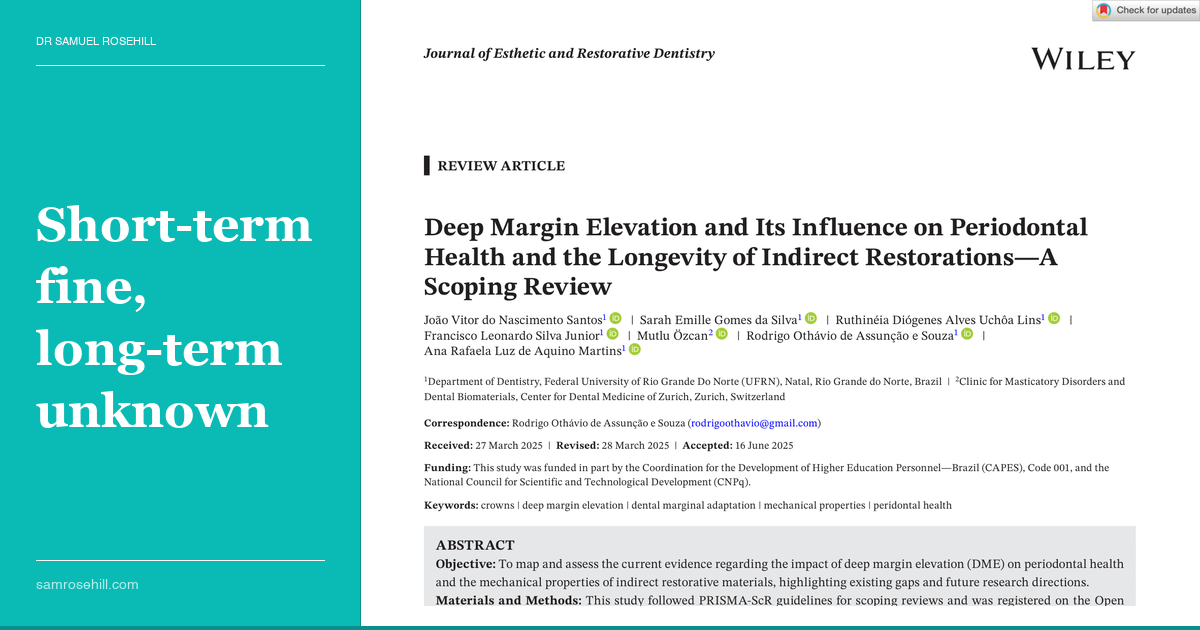
Source Paper
Deep Margin Elevation and Its Influence on Periodontal Health and the Longevity of Indirect Restorations—A Scoping Review
Restorative dentistry has a talent for normalising techniques before the longitudinal evidence catches up. Deep margin elevation — moving a subgingival margin coronally with composite resin before an indirect restoration — slipped into routine practice on the logic of the lesser evil: the alternative is surgical crown lengthening with its own morbidity, or extraction. The literature, weighted heavily towards in vitro work and short follow-up, has been reassuring. “Deep Margin Elevation and Its Influence on Periodontal Health and the Longevity of Indirect Restorations — A Scoping Review,” published in the Journal of Esthetic and Restorative Dentistry in 2025 by Santos, da Silva, Lins, and colleagues from the Federal University of Rio Grande do Norte and the University of Zurich, maps what is known. The map’s most notable feature is how much of it is still blank.
The problem is temporal. Clinical follow-up in this literature runs from 3 months to 12 years, which sounds broad until you note where the studies cluster. The 12-year outlier is Bresser et al. (2019), following 189 indirect restorations: 50% with bleeding on probing, 11% with bone loss, 39% with healthy gingiva. Everything else sits in the comfortable 3-month-to-2-year band. The authors are candid that short-term reassurance is not equivalent to long-term evidence.
The Data Anchor
The review followed PRISMA-ScR guidelines across PubMed/Medline, Embase, Scopus, and Web of Science in April 2025. From 148 initial citations, 26 met eligibility: 12 in vitro, eight clinical, six reviews. Bulk-fill resin-based composite was the predominant DME material (n = 11); ceramic crowns were the most common definitive restoration (n = 18). Six studies simulating five years of loading through thermocycling (1,200,000 cycles) found no significant compromise to fracture resistance or fatigue strength. Finite element analyses suggest a low-modulus interlayer (highly filled flowable composite) reduces stress at the cervical margin.
Aziz et al. (2024) provides partial counterweight: 153 DME patients followed for a mean 10.1 years, no significant difference in periodontal parameters versus controls, crown survival at 95.8%. The populations and methodologies differ from Bresser’s cohort. The two studies simply do not agree.
Key Findings
- Short-term clinical evidence is reassuring, conditionally. Studies from 3 months to 2 years report no significant periodontal differences between DME and control sites, provided the supracrestal tissue height is preserved and margins remain at least 1 mm from the alveolar crest.
- Bresser et al.’s 12-year result is the inconvenient outlier: 50% bleeding on probing, 11% bone loss, 39% healthy gingiva. It should not be averaged away by shorter studies.
- Bleeding on probing is a recurring signal. Ferrari et al. reported it in 53% of cases at 12 months; Hausdörfer et al. found it significantly elevated versus controls at one year. Neither reported alarming probing depths, but bleeding is a signal, not a reassurance.
- Laboratory evidence supports DME mechanically. Bulk-fill composite performs equivalently to no-DME controls in fracture resistance; flowable resin as interlayer may offer stress-distribution advantages.
- Limitation: 12 of 26 included studies are in vitro. Biofilm, operator variability, and patient factors do not feature in bench tests.
DME does not adversely affect periodontal health when technique is optimal. Most clinical studies were conducted under controlled conditions that may not generalise to routine execution.
💡 The Clinical Bottom Line
The practical message from every favourable-outcome study is three criteria: absolute isolation, a well-adapted matrix, and respect for the supracrestal tissue height. Bulk-fill composite resin is the preferred DME material; highly filled flowable composite as interlayer may reduce cervical stress. Easy to state; surprisingly easy to compromise under time pressure.
DME became default-adjacent before anyone looked closely at the 12-year radiograph. That is not a reason to stop; it is a reason to perform it as though that radiograph will eventually matter.
Dr Samuel Rosehill is a general dentist with a prosthodontic focus, practising at Ethical Dental in Coffs Harbour, NSW. He holds a BDSc (Hons) from the University of Queensland, an MBA, an MMktg, and an MClinDent in Fixed & Removable Prosthodontics (Distinction) from King’s College London.
Clinical Relevance
Most clinical studies on deep margin elevation report no significant adverse periodontal effect at follow-up periods of 3 months to 2 years, provided the supracrestal tissue height is respected. The single 12-year longitudinal study in the literature tells a less comfortable story: bleeding on probing in 50% of cases, bone loss in 11%, and only 39% with healthy gingiva. Laboratory evidence supports bulk-fill composite resin as the material of choice for the elevation step, with low-modulus interlayers reducing stress at the DME–restoration interface. Clinicians should treat DME as a technically demanding technique requiring absolute isolation, well-adapted matrices, and scrupulous finishing rather than a routine shortcut around crown lengthening.
Disclosure: The author has no financial conflicts of interest related to the products or topics discussed in this review. This is an independent summary prepared for educational purposes.
Continue the conversation
This review is also published on Substack, where you can leave comments and join the discussion.
Read on Substack →