What If the Refund Request Was Avoidable? Ceramic Veneers and the Pre-Delivery Choices That Predict Dissatisfaction
A 1:1 matched case–control study from Mumbai finds that chairside bis-acryl mock-ups and chairside-only shade matching are strongly associated with patient-initiated esthetic dissatisfaction within 12 months of ceramic veneer delivery — with adjusted odds ratios of 5.87 and 4.41 respectively — while cost tier has no significant effect.
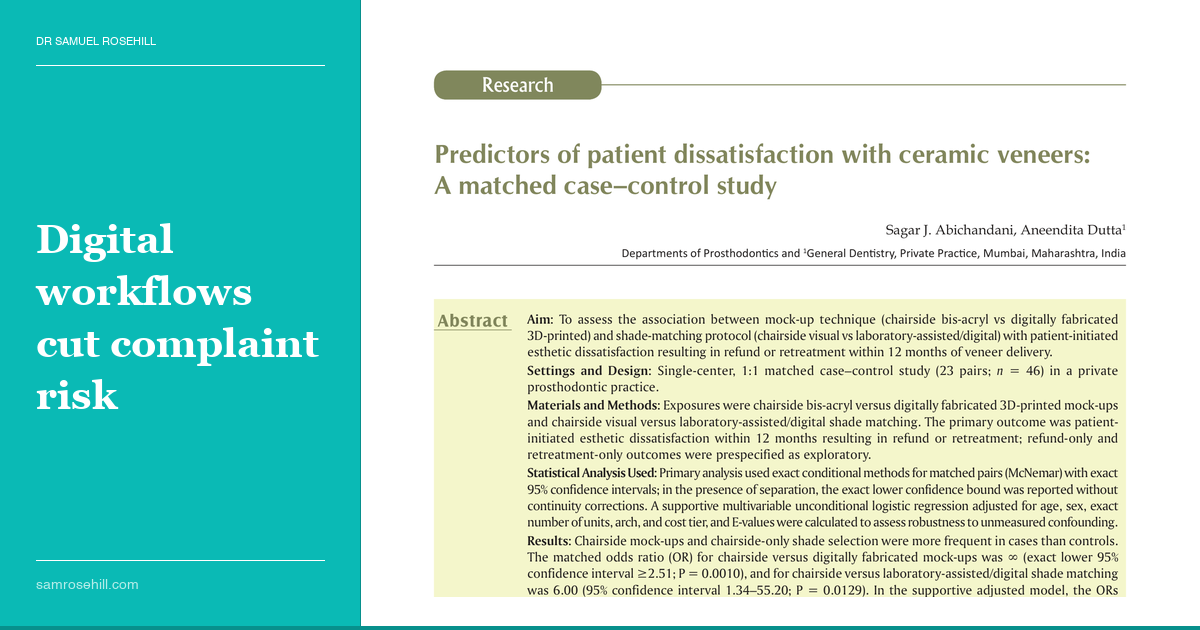
Digital workflows cut complaint risk
Source Paper
Predictors of patient dissatisfaction with ceramic veneers: A matched case–control study
What if the patient sitting in your chair three weeks after veneer delivery (the one with the tight smile and the printed photographs) was, in a statistically meaningful sense, predictable? Not their personality, but their dissatisfaction: the process choices made months earlier that elevated their odds of leaving unhappy to six times those of the patient in the next chair. That is the uncomfortable question at the centre of “Predictors of patient dissatisfaction with ceramic veneers: A matched case–control study” by Sagar J. Abichandani and Aneendita Dutta from private prosthodontic practice in Mumbai, published in the Journal of Indian Prosthodontic Society in 2026. The data suggests the answer was already visible in the pre-delivery workflow.
The Data Anchor
Abichandani and Dutta designed a 1:1 matched case–control study from clinical records spanning 2021–2023: 23 cases (patients requesting refund or retreatment due to esthetic dissatisfaction within 12 months) matched pair-for-pair with 23 satisfied controls (n = 46). Matching was on operator, veneer type, and number of units (±1). The two exposures of interest were mock-up method (chairside bis-acryl versus digitally designed 3D-printed) and shade selection (chairside visual tab versus laboratory-assisted spectrophotometry with cross-polarised photography and technician verification).
Primary analysis used exact conditional McNemar methods with exact 95% confidence intervals; a supportive multivariable logistic regression adjusted for age, sex, units, arch, and cost tier. E-values assessed robustness to unmeasured confounding.
Key Findings
- Mock-up method dominated. Every dissatisfied case in the discordant pairs had used a chairside mock-up; not one had used a digital 3D-printed alternative where their control had not. Matched OR = ∞ (lower 95% CI ≥ 2.51; P = 0.0010); adjusted AOR 5.87 (95% CI 1.59–21.66; P = 0.008).
- Shade protocol mattered independently. Chairside visual matching: matched OR 6.00 (95% CI 1.34–55.20; P = 0.0129), AOR 4.41 (95% CI 1.26–15.42; P = 0.021); significant even after accounting for mock-up type.
- Both chairside together: OR 11.00 (95% CI 1.60–473.47; P = 0.0063). The wide interval is honest about the sample size.
- Cost tier was not a predictor (P = 0.71): economy, standard, and premium cases distributed similarly across satisfied and dissatisfied patients.
- Limitations warrant caution. Retrospective single-centre design, n = 46, incomplete recording of optical covariates (substrate shade, cement value), and nonestimable component outcomes limit generalisability. E-values suggest an unmeasured confounder would need an 8–11-fold association with both exposure and outcome to fully explain the findings.
This is association, not causation. The E-value threshold is demanding enough to take the signal seriously, while the multicentre prospective study the authors have planned catches up.
💡 The Clinical Bottom Line
The study offers a reframe worth sitting with: veneer dissatisfaction may be, in part, a quality-assurance problem rather than a communication problem. The two process choices most strongly associated with early complaints (mock-up method and shade protocol) were both modifiable and both independent of cost. A standardised workflow incorporating digitally designed 3D-printed mock-ups, spectrophotometry under D65-approximate lighting, cross-polarised photography, and documented technician verification is the practice-change recommended here.
The confidence intervals are wide and replication at scale is needed. But the direction is clear and the mechanisms are plausible. Veneer dissatisfaction may not be entirely predictable, but it appears to be, in part, preventable.
Dr Samuel Rosehill is a general dentist with a prosthodontic focus, practising at Ethical Dental in Coffs Harbour, NSW. He holds a BDSc (Hons) from the University of Queensland, an MBA, an MMktg, and an MClinDent in Fixed & Removable Prosthodontics (Distinction) from King’s College London.
Clinical Relevance
Chairside bis-acryl mock-ups and chairside-only shade matching are independently associated with higher odds of early esthetic dissatisfaction requiring refund or retreatment, with adjusted ORs of 5.87 and 4.41 respectively. Digital workflows using 3D-printed mock-ups and calibrated spectrophotometric shade protocols significantly reduce this risk. Cost tier showed no significant association with dissatisfaction outcomes — the problem is process, not price point.
Disclosure: The author has no financial conflicts of interest related to the products or topics discussed in this review. This is an independent summary prepared for educational purposes.
Continue the conversation
This review is also published on Substack, where you can leave comments and join the discussion.
Read on Substack →