The Shortcut That Outperformed: Digital Dentures Beat Conventional on Patient Satisfaction
A randomised crossover trial comparing mucostatic digital complete dentures (intraoral scanner, DLP printing) with conventional selective-pressure impression dentures found significantly higher patient satisfaction with the digital method across comfort, confidence, chewing, aesthetics, and overall satisfaction — while OHIP-14 quality-of-life scores showed no difference between the two.
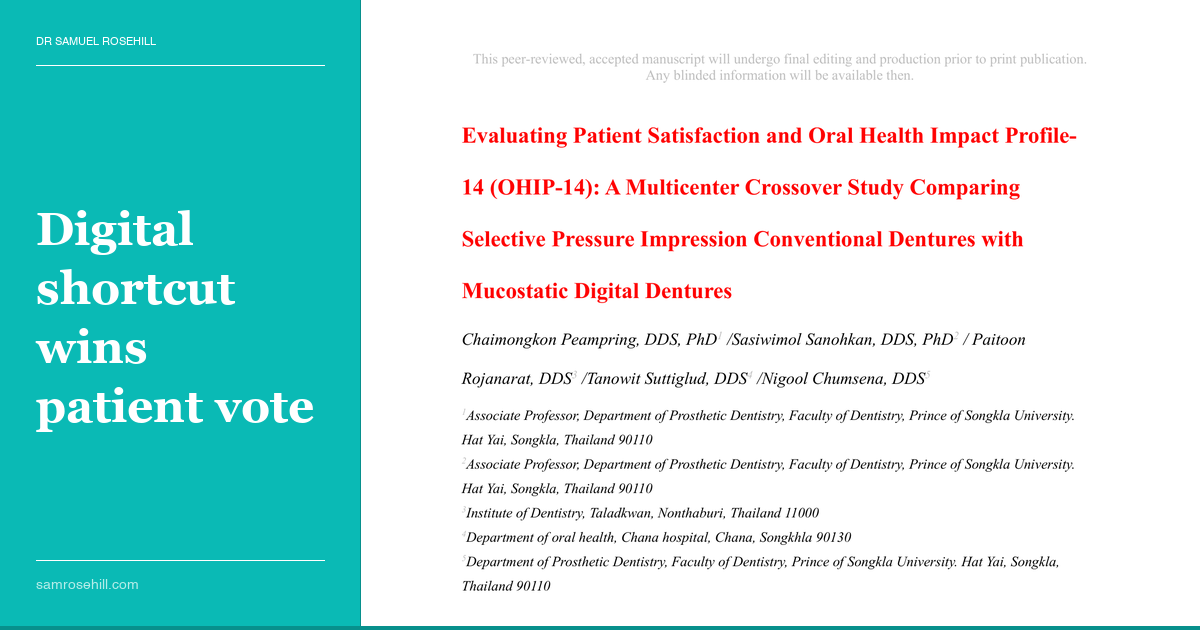
Digital shortcut wins patient vote
Source Paper
Evaluating Patient Satisfaction and Oral Health Impact Profile-14 (OHIP-14): A Multicenter Crossover Study Comparing Selective Pressure Impression Conventional Dentures with Mucostatic Digital Dentures
The conventional complete denture workflow has always carried a certain moral authority. Five appointments, custom trays, border moulding, selective pressure impressions, heat-polymerised polymethyl methacrylate (PMMA): the whole process has the solemnity of a craft that exists because no shortcut works as well. The patient who earns their dentures through that procedure, the logic goes, is rewarded with a prosthesis that fits.
Evaluating Patient Satisfaction and Oral Health Impact Profile-14 (OHIP-14): A Multicenter Crossover Study Comparing Selective Pressure Impression Conventional Dentures with Mucostatic Digital Dentures, published in the International Journal of Prosthodontics by Peampring and colleagues from Prince of Songkla University and collaborating Thai institutions, tested that assumption. The patients preferred the digital dentures. Not marginally, and not on one metric. Across treatment duration, comfort, confidence, chewing, aesthetics, and overall satisfaction, the digital method won. The quality-of-life scores were indistinguishable.
The Data Anchor
Twenty-three patients aged 40 and older with completely edentulous arches were enrolled across three Thai treatment centres. This was a randomised crossover trial: each participant received both denture types in a randomised order, wearing each for four weeks, making every patient their own control.
The conventional denture required five visits: primary impressions, border moulding with selective-pressure final impression, wax bite rim evaluation, trial try-in, and delivery after heat-polymerisation in PMMA. The digital workflow required four visits and used an intraoral scanner (Trios3, 3Shape, Denmark) to capture the edentulous ridge in a relaxed mucostatic state. Bases were produced by digital light processing (DLP) additive manufacturing from UV-curable resin; tooth arrangement used a virtual articulator in 3Shape Dental System software.
Satisfaction across seven domains was measured on a visual analogue scale (VAS) from 0 to 100. Quality of life was assessed with the Oral Health Impact Profile-14 (OHIP-14), a validated 14-item instrument on a 5-point Likert scale (0–56 total). Analysis used the Mann-Whitney U test.
Key Findings
- Digital dentures produced significantly higher satisfaction in six of seven domains: treatment duration, comfort, confidence, chewing ability, aesthetics, and overall satisfaction.
- Speech and pronunciation satisfaction was equivalent between denture types; palatal coverage and base thickness appear to affect speech similarly regardless of fabrication method.
- OHIP-14 scores showed no significant difference across all 14 subscales. The highest impact domain for both types was discomfort (median score 2, “occasionally”).
- Both dentures substantially improved quality of life versus edentulism. Patients new to complete dentures showed meaningful improvement with either prosthesis.
- Limitation: n = 23 from three Thai centres limits generalisability; the absence of a washout period (ethically required) means carryover effects cannot be entirely excluded.
The OHIP-14 equivalence is the underappreciated finding. It means the digital method does not trade quality of life for convenience — it wins on satisfaction while delivering the same functional outcome.
💡 The Clinical Bottom Line
For clinicians weighing the investment in a fully digital complete denture workflow, the preference data here are not subtle. In every domain where patients could articulate a preference, they chose the digital prosthesis — even though the objective quality-of-life burden was identical. One fewer appointment is part of the explanation; the mucostatic impression, capturing tissue at rest rather than under pressure, may account for some of the comfort advantage.
The speech exception is worth noting for patient counselling: neither method resolves difficulties from palatal coverage, and patients are better told this before treatment planning than after delivery.
The conventional workflow’s moral authority, it turns out, is not matched by patients’ lived experience. They preferred the shortcut.
Dr Samuel Rosehill is a general dentist with a prosthodontic focus, practising at Ethical Dental in Coffs Harbour, NSW. He holds a BDSc (Hons) from the University of Queensland, an MBA, an MMktg, and an MClinDent in Fixed & Removable Prosthodontics (Distinction) from King’s College London.
Clinical Relevance
This multicenter crossover RCT of 23 edentulous patients found significantly higher satisfaction with fully digital complete dentures (intraoral scan + DLP printing) versus conventional selective-pressure impression dentures across treatment duration, comfort, confidence, chewing ability, aesthetics, and overall satisfaction. OHIP-14 quality-of-life scores were equivalent between the two denture types, though both improved on the edentulous baseline. The digital workflow saved one clinical visit (four versus five). For clinicians considering the transition to fully digital denture fabrication, these patient-reported outcomes make a compelling practical case.
Disclosure: The author has no financial conflicts of interest related to the products or topics discussed in this review. This is an independent summary prepared for educational purposes.
Continue the conversation
This review is also published on Substack, where you can leave comments and join the discussion.
Read on Substack →