The Vertical Preparation That Isn't Actually Conservative
An in vitro volumetric study by Real-Voltas and colleagues from the Universitat Internacional de Catalunya finds that conventional BOPT (Biologically Oriented Preparation Technique) removes less tooth structure than chamfer in incisors and canines — but modified BOPT (BOPTm) removes substantially more, inverting the conservation assumption that drives many clinicians toward vertical preparations.
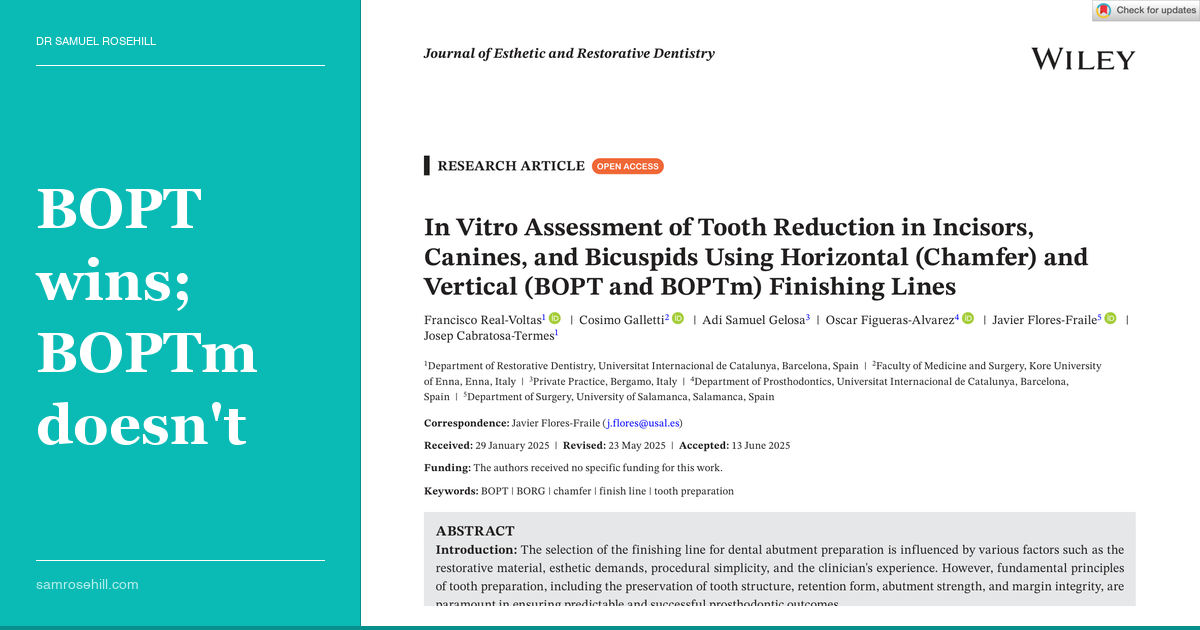
BOPT wins; BOPTm doesn't
Source Paper
In Vitro Assessment of Tooth Reduction in Incisors, Canines, and Bicuspids Using Horizontal (Chamfer) and Vertical (BOPT and BOPTm) Finishing Lines
The chamfer has enjoyed thirty years as the unremarkable default of fixed prosthodontics, not because it is optimal in every situation, but because it is teachable, reproducible, and the profession decided not to revisit the question. The appeal of vertical preparations is obvious: less grinding, better soft-tissue biology, more gingival flexibility. The logic holds, if you accept the premise that all vertical preparations are alike.
“In Vitro Assessment of Tooth Reduction in Incisors, Canines, and Bicuspids Using Horizontal (Chamfer) and Vertical (BOPT and BOPTm) Finishing Lines,” by Real-Voltas and colleagues from the Universitat Internacional de Catalunya and the University of Salamanca, tests that premise with volumetric precision. The two vertical techniques in question are BOPT (the Biologically Oriented Preparation Technique) and its deeper-going modification, BOPTm. For anterior teeth, conventional BOPT is the most conservative option — but BOPTm removes more tooth structure than a chamfer, not less. The vertical preparation category contains multitudes.
The Data Anchor
Ninety upper maxillary resin models (Bonemodels SLU, U-066) were distributed across nine subgroups: three tooth types (incisor, canine, premolar) by three finishing lines (chamfer, BOPT, BOPTm), n = 10 each. A single operator prepared all specimens on a Kavo E680 L handpiece with 3.5× optical magnification, scanned them with an Open Select V2 extraoral scanner, and calculated volume removed (in mm³) via Meshmixer and Geomagic Control X. Univariate ANOVA with 95% confidence intervals; significance at P < 0.05.
The BOPTm protocol extends the intrasulcular preparation 2 mm deeper than conventional BOPT, stopping short of the alveolar crest. Greater subgingival depth creates more connective tissue volume for provisional conditioning; the structural trade-off is what this study measures.
Key Findings
- In incisors: chamfer 159.54 mm³, BOPT 124.71 mm³, BOPTm 203.18 mm³ (F = 39.079, P < 0.001). BOPT was significantly more conservative; BOPTm significantly more aggressive than both.
- In canines: chamfer 164.56 mm³, BOPT 109.14 mm³, BOPTm 180.20 mm³ (F = 70.986, P < 0.001). Same ranking; BOPT removed roughly one-third less tissue than BOPTm.
- In premolars: chamfer 127.50 mm³, BOPT 130.50 mm³, BOPTm 139.00 mm³ (F = 0.685, P = 0.513). No significant differences; tooth shape neutralised the technique effect.
- BOPT across tooth types: no significant differences in reduction volume between incisors, canines, and premolars. BOPT is unusually consistent across morphologies in a way chamfer and BOPTm are not.
- Limitation: in vitro, single operator, n = 10 per subgroup. The volumetric method is rigorous within those constraints; soft-tissue dynamics in vivo are a separate question.
The explanation is geometric. Incisors and canines taper at the neck; placing a finishing line more apically forces more axial reduction to achieve acceptable emergence width. Premolars taper far less, so margin depth changes reduction volume much less.
The paper reframes a category error embedded in the BOPT literature: vertical preparation is not one technique with a known conservation profile but a family of techniques whose structural consequences diverge substantially based on how far subgingivally you take the bur.
💡 The Clinical Bottom Line
For clinicians preparing upper incisors or canines, the ranking is counterintuitive enough to state plainly: BOPT is the most conservative, chamfer sits in the middle, and BOPTm is the most aggressive (in ascending order of tissue removed). Modified BOPT, chosen for its soft-tissue conditioning potential, carries a structural cost that exceeds a conventional chamfer preparation.
For premolars, the choice can be guided by biology, workflow, and soft-tissue goals; no meaningful conservation trade-off exists between the three techniques.
The chamfer’s thirty-year reign looks, on this evidence, more defensible for anterior teeth than the marketing around vertical preparations has suggested. Not optimal. Just not as costly as one of the alternatives.
Dr Samuel Rosehill is a general dentist with a prosthodontic focus, practising at Ethical Dental in Coffs Harbour, NSW. He holds a BDSc (Hons) from the University of Queensland, an MBA, an MMktg, and an MClinDent in Fixed & Removable Prosthodontics (Distinction) from King’s College London.
Clinical Relevance
Conventional BOPT is the most conservative finishing line for incisors and canines, removing less tissue than chamfer. Modified BOPT (BOPTm) is the most aggressive of the three techniques tested, removing significantly more tissue than either chamfer or BOPT. For premolars, tooth shape neutralises the technique effect and no significant differences were found. Clinicians choosing vertical preparations for conservation reasons should know that the subtype matters as much as the class.
Disclosure: The author has no financial conflicts of interest related to the products or topics discussed in this review. This is an independent summary prepared for educational purposes.
Continue the conversation
This review is also published on Substack, where you can leave comments and join the discussion.
Read on Substack →