The Zirconia Biocompatibility Story Has a Footnote. The Footnote Is the Story.
Clinton Stevens' 2026 commentary in the International Journal of Periodontics & Restorative Dentistry argues that monolithic zirconia's reputation as the most biocompatible ceramic in dentistry is not supported by evidence — and that when soft-tissue response, enamel wear, tooth structure conservation, and clinical retrievability are assessed together, the claim quietly falls apart.
Biocompatibility claim doesn't hold
Source Paper
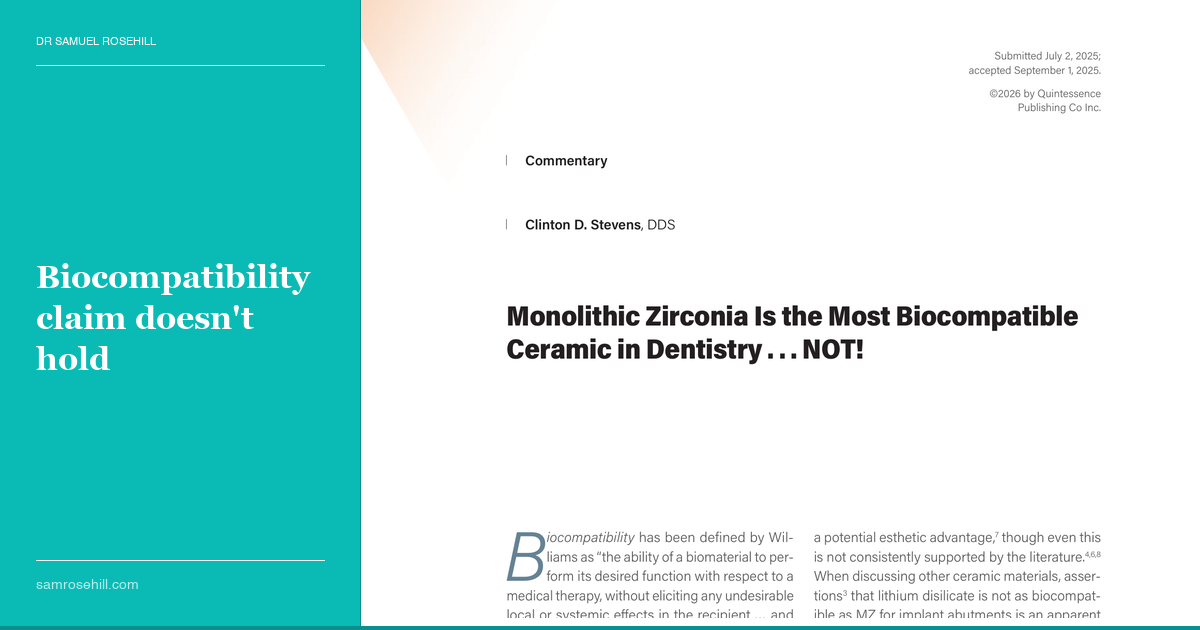
Monolithic Zirconia Is the Most Biocompatible Ceramic in Dentistry . . . NOT!
Everything we think we know about monolithic zirconia’s biocompatibility may be slightly, quietly, unhelpfully wrong. Not catastrophically wrong — MZ is not dissolving into the gingival sulcus — but wrong in the way that matters most: circulating as settled fact, untethered from citations, directing decisions that are difficult to reverse.
Clinton Stevens’ 2026 commentary, “Monolithic Zirconia Is the Most Biocompatible Ceramic in Dentistry … NOT!,” published in the International Journal of Periodontics & Restorative Dentistry (Vol 46, No 1), performs the rather unglamorous service of checking whether the commonly recited claim has any evidence behind it. The short answer: not much, and in some domains the evidence points the other way.
Stevens works through four categories: soft-tissue response, wear behaviour, tooth structure conservation, and clinical performance. In each, he asks whether MZ has earned its reputation.
The Data Anchor
On soft-tissue response, multiple systematic reviews (Linkevicius et al., 2015; Sanz-Sánchez et al., 2018; Laleman et al., 2023) found no significant difference between MZ and titanium abutments for peri-implant outcomes. The claim that lithium disilicate is less biocompatible than MZ rests on a misreading of two in vitro studies; one of them concluded that lithium disilicate was expected to perform well clinically long-term. More recent in vitro work with human gingival fibroblasts found lithium disilicate produced less cytotoxicity than MZ on initial exposure.
On wear, a 2024 network meta-analysis by Mao et al. of controlled clinical trials found MZ wears enamel antagonists significantly more than lithium disilicate and enamel-to-enamel controls. Polished MZ generates essentially no self-wear, which sounds reassuring until you note that every worn micron has to go somewhere.
The material properties make the disparity concrete. MZ Vickers hardness is 14 GPa, elastic modulus 210 GPa; enamel sits at 3.62 GPa and 94 GPa. These are not comparable materials.
On conservation, 3Y-MZ at 1.0 mm minimum thickness provides no preparation advantage over adhesively retained lithium disilicate, which already carries 16.9-year clinical survival data (Malament et al., 2021). Partial-coverage lithium disilicate restorations are measurably more conservative than any MZ crown.
Key Findings
- Soft-tissue advantage is unsupported. Systematic reviews show MZ equals titanium abutments but does not beat it; assertions about lithium disilicate’s inferiority are based on misread studies.
- MZ wears opposing enamel more, per network meta-analysis of clinical trials. At best, adjusted and polished MZ matches lithium disilicate; at worst, it exceeds it significantly.
- The conservation argument dissolves at 1.0 mm. Partial-coverage adhesive restorations are categorically more conservative than MZ crowns regardless of MZ thickness.
- Retrievability is a genuine liability. MZ is notoriously difficult to remove, cannot be repaired, and its radiopacity complicates secondary caries monitoring.
- Limitation: This is a commentary synthesising existing literature, not a primary study; the underlying evidence carries its own methodological variation.
💡 The Clinical Bottom Line
Stevens is clear: MZ has legitimate indications where strength and fracture toughness are primary. The problem is not MZ itself; it is the uncritical, citation-free assertion that it is the most biocompatible ceramic option. That claim does not survive the four-domain test this commentary applies.
Biocompatibility is a systems question. Cellular cytotoxicity is one input; what the material does to adjacent tooth structure, how it performs over decades, and whether it can be retrieved are equally part of the answer.
The comfortable story about zirconia’s inertness has always felt like enough. It is not quite enough. What wears the opposing tooth matters. What cannot be removed matters. A material’s credentials, examined honestly across the full stomatognathic system, are more qualified than a single, uncited talking point allows.
Dr Samuel Rosehill is a general dentist with a prosthodontic focus, practising at Ethical Dental in Coffs Harbour, NSW. He holds a BDSc (Hons) from the University of Queensland, an MBA, an MMktg, and an MClinDent in Fixed & Removable Prosthodontics (Distinction) from King’s College London.
Clinical Relevance
Monolithic zirconia's status as the most biocompatible ceramic in dentistry is an assertion that circulates without citations and does not survive scrutiny across four key domains: soft-tissue response (no clear advantage over titanium or lithium disilicate), enamel wear (network meta-analysis data show MZ wears antagonists more than lithium disilicate and enamel controls), tooth structure conservation (once minimum thickness requirements are factored in, the conservative advantage over adhesively retained lithium disilicate disappears), and clinical retrievability (notoriously difficult to remove, not repairable). Clinicians should treat MZ as a material with specific indications rather than a default biocompatible option.
Disclosure: The author has no financial conflicts of interest related to the products or topics discussed in this review. This is an independent summary prepared for educational purposes.
Continue the conversation
This review is also published on Substack, where you can leave comments and join the discussion.
Read on Substack →