What Try-In Does to a Zirconia Bond
Musharbash and colleagues measured how saliva contamination and four cleaning protocols affect resin bond strength to zirconia, finding airborne-particle abrasion strongest immediately but the chemical cleaners Ivoclean, ZirClean, and Katana Cleaner statistically equivalent after thermocycling, while a merely-rinsed contaminated surface was far weaker than all of them.
Cleaners match abrasion after ageing
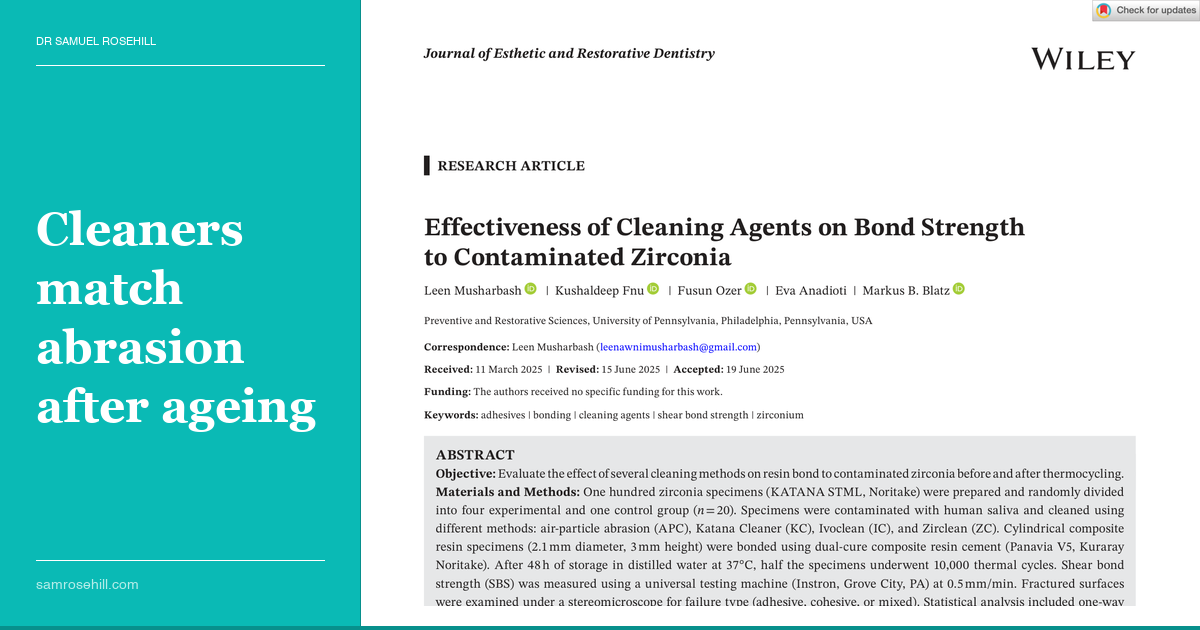
Source Paper
Effectiveness of Cleaning Agents on Bond Strength to Contaminated Zirconia
We have engineered zirconia to survive forces that would split a molar and formulated resin cements that grip ceramic at the molecular level. Then, in the name of checking the fit, we try the crown in the mouth and let a minute of the patient’s saliva settle onto the bonding surface, undoing much of that chemistry before the cement is applied.
Effectiveness of Cleaning Agents on Bond Strength to Contaminated Zirconia, published by Musharbash and colleagues in the 2025 Journal of Esthetic and Restorative Dentistry, is a careful accounting of how much that minute costs and what buys it back. The short version: re-roughening the surface works best on the day, the chemical cleaners catch up after ageing, and doing nothing stays an expensive mistake.
The Data Anchor
The team took 100 specimens of KATANA STML zirconia, air-abraded them, and then did the unglamorous thing nobody puts in the brochure — bathed each one in human saliva for a minute, as a try-in does. The specimens were sorted into five groups of 20. One was left contaminated and merely rinsed in alcohol (the control). The rest were cleaned by airborne-particle abrasion (APA), or by one of three commercial agents: Katana Cleaner, Ivoclean, and ZirClean.
Composite cylinders were bonded with Panavia V5 and its primer, and shear bond strength (SBS) was recorded in megapascals. Half of each group was tested after 24 hours, the other half after 10,000 thermal cycles, roughly 1.7 years in the mouth.
Fresh, the re-abraded surface was the standout at 52.78 MPa, against 32.77 to 34.66 MPa for the three chemical cleaners and a forlorn 22.22 MPa for the contaminated control. Then they aged it. After thermocycling every number fell, and the gap fell with them: APA dropped to 18.97 MPa, statistically indistinguishable from Katana Cleaner (17.11), Ivoclean (16.26), and ZirClean (15.13). The untreated control limped in at 6.51 MPa, barely a third of the best-cleaned group.
Key Findings
- Cleaning is not optional. The uncleaned control finished weakest in every comparison; saliva’s phosphate groups settle onto zirconia and do not leave for a polite water rinse.
- On the day, re-abrasion wins. Airborne-particle abrasion gave much the highest fresh bond strength (52.78 MPa); mechanical roughening reactivates the surface in a way a chemical wipe does not.
- After ageing, that advantage disappears. Thermocycling erased the difference between re-abrasion and all three cleaners. If the bond must last years rather than survive a viva, the cleaners are not the poor cousins.
- Brand barely mattered. Despite three different chemistries (alkaline zirconium oxide, potassium hydroxide, and an acidic methacryloyloxydecyl dihydrogen phosphate (MDP) salt), Ivoclean, ZirClean, and Katana Cleaner gave statistically equivalent results.
- It is in vitro, and modestly so. Composite discs stood in for teeth, one operator did everything, and 1.7 simulated years is short. Trust the direction of travel more than the absolute megapascals.
💡 The Clinical Bottom Line
The Monday-morning version is unfussy: every zirconia restoration that has been tried in and bathed in saliva needs decontaminating before cementation, and a rinse with water does not count. If you can re-sandblast chairside without harming the crown, you get the best same-day bond. When you cannot, a dedicated cleaner buys back essentially the same durable bond.
The reassuring part is how little the brand matters and how much the habit does. This bond is not lost to some exotic failure of materials science — it is lost in the ordinary moment when a beautiful crown sits in saliva, comes out, and gets cemented as though nothing happened.
Dr Samuel Rosehill is a general dentist with a prosthodontic focus, practising at Ethical Dental in Coffs Harbour, NSW. He holds a BDSc (Hons) from the University of Queensland, an MBA, an MMktg, and an MClinDent in Fixed & Removable Prosthodontics (Distinction) from King’s College London.
Clinical Relevance
Any zirconia restoration tried in intraorally is contaminated by salivary phosphates that a water rinse will not remove, and an uncleaned surface keeps barely a third of the durable resin bond of a properly cleaned one. Airborne-particle abrasion restores the highest immediate bond strength, but after thermocycling the dedicated chemical cleaners (Ivoclean, ZirClean, Katana Cleaner) are statistically equivalent to re-abrasion. When chairside re-sandblasting is impractical, a chemical cleaner is a defensible substitute; doing nothing is not.
Disclosure: The author has no financial conflicts of interest related to the products or topics discussed in this review. This is an independent summary prepared for educational purposes.
Continue the conversation
This review is also published on Substack, where you can leave comments and join the discussion.
Read on Substack →