Sandblast It and Bond: Why Alumina Air-Abrasion Remains the Gold Standard for Zirconia
An in vitro study comparing five zirconia surface treatments confirms that alumina air-particle abrasion delivers the highest and most durable bond strengths — and that heated hydrofluoric acid matches it, but at a practical cost nobody should pay.
Sandblast still wins
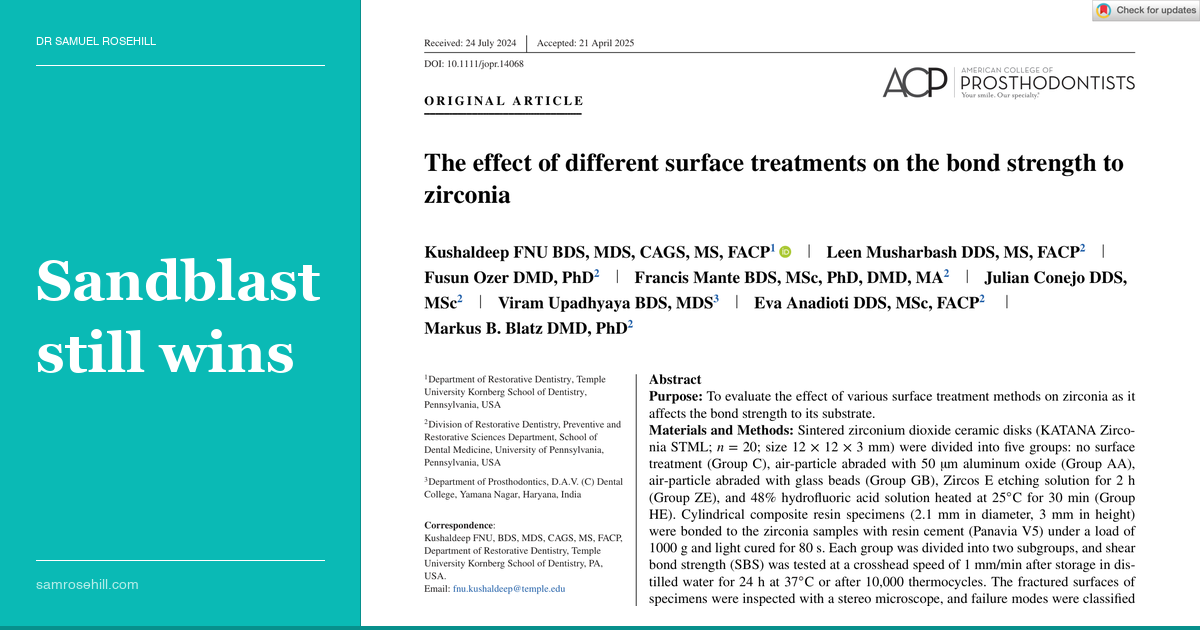
Source Paper
The effect of different surface treatments on the bond strength to zirconia
Most of us, if pressed on the matter after a long clinical day, would admit that our zirconia bonding protocol was established less by rigorous literature review than by whatever the lab technician suggested the first time we cemented a monolithic crown and hoped for the best. The proliferation of surface treatment options (sandblast? glass beads? acid etch? laser?) has created an environment where confidence outpaces evidence, and where the question of how to reliably bond to a glass-free polycrystalline ceramic remains surprisingly unresolved. FNU and colleagues from the University of Pennsylvania, in “The effect of different surface treatments on the bond strength to zirconia” (Journal of Prosthodontics, 2025), have run the comparison that many of us needed: five treatments, one high-translucency zirconia, and the critical addition of thermocycling to test whether the bond holds up when the mouth does what mouths do.
The Data Anchor
One hundred sintered KATANA Zirconia STML disks (Kuraray Noritake) were divided into five groups (n = 20 each): no surface treatment (control), air-particle abrasion with 50 μm aluminium oxide at 2 bar for 10 seconds, air-abrasion with 50 μm glass beads at 0.25 MPa for 20 seconds, immersion in Zircos E etching solution for 2 hours, and immersion in 48% hydrofluoric acid heated to 25°C for 30 minutes. Cylindrical composite specimens were bonded with Panavia V5 dual-cure resin cement. Each group was split into two subgroups: shear bond strength (SBS) tested after 48 hours in distilled water, or after 10,000 thermocycles (5–55°C, 30-second dwell). Failure modes were classified by SEM at 75x magnification.
Key Findings
- Alumina air-abrasion delivered the highest bond strength at 14.98 MPa (pre-ageing) and 13.47 MPa after thermocycling, maintaining 90% of its initial value through simulated ageing
- Heated 48% HF acid matched alumina statistically at 14.8 MPa (pre-ageing) and 13.15 MPa (post-ageing), but requires concentrated acid at temperatures that make it clinically impractical and potentially dangerous
- Glass bead abrasion produced moderate results (9.29 MPa dropping to 8.56 MPa), significantly inferior to alumina but superior to no treatment
- Zircos E etching solution performed worst among all active treatments at just 4.83 MPa, declining to 4.16 MPa after thermocycling and showing 100% adhesive failure, undermining its marketing proposition as a chairside zirconia etch
- All groups showed significant SBS reduction after thermocycling, reinforcing that any bonding study without ageing protocols provides an incomplete clinical picture
- Mixed failure modes dominated in high-performing groups, while control and Zircos E shifted to 100% adhesive failure after thermocycling, indicating complete bond degradation
- Limitation: in vitro shear bond testing does not replicate the complex stress distribution of clinical loading
The Zircos E result is the quiet disappointment here. A purpose-built zirconia etching system that costs real money and requires two hours of immersion produced bond strengths worse than simply doing nothing with alumina particles for ten seconds. Marketing occasionally outpaces metallurgy.
💡 The Clinical Bottom Line
The message from this study is both reassuring and slightly boring, which is exactly what you want from adhesion science: alumina air-particle abrasion with 50 μm Al₂O₃ followed by an MDP-containing resin cement remains the gold standard for bonding to high-translucency zirconia. It is the cheapest option, the fastest option, and the most durable option after ageing. Novel etching systems have not yet produced a clinically viable alternative. If your protocol already involves sandblasting and Panavia, this paper confirms you can stop second-guessing yourself. If it does not, this would be an excellent time to start.
Dr Samuel Rosehill is a general dentist with a prosthodontic focus, practising at Ethical Dental in Coffs Harbour, NSW. He holds a BDSc (Hons) from the University of Queensland, an MBA, an MMktg, and an MClinDent in Fixed & Removable Prosthodontics (Distinction) from King’s College London.
Reference: FNU K, Musharbash L, Ozer F, et al. The effect of different surface treatments on the bond strength to zirconia. J Prosthodont. 2025;34:734–740. doi:10.1111/jopr.14068
Clinical Relevance
Alumina air-particle abrasion with 50 μm Al₂O₃ combined with MDP-containing resin cement remains the most effective and practical protocol for bonding to high-translucency zirconia — newer etching methods do not yet offer a clinically viable alternative.
Disclosure: The author has no financial conflicts of interest related to the products or topics discussed in this review. This is an independent summary prepared for educational purposes.
Continue the conversation
This review is also published on Substack, where you can leave comments and join the discussion.
Read on Substack →