Customised Healing Abutments: The Upgrade That Was Already Right in Front of Us
A 2024 PRISMA-compliant systematic review of five clinical studies finds that customised healing abutments consistently trend toward better peri-implant soft and hard tissue outcomes than prefabricated titanium alternatives, with significantly improved Pink Aesthetic Scores and less chairside pain during crown delivery — though the evidence base remains small and the call for larger trials is urgent.
Customised abutments trend better
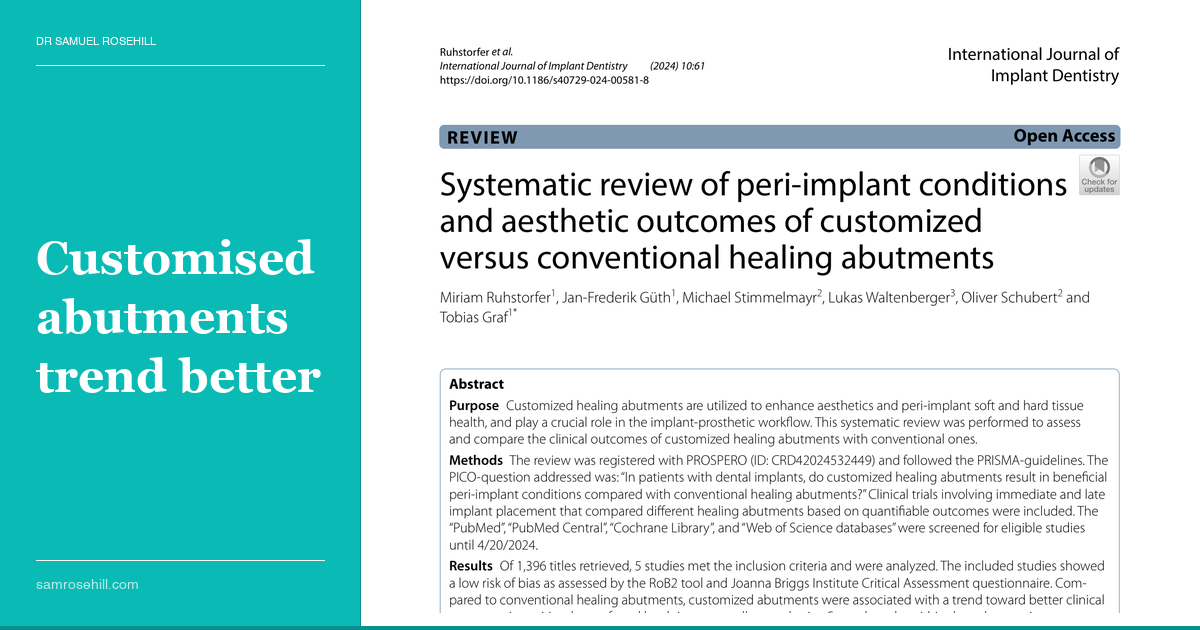
Source Paper
Systematic review of peri-implant conditions and aesthetic outcomes of customized versus conventional healing abutments
We have landed spacecraft on Mars, decoded the genome, and designed entirely digital implant workflows that can place a crown without a single impression tray. And yet the standard healing abutment for a dental implant has, for decades, been a round titanium peg bearing approximately zero resemblance to the tooth it is replacing.
This is not, it turns out, irrelevant. Ruhstorfer, Güth, Stimmelmayr, Waltenberger, Schubert, and Graf have examined exactly what happens when you give healing peri-implant tissue an abutment that actually mimics an emergence profile, in “Systematic review of peri-implant conditions and aesthetic outcomes of customized versus conventional healing abutments,” published in the International Journal of Implant Dentistry in 2024. The tissue, it emerges, seems to prefer it. The evidence base is only five studies deep, which should give the methodologically scrupulous among us pause.
The Data Anchor
This PRISMA-registered systematic review (PROSPERO ID: CRD42024532449) screened 1,396 titles across four databases, arriving at five eligible studies: two RCTs, two prospective cohorts, and one retrospective cohort. Across these, 190 implants were examined (91 customised, 99 conventional titanium). Follow-up ranged from 6 to 36 months; survival was 100% in all groups.
Four studies involved immediate placement after extraction; one examined late placement in healed sites. Customised abutments were predominantly hand-made resin, with one study using a CAD/CAM-milled PEEK abutment (Chokaree et al., 2024). All showed a low risk of bias; data heterogeneity precluded meta-analysis.
Key Findings
- Soft tissue preservation favoured customised abutments. Amato et al. found significantly lower bucco-palatal volumetric reduction in keratinised tissue (p < 0.001). Crespi et al. showed significantly greater alveolar width gain at 3 months (+2.5 ± 0.5 mm versus +1.0 ± 0.9 mm, p < 0.001), stable through 3 years.
- Aesthetic outcomes were mixed but trending positive. Chokaree et al. reported significantly better Pink Aesthetic Score at 6 months (p = 0.022); Perez et al. found no significant PES difference at 12 months. Notably, no study reported any aesthetic disadvantage with customised abutments.
- Hard tissue was largely equivalent. Three of five studies found no significant difference in vertical bone changes over 6–12 months.
- Patient-reported pain at crown delivery was lower. Chokaree et al. found significantly higher pain scores with conventional abutments at prosthesis insertion (p = 0.003) and 2 h later (p = 0.013), resolving by 24 h. Tissue pre-shaped to the emergence profile requires far less persuasion during delivery.
- Limitation: Five studies, 91 customised-abutment implants. Evidence is consistent but thin, and no follow-up extends beyond 36 months.
💡 The Clinical Bottom Line
The case for customised healing abutments rests less on any single dramatic finding and more on a cumulative absence of downsides. Across five studies, 91 implants, and follow-ups of up to three years, not one biological or aesthetic disadvantage was recorded. Multiple studies showed meaningfully better soft tissue volumes, papilla indices, and patient comfort at the moment that matters most: when the crown goes in.
The clinical logic aligns neatly with the data. Tissue shaped during healing does not need to be forced into shape later. Customised abutments are not yet mandated by a mountain of high-quality evidence, but the mountain, such as it is, appears to be pointing in one direction.
For clinicians already using customised healing abutments, this review offers confirmation. For those still reflexively reaching for the round titanium peg, the question the authors are quietly asking is a simple one: why would you not?
Dr Samuel Rosehill is a general dentist with a prosthodontic focus, practising at Ethical Dental in Coffs Harbour, NSW. He holds a BDSc (Hons) from the University of Queensland, an MBA, an MMktg, and an MClinDent in Fixed & Removable Prosthodontics (Distinction) from King’s College London.
Clinical Relevance
Customised healing abutments — whether hand-made resin or CAD/CAM PEEK — outperformed prefabricated titanium counterparts on soft tissue volume preservation, papilla indices, Pink Aesthetic Score, and patient-reported pain at crown delivery in the majority of included studies. No study reported any biological or aesthetic disadvantage. Clinicians placing implants in aesthetic zones should consider incorporating customised healing abutments into the workflow, while acknowledging that the current evidence base is limited to five small studies with follow-ups of 6–36 months.
Disclosure: The author has no financial conflicts of interest related to the products or topics discussed in this review. This is an independent summary prepared for educational purposes.
Continue the conversation
This review is also published on Substack, where you can leave comments and join the discussion.
Read on Substack →