Your Anxious Patient Will Hurt More at 6pm — Here's the Proof
A prospective study of 332 implant patients finds preoperative dental anxiety independently predicts postoperative pain, but only up to a critical threshold score. What this means for how you screen patients before surgery.
Screen anxiety before you drill
Source Paper
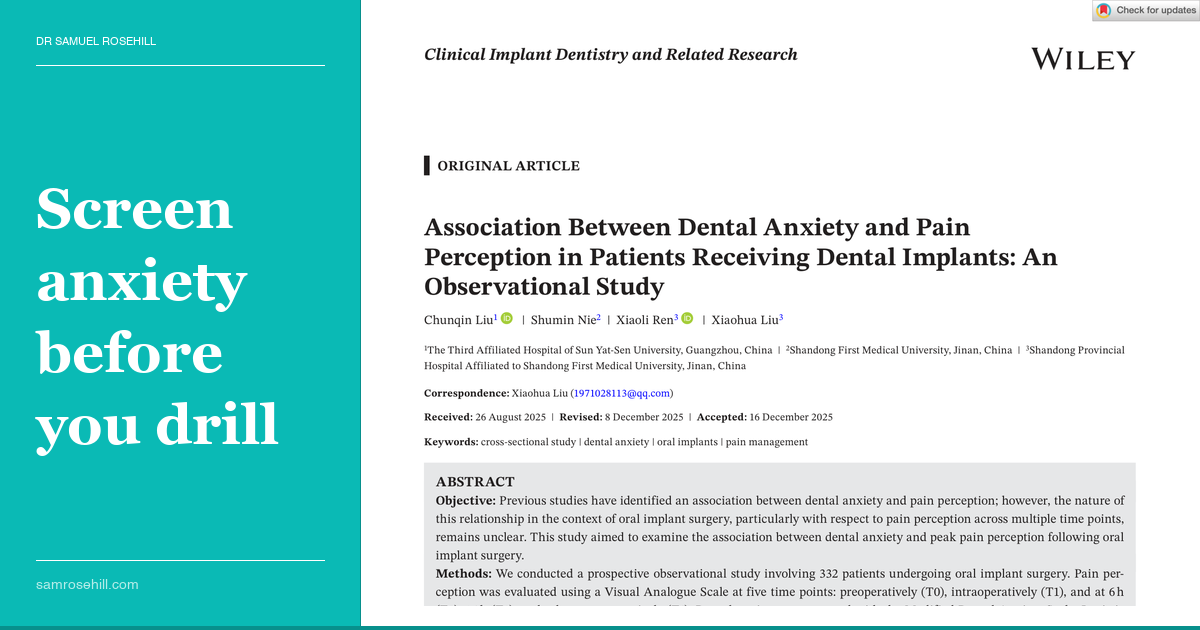
Association Between Dental Anxiety and Pain Perception in Patients Receiving Dental Implants: An Observational Study
“She said the implant barely bothered her during the procedure, but she was in agony by the time she got home.” The surgeon was refilling her coffee, not looking for an argument. “Did anyone ask her how anxious she was beforehand?” Silence. “Because that’s not a random outcome.”
That exchange plays out in implant practices everywhere, and it captures the puzzle Liu, Nie, Ren, and Liu set out to untangle in this 2026 paper published in Clinical Implant Dentistry and Related Research. Does preoperative dental anxiety predict postoperative pain, and if so, how? The answer is more nuanced and more actionable than most clinicians would expect.
The Data Anchor
This prospective observational study enrolled 332 adults (mean age 46.6 years; 54.2% female) undergoing implant surgery at Shandong Provincial Hospital between November 2023 and March 2024. Dental anxiety was measured using the Modified Chinese Dental Anxiety Scale (M-C-DAS), a validated five-item instrument scored from 5 to 25. Pain was assessed on a 10 cm Visual Analogue Scale at five time points: preoperatively, intraoperatively, and at 6, 24, and 168 hours postoperatively. Analysis used logistic regression and a generalised additive model (GAM) to detect nonlinearity, with segmented regression to identify the breakpoint.
The mean anxiety score was 11.70 (SD 3.42), and 61.1% of the cohort met the threshold for significant dental anxiety. Only 18.7% required any postoperative analgesics.
Key Findings
- Peak pain hit at 6 hours, not 24 hours as widely assumed, with mean VAS rising from 0.26 at baseline to 4.36 at 6 hours, then falling to 2.55 at 24 hours. At peak, 64.2% of patients reported moderate to severe pain.
- Each one-unit rise in anxiety score increased the odds of moderate-to-severe peak pain by 38% (OR = 1.38, 95% CI: 1.26, 1.53), after adjusting for age, implant number, loading timing, and site.
- The relationship is nonlinear, with a threshold at M-C-DAS score 14.01. Below this, each additional anxiety point sharply raised pain odds (OR = 1.51; p < 0.001). Above it, the association was non-significant (OR = 0.91; p > 0.05), suggesting a plateau when anxiety tips into frank fear.
- Mandibular placement (OR = 2.15) and a history of unpleasant dental experiences also independently predicted peak pain.
- Limitation: single-centre Chinese tertiary hospital design; surgical complexity variables (bone grafting, flap design, procedure duration) were not recorded.
💡 The Clinical Bottom Line
Add the M-C-DAS to your implant consent workflow. It takes under three minutes, and the evidence suggests it predicts 6-hour pain better than age, income, or sex. The actionable zone is below a score of 14: that is where rising anxiety most sharply amplifies pain, and where a brief psychological intervention (structured communication, music, or a referral conversation) has the best chance of bending the curve. The patient who quietly scores a 12 and says nothing is the one worth worrying about.
Dr Samuel Rosehill is a general dentist with a prosthodontic focus, practising at Ethical Dental in Coffs Harbour, NSW. He holds a BDSc (Hons) from the University of Queensland, an MBA, an MMktg, and an MClinDent in Fixed & Removable Prosthodontics (Distinction) from King’s College London.
Clinical Relevance
Screen all implant patients with the Modified Dental Anxiety Scale preoperatively and target anxiety reduction interventions for those scoring below the 14-point threshold, where rising anxiety most sharply increases postoperative pain risk.
Disclosure: The author has no financial conflicts of interest related to the products or topics discussed in this review. This is an independent summary prepared for educational purposes.
Continue the conversation
This review is also published on Substack, where you can leave comments and join the discussion.
Read on Substack →