The Implant That Failed Wasn't the Patient's Fault
A cross-sectional study by Monje and colleagues found that implant malpositioning, not patient-level risk factors, was the dominant driver of peri-implantitis, with offset implants carrying up to 7.4-fold greater odds of disease than axially placed counterparts.
The surgeon, not the patient
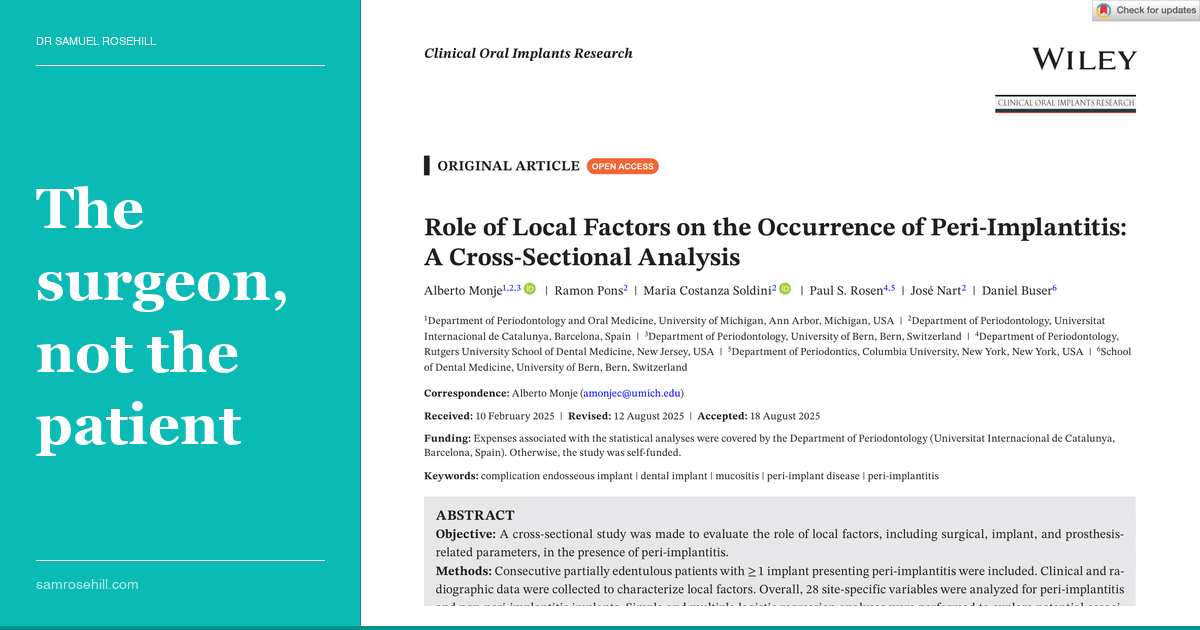
Source Paper
Role of Local Factors on the Occurrence of Peri-Implantitis: A Cross-Sectional Analysis
Two decades of peri-implantitis research have built a recognisable portrait of the patient who fails: the smoker, the periodontitis survivor, the erratic attender, the poorly controlled diabetic. It is a useful portrait. It is also, according to Monje and colleagues, possibly the wrong wall to hang it on.
Role of Local Factors on the Occurrence of Peri-Implantitis: A Cross-Sectional Analysis makes its argument quietly. Rather than comparing implants across patients, the study compares diseased and healthy implants within the same patients. Same genetics, same habits, same maintenance exposure. If implants behave differently under those conditions, the explanation is not the patient. It is the implant, and what was done to it.
The paper’s conclusion, published in Clinical Oral Implants Research, is stated without flourish: implant malpositioning is a critical factor associated with peri-implantitis. Malpositioning happens in the operatory. This belongs on the surgeon’s side of the ledger.
The Data Anchor
One hundred consecutive partially edentulous patients were enrolled at the CICOM-MONJE Institute in Badajoz, Spain, each presenting at least one implant with peri-implantitis. In total, 452 implants were evaluated: 227 (50.2%) with peri-implantitis and 225 (49.8%) without, all in function for at least 36 months. Positional factors were mapped from cone-beam computed tomography (CBCT) scans by a calibrated examiner (intra-class correlation coefficient, or ICC, >0.85). Multiple logistic regression used generalised estimating equations (GEEs) to account for clustering of implants within patients.
A predictive model built from the significant variables achieved 79.7% diagnostic accuracy and an area under the curve (AUC) of 88%. More total implants per patient correlated with fewer diseased implants (r = −0.38; P < .001). Peri-implantitis was choosing selectively within the same host.
Key Findings
- Implant tilt was the strongest signal. Implants offset 10°–30° had an odds ratio (OR) of 5.84; those tilted ≥30° had OR = 7.43 (both P < .001). The emergence profile, dictated by axial position, is the proposed mechanism.
- Implants outside the bony housing carried approximately 8-fold greater odds of disease compared with implants ≥2 mm inside the bony envelope (OR = 0.13; P = .0001). When thin buccal bone resorbs, the roughened implant surface is left exposed to the sulcus.
- Medial position within a multi-unit prosthesis carried 3.9-fold greater odds of disease (P = .006), attributed to restricted interproximal access and implant proximity.
- Morse taper connections were the least likely to exhibit peri-implantitis (OR = 0.43; P = .03), consistent with greater abutment stability and reduced microleakage compared with external-hex designs (the reference category in the regression). The internal-hex subgroup showed much higher odds (OR = 10.8) but contained only 11 implants and is too small to compare meaningfully.
- Centred positioning was protective in both mesio-distal (OR = 0.46; P = .04) and bucco-lingual (OR = 0.29; P = .001) planes. Buccal deviation was riskier than lingual.
- Causation cannot be established. The cross-sectional design, exclusive enrolment of patients with peri-implantitis, and predominance of one implant connection and surface type all limit generalisability.
💡 The Clinical Bottom Line
The study does not argue that patient risk factors are irrelevant; periodontitis history, poor compliance, and systemic drivers remain on the list. What it does argue is that a well-positioned implant placed in adequate bone may be self-protective even in susceptible patients, while a malpositioned one creates local conditions that no amount of hygiene instruction will fully remedy.
The practical corollary is uncomfortable in the way most useful data are: peri-implantitis is not only something that happens to high-risk patients. It is also something that happens to poorly positioned implants.
Computer-guided surgery and prosthetically driven planning are not refinements for complex cases; for Monje and colleagues, they are the logical extension of findings that place surgical precision at the centre of disease prevention.
Dr Samuel Rosehill is a general dentist with a prosthodontic focus, practising at Ethical Dental in Coffs Harbour, NSW. He holds a BDSc (Hons) from the University of Queensland, an MBA, an MMktg, and an MClinDent in Fixed & Removable Prosthodontics (Distinction) from King’s College London.
Clinical Relevance
Implant malpositioning in the mesio-distal, bucco-lingual, and axial planes was the strongest local predictor of peri-implantitis in this within-patient comparison of 452 implants. Tilted implants (≥30°) carried 7.4-fold higher odds of disease; implants outside the bony housing carried 8-fold higher odds than those ≥2 mm inside the envelope. Morse taper connections were the least likely connection type to exhibit peri-implantitis. These are cross-sectional data and causation cannot be established, but the surgical and restorative implications for positioning precision are substantial.
Disclosure: The author has no financial conflicts of interest related to the products or topics discussed in this review. This is an independent summary prepared for educational purposes.
Continue the conversation
This review is also published on Substack, where you can leave comments and join the discussion.
Read on Substack →