Digital Mesh Still Has to Heal
A 2026 prospective clinical trial of CAD/CAM customised titanium mesh for Cawood and Howell Class V ridge atrophy reports nearly 6 mm of vertical and horizontal bone gain, low marginal bone loss, and a familiar soft-tissue warning: exposure still matters.
Digital mesh still exposes
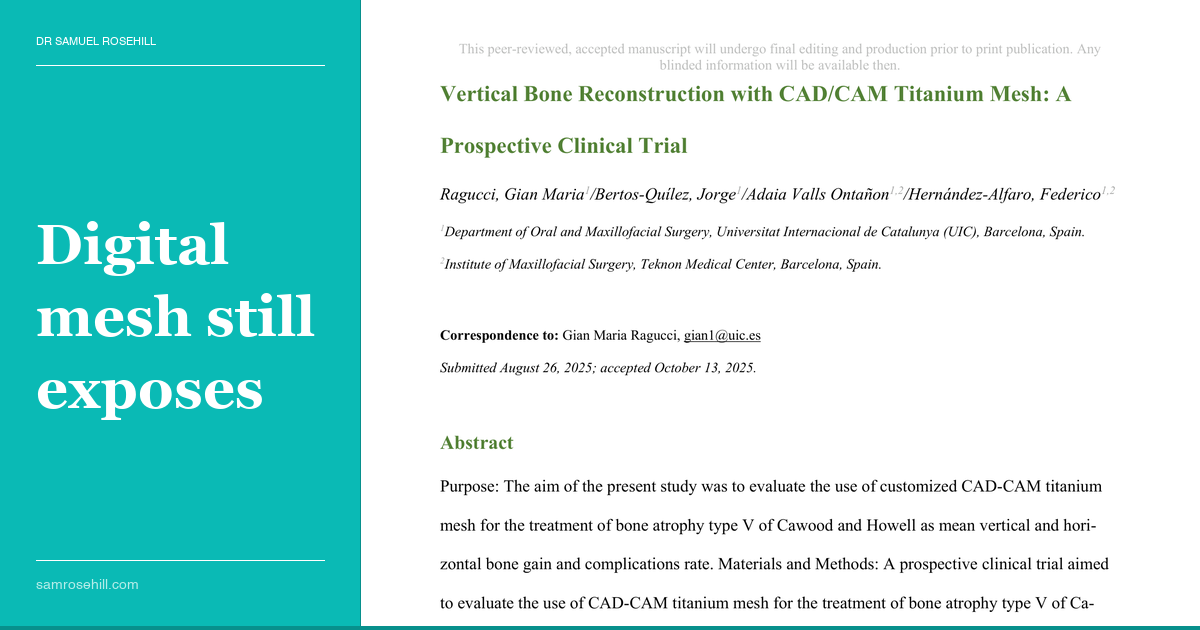
Source Paper
Vertical Bone Reconstruction with CAD/CAM Titanium Mesh: A Prospective Clinical Trial
Custom titanium mesh has the seductive promise of tailoring: measure carefully, design digitally, fabricate precisely, and the difficult ridge should receive its bespoke little scaffold with the dignity of a well-cut suit. “Vertical Bone Reconstruction with CAD/CAM Titanium Mesh: A Prospective Clinical Trial,” by Ragucci, Bertos-Quílez, Valls Ontañon, and Hernández-Alfaro, shows why that promise is real but incomplete. The mesh can be beautifully planned; the soft tissue still has to agree.
That is the useful tension in this paper. Digital precision reduces one kind of surgical improvisation, but it does not abolish biology.
The Data Anchor
This prospective clinical trial treated 25 patients across 30 surgical sites with Cawood and Howell Class V alveolar ridge atrophy. Planning used CBCT, intraoral scanning, and extra-intraoral photographs before customised CAD/CAM titanium mesh fabrication. The graft mixture was 60% autogenous bone and 40% deproteinised bovine bone mineral (Bio-Oss), covered with Bio-Gide collagen membrane.
Implants were placed at 9 months after regeneration, using Straumann fixtures, then uncovered after a further 3 months. Final screw-retained prostheses were delivered through a digital workflow, with clinical and radiographic review one year after prosthesis delivery.
Key Findings
- Bone gain was clinically substantial. In 29 evaluable sites, mean vertical gain was 5.87 ± 1.6 mm and mean horizontal gain was 5.64 ± 2.1 mm by CBCT superimposition.
- Marginal bone loss was low after restoration. Mean mesial MBL was 0.61 ± 0.34 mm and distal MBL was 0.46 ± 0.32 mm, for an overall mean of 0.53 ± 0.30 mm.
- No intraoperative surgical complications were recorded. The authors reported no flap damage, nerve injury, or vascular complication during surgery.
- Exposure did not disappear. Four patients (16%) had Class I mesh exposure (≤ 3 mm, no purulence), managed with chlorhexidine without compromising regeneration.
- One case crossed the line. One patient (4%) developed Class III exposure with purulent exudate, requiring titanium mesh removal and leaving compromised regeneration.
- Limitation: no control group, small sample, carefully selected healthy patients, and one patient lost to follow-up after regenerative surgery.
💡 The Clinical Bottom Line
For Monday morning, CAD/CAM titanium mesh is worth viewing as a handling and planning improvement, not a soft-tissue exemption certificate. The results are encouraging: almost 6 mm of vertical and horizontal gain is not a rounding error.
But consent should still include exposure, infection, and mesh removal, because the digital file does not close the flap. The future may be customised; wound healing remains stubbornly analogue.
Dr Samuel Rosehill is a general dentist with a prosthodontic focus, practising at Ethical Dental in Coffs Harbour, NSW. He holds a BDSc (Hons) from the University of Queensland, an MBA, an MMktg, and an MClinDent in Fixed & Removable Prosthodontics (Distinction) from King’s College London.
Clinical Relevance
CAD/CAM customised titanium mesh produced mean vertical bone gain of 5.87 mm and horizontal gain of 5.64 mm in severe Class V ridge atrophy, with low mean marginal bone loss after implant restoration. However, 16% of patients had minor mesh exposure and 4% had infected exposure requiring mesh removal. The digital workflow improves fit and planning, but it does not remove the need for careful flap design, exposure management, and realistic consent.
Disclosure: The author has no financial conflicts of interest related to the products or topics discussed in this review. This is an independent summary prepared for educational purposes.
Continue the conversation
This review is also published on Substack, where you can leave comments and join the discussion.
Read on Substack →