Grinding With a GPS: Computer-Guided Occlusal Adjustment Goes Digital
A fully digital workflow for occlusal adjustment — from virtual articulator simulation to 3D-printed grinding guides — offers a glimpse of how technology might tame one of prosthodontics' most unpredictable chairside procedures.
Guided grinding goes digital
Source Paper
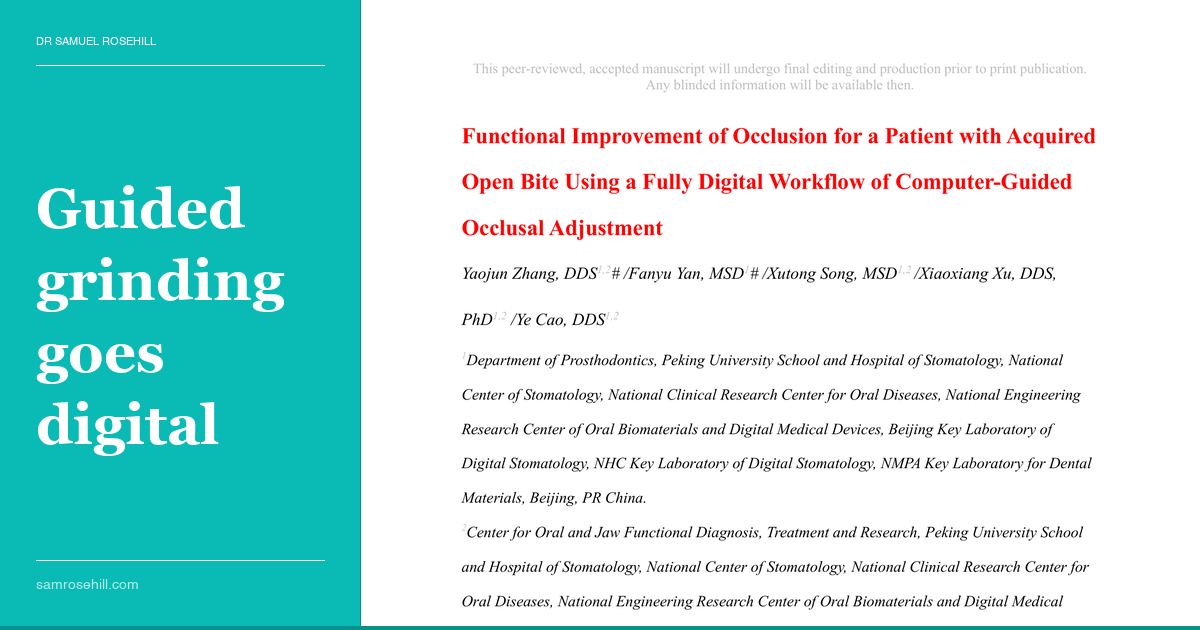
Functional Improvement of Occlusion for a Patient with Acquired Open Bite Using a Fully Digital Workflow of Computer-Guided Occlusal Adjustment
Occlusal adjustment has always been the dental procedure most likely to make you feel like you’re defusing a bomb while someone describes the wiring over the phone. You mark the contacts with articulating paper, grind a fraction of a millimetre, check again, and repeat — knowing that each pass is irreversible and that the difference between a therapeutic outcome and a iatrogenic disaster lives somewhere in the thickness of a blue dot.
Zhang and colleagues from Peking University School of Stomatology have proposed an alternative in Functional Improvement of Occlusion for a Patient with Acquired Open Bite Using a Fully Digital Workflow of Computer-Guided Occlusal Adjustment — a case report that reads less like conventional prosthodontics and more like surgical navigation applied to selective grinding.
The Data Anchor
The patient was a 65-year-old woman who developed an anterior open bite following extraction of a mandibular second molar, with occlusal contacts restricted to the maxillary and mandibular right first molars. Digital models were acquired using intraoral scanning (TRIOS 3, 3Shape), and personalised jaw motion trajectories were recorded with a jaw motion analyser (JMAnalyser+ 3.0.8, Zebris Medical). The data were imported into Exocad DentalDB 3.0 for virtual articulator mounting and simulated occlusal adjustment — iteratively deleting occlusal contact areas and lowering the virtual incisal guide pin until bilateral premolar and first molar contacts were achieved. Two 3D-printed guides were then fabricated: a range-indicating guide showing where to grind, and a depth-indicating guide with cylindrical sleeves showing how much to remove (each sleeve placed 2 mm above the adjusted surface). A custom bur with a stop ring completed the chairside toolkit.
Key Findings
- The workflow translates virtual occlusal planning into physical grinding guides — Boolean subtraction of the original and adjusted arch data in industrial CAD software (Geomagic Studio 10.0) identified the precise locations and volumes of tooth structure requiring removal.
- Chairside execution used a two-guide sequence — the depth-indicating guide was placed first, with the stop-ring bur creating reference points; the range-indicating guide was then used to smooth surfaces between those references, followed by conventional articulating paper refinement.
- Occlusal function was significantly improved at six months — the patient achieved stable bilateral posterior contacts with no reported discomfort or instability.
- The honest limitation: this is a single case report with no comparative data, no measurement of adjustment accuracy against the digital plan, and a six-month follow-up that is too short to assess long-term occlusal stability. The concept is compelling; the evidence base is embryonic.
We’ve had guided surgery for implants for two decades. The idea that we might also guide the most irreversible of restorative procedures — subtractive occlusal adjustment — feels both overdue and slightly unnerving.
💡 The Clinical Bottom Line
This workflow won’t replace your articulating paper tomorrow morning, but it represents a genuinely novel concept: applying the logic of guided surgery (digital plan, 3D-printed template, controlled execution) to selective grinding. For complex cases — acquired open bites, significant occlusal rehabilitation, patients where the margin for error is vanishingly small — the ability to simulate adjustments on a virtual articulator with real jaw motion data before committing to irreversible tooth reduction is conceptually powerful. The challenge now is validating accuracy, demonstrating reproducibility across operators, and proving it works beyond carefully selected case reports. Still, if you’ve ever stared at a mouth full of blue marks wondering which ones to chase, the appeal of a guide that already knows the answer is hard to resist.
Dr Samuel Rosehill is a general dentist with a prosthodontic focus, practising at Ethical Dental in Coffs Harbour, NSW. He holds a BDSc (Hons) from the University of Queensland, an MBA, an MMktg, and an MClinDent in Fixed & Removable Prosthodontics (Distinction) from King’s College London.
Reference: Zhang, Y. et al. Functional Improvement of Occlusion for a Patient with Acquired Open Bite Using a Fully Digital Workflow of Computer-Guided Occlusal Adjustment. Int J Prosthodont. 2026. https://doi.org/10.11607/ijp.9550
Clinical Relevance
This case report demonstrates a fully digital workflow for guided occlusal adjustment using intraoral scanning, jaw motion analysis, virtual articulator simulation, and 3D-printed range- and depth-indicating guides — a concept that could reduce the unpredictability of complex selective grinding.
Disclosure: The author has no financial conflicts of interest related to the products or topics discussed in this review. This is an independent summary prepared for educational purposes.
Continue the conversation
This review is also published on Substack, where you can leave comments and join the discussion.
Read on Substack →