Merging Face and Teeth Into a Virtual Patient: What the Evidence Actually Shows
A 2026 systematic review in the Journal of Prosthetic Dentistry by Lawand, Tohme, Azevedo, and colleagues analyses 48 studies across three alignment families and finds that extraoral scan bodies — particularly those with three-dimensional cubic geometry — consistently outperform marker-free and peri-oral approaches for virtual patient registration accuracy.
Use a scan body. Geometry matters.
Source Paper
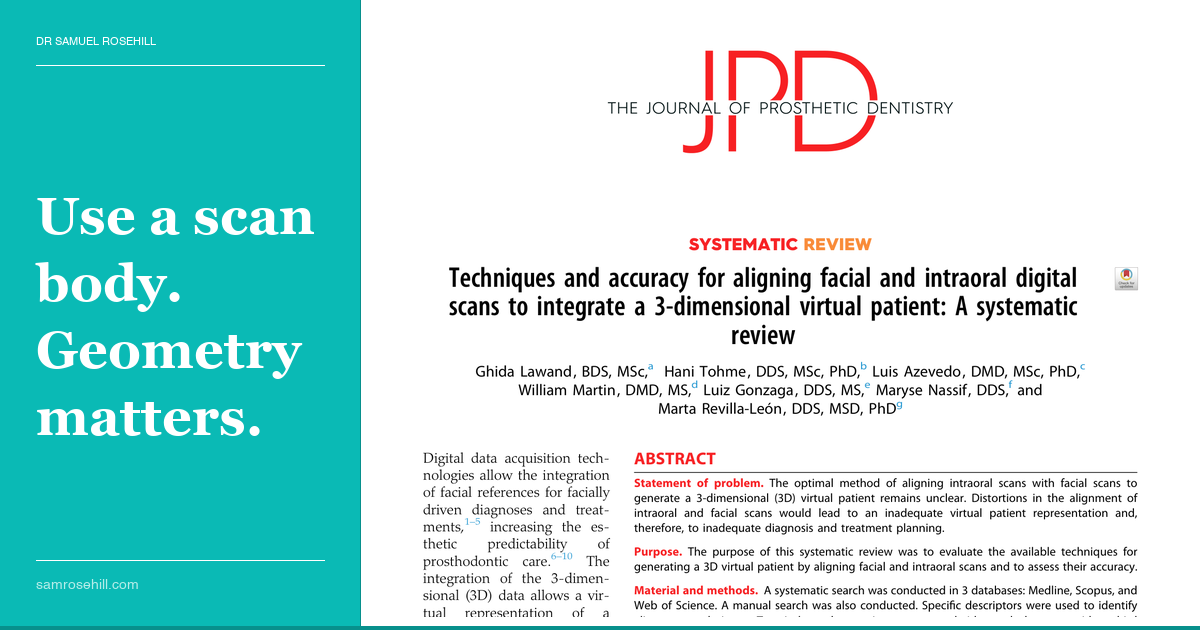
Techniques and accuracy for aligning facial and intraoral digital scans to integrate a 3-dimensional virtual patient: A systematic review
Two scanning technologies have been placed in an impossible marriage. Facial scanners distort the teeth (precisely what intraoral scanners exist to capture), and intraoral scanners stop at the lip margin. Two datasets, mutually exclusive strengths, and a registration problem between them. “Techniques and accuracy for aligning facial and intraoral digital scans to integrate a 3-dimensional virtual patient: A systematic review,” published in The Journal of Prosthetic Dentistry by Lawand, Tohme, Azevedo, Martin, Gonzaga, Nassif, and Revilla-León, asks which bridging strategies work and whether anyone has the numbers to prove it.
Some work better than others, as it turns out, and the numbers are harder to compare than they should be.
The Data Anchor
The review searched Medline, Scopus, and Web of Science for studies published 2016 to 2024. From 2,832 records, 48 studies survived screening (kappa = 0.82 for abstract screening, 0.88 for full-text review): 34 dental technique reports, 9 clinical studies, 4 in vitro studies, 1 case report. Three alignment families emerged: retracted facial scan techniques, extraoral scan bodies, and peri-oral intraoral scans.
The most used facial scanner was the Bellus 3D Dental Pro (17 studies); the TRIOS 3 led among intraoral scanners (8 studies). The dominant computational method was the iterative closest point (ICP) algorithm (24 studies). Accuracy data appeared in only 13 of the 48 studies, with heterogeneous outcome measures (linear deviations, angular deviations, colour maps) that make pooling impossible.
Key Findings
- Extraoral scan bodies showed the highest accuracy across all techniques. Revilla-León et al. (2024) compared three devices and found the cubic 3D scan body achieved best trueness; three-dimensional geometry captures surface data across multiple planes rather than relying on a single flat reference.
- Scan body geometry matters as much as scan body presence. A 1-plane design captures less spatial information than a 3D cubic form; the latter reduces the known vulnerability of ICP algorithms to poor initial alignment.
- Marker-free methods (exaggerated smile, cheek retractors) offer simplicity but are bounded by anatomic variability and soft-tissue dynamics; they perform poorly for complete arch reconstructions or high-aesthetic implant cases.
- Peri-oral intraoral scanning occupies a middle ground: less intervention than a scan body protocol, but requiring high-resolution equipment and skilled operators to approach scan body accuracy.
- The operator is a system variable, not background noise. One in vitro study found operator handling had a statistically significant effect on both trueness and precision across all tested devices.
- Limitation: only 13 of 48 studies reported quantitative accuracy data, using incompatible metrics; no technique-versus-technique meta-analysis was possible.
Three-quarters of the included studies are dental technique reports or case reports — breadth of description, thin quantitative backbone. “Extraoral scan bodies are more accurate” is probably true; how much more accurate in clinical settings remains open.
💡 The Clinical Bottom Line
For most digital prosthodontic cases, the evidence supports using an extraoral scan body rather than relying on tooth-surface registration alone. For simpler dentate cases, retracted facial scans are a reasonable option. For implant-supported prostheses and edentulous arches, marker-free alignment carries too much uncertainty: existing dentures or interim restorations need to be incorporated as reference structures, and a geometrically rich scan body is the registration anchor of choice.
No study has yet defined what degree of facial-to-intraoral misalignment is clinically consequential for which treatment types. Until that threshold exists, use the most accurate method available — which currently means an extraoral scan body with three-dimensional geometry, operated by someone who has mastered the workflow.
Dr Samuel Rosehill is a general dentist with a prosthodontic focus, practising at Ethical Dental in Coffs Harbour, NSW. He holds a BDSc (Hons) from the University of Queensland, an MBA, an MMktg, and an MClinDent in Fixed & Removable Prosthodontics (Distinction) from King’s College London.
Clinical Relevance
Extraoral scan bodies — especially those with three-dimensional cubic geometry — produce more accurate facial-to-intraoral scan registration than marker-free or peri-oral techniques, particularly for complex implant and edentulous cases. Marker-free methods relying on exaggerated smile or cheek retractors suit simpler dentate cases but perform poorly under high-precision demands. No consensus on outcome variables or alignment protocols exists across the 48 included studies, meaning published accuracy figures are not directly comparable; clinicians should treat extraoral scan body use as best practice until standardised benchmarks emerge.
Disclosure: The author has no financial conflicts of interest related to the products or topics discussed in this review. This is an independent summary prepared for educational purposes.
Continue the conversation
This review is also published on Substack, where you can leave comments and join the discussion.
Read on Substack →