Digital Dentistry Finally Notices the Edentulous Patient
A Harvard team describes a 3D-printed multifunctional intraoral device that consolidates impression-taking, centric relation recording, facial scanning, and optical jaw tracking into a single visit for edentulous patients — bringing complete-denture workflows into the digital era for the first time.
One device, one visit
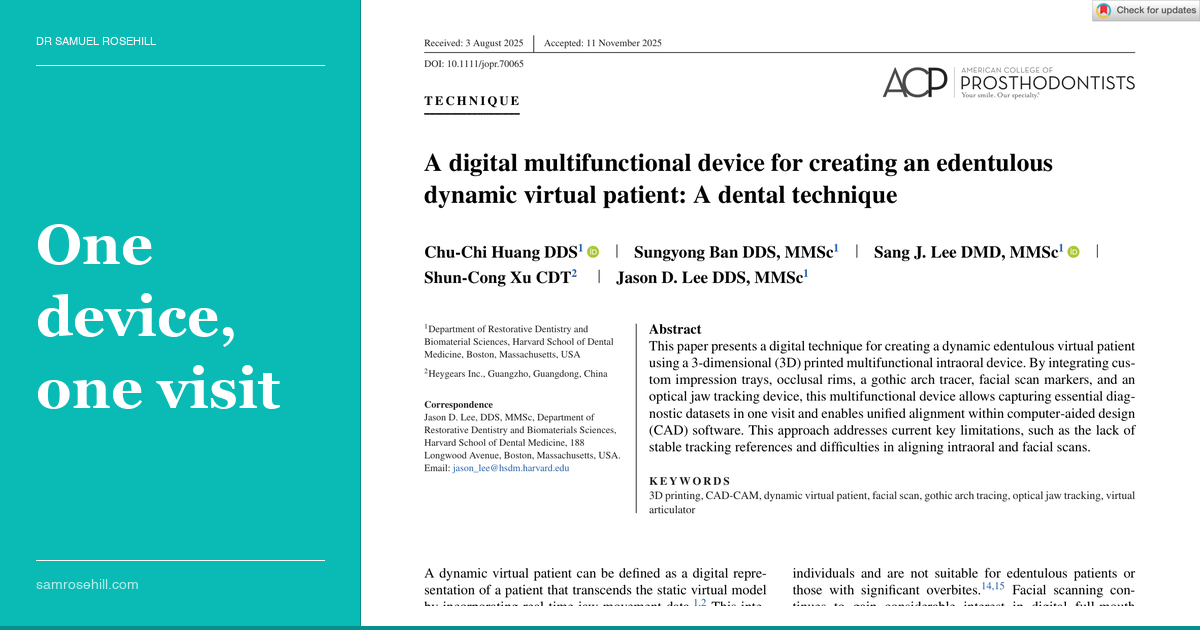
Source Paper
A digital multifunctional device for creating an edentulous dynamic virtual patient: A dental technique
Digital dentistry has spent a decade making the dentate patient’s life considerably more interesting. Scan, design, mill, seat: the crown that once required a week in the laboratory now arrives before lunch. The edentulous patient, meanwhile, has been queuing patiently beside a rack of impression trays and waiting for someone to notice.
A digital multifunctional device for creating an edentulous dynamic virtual patient: A dental technique, by Huang and colleagues at Harvard School of Dental Medicine, is that notice. The problem it solves is geometric.
Optical jaw tracking devices require a stable reference point (typically the maximal intercuspal position), and their marker holders are designed for dentate arches. Facial scanners face a related difficulty: superimposing a facial scan onto an intraoral dataset is straightforward when teeth provide common landmarks; remove them and the alignment problem becomes considerably less tidy. The dynamic virtual patient has remained, until this technique, a dentate-only privilege.
The Data Anchor
Huang and colleagues describe a 13-step protocol built around a device designed in CAD software (3Shape Dental System 2022) and printed in light-polymerised resin on a digital light processing printer (Ultracraft A2D 4K; HeyGears). The starting point is the patient’s interim immediate dentures, soft-relined, scanned (TRIOS 3; 3Shape), and used as the dimensional reference for the new device.
Into this single appliance, the team integrated five components: custom closed-mouth impression trays, occlusal rims for VDO determination, a gothic arch tracer, a detachable facial scan marker plate with reference beads, and an optical jaw tracking device holder (TWIM; Modjaw), all connected via stackable pairing joints and sequentially attached during one appointment. Virtual articulator alignment (Artex CR; Amann Girrbach) uses the Bergstrom and nasion points referenced to the facial scan, avoiding a conventional facebow transfer entirely.
The facial scan marker plate is the quietly clever part. Custom-fitted to the impression tray and fixed in spatial relationship to the registered centric relation position, it may render smartphone-based facial scans (Abound 3D Scanner; Abound Labs) clinically adequate, removing a significant cost barrier for this workflow.
Key Findings
- Five datasets, one visit. Final impressions, VDO, centric relation, facial scan, and jaw motion data are all registered into a unified CAD coordinate system (Exocad DentalCAD 3.2 Elefsina) without separate appointments or laboratory remounting.
- The OJTD holder solves the edentulous stability problem. Integrating the optical jaw tracking mount into a mucosal-surface impression tray gives the tracker the stable platform that standard holders cannot provide; prior published approaches relied on reflective denture stickers or custom self-developed systems.
- Broader application is plausible. Though demonstrated on a complete denture patient, the device design is adaptable to full-mouth rehabilitation cases where stable occlusal stops are absent.
- Limitations are declared, not hedged. Custom tray retention, scanning and alignment errors, CAD software compatibility, and the absence of incisal guidance during jaw motion recording all require validation. No accuracy data are presented: this is a technique description, not a clinical trial.
💡 The Clinical Bottom Line
For complete denture prosthodontics, this technique offers a credible digital pathway where previously only analogue methods existed. The required software ecosystem (3Shape, Exocad, Modjaw) and a DLP printer are not trivial investments, and the workflow’s alignment accuracy awaits formal study.
The conceptual contribution (a single device that gives the optical jaw tracker something to mount on and the facial scanner something to register against, while capturing impressions and gothic arch simultaneously) is the kind of integration that tends to age well in technique literature.
The edentulous patient was never resistant to the digital revolution. The revolution just had not yet built a device that fitted.
Dr Samuel Rosehill is a general dentist with a prosthodontic focus, practising at Ethical Dental in Coffs Harbour, NSW. He holds a BDSc (Hons) from the University of Queensland, an MBA, an MMktg, and an MClinDent in Fixed & Removable Prosthodontics (Distinction) from King’s College London.
Clinical Relevance
The edentulous arch has been systematically excluded from digital workflow advances because optical jaw trackers require a stable dental reference point and facial scanners struggle to superimpose onto toothless arches. This technique from Harvard consolidates five clinical datasets — final impressions, vertical dimension of occlusion, centric relation, facial scan, and jaw motion — into one appointment using a single 3D-printed device, creating a dynamic virtual patient that previously required multiple analogue appointments and laboratory remounting.
Disclosure: The author has no financial conflicts of interest related to the products or topics discussed in this review. This is an independent summary prepared for educational purposes.
Continue the conversation
This review is also published on Substack, where you can leave comments and join the discussion.
Read on Substack →