Maybe the Second Molar Can Sit This One Out
Gao and colleagues compare first-molar-only implant restoration with restoring both first and second molars, finding similar survival and chewing outcomes with lower cost and less peri-implant disease in the first-molar-only group.
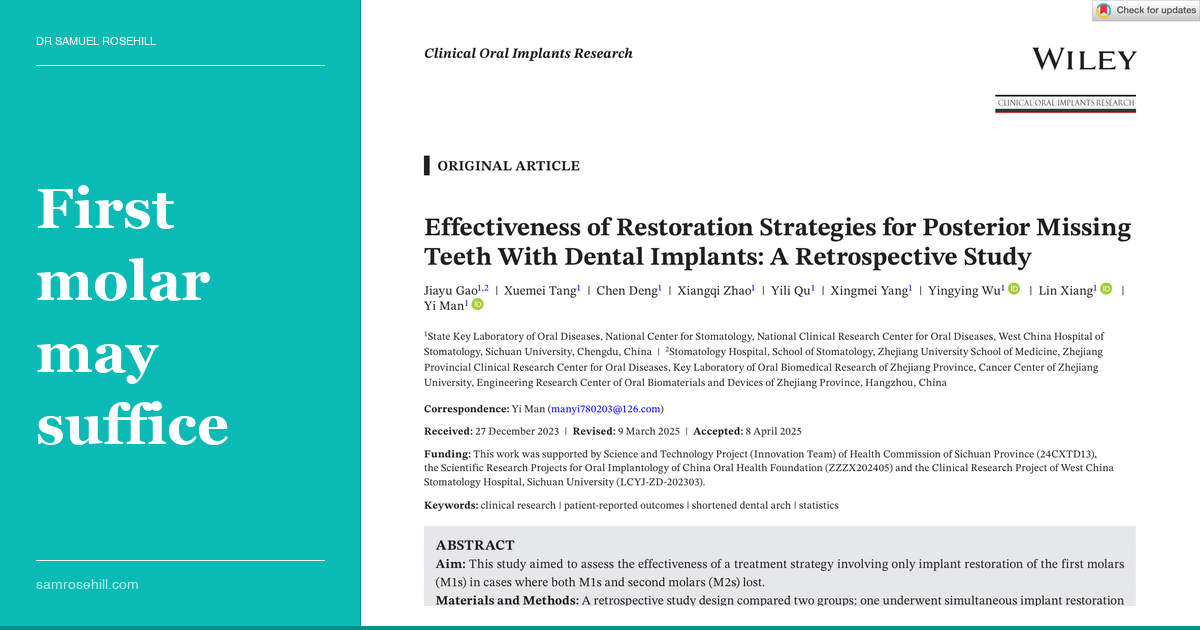
First molar may suffice
Source Paper
Effectiveness of Restoration Strategies for Posterior Missing Teeth With Dental Implants: A Retrospective Study
There is a particular bravery in suggesting that dentistry might occasionally do less. Not neglectfully less, not “see how it goes” less, but intelligently less: the kind of less that asks whether the second molar really needs its own implant, crown, maintenance schedule, and future argument with a water flosser. Gao and colleagues’ Effectiveness of Restoration Strategies for Posterior Missing Teeth With Dental Implants: A Retrospective Study puts that question where it belongs, in the posterior mandible and maxilla, where access is poor and enthusiasm can be expensive.
Their answer is not that second molars are decorative. It is that, when both first molars (M1s) and second molars (M2s) are missing, restoring only the M1 may often be enough — a sentence that will make maximalists reach for a calming beverage.
The Data Anchor
This retrospective study included 247 patients and 283 partially edentulous posterior regions. Group 1 restored both M1s and M2s, contributing 195 regions. Group 2 restored only the M1, contributing 88 regions. The investigators assessed implant survival, complication-free survival, cumulative cost, peri-implant conditions, marginal bone loss (MBL), and patient-reported outcome measures (PROMs).
Overall implant survival was similar: 92.8% in the two-molar restoration group and 94.0% in the M1-only group. The mixed-effects Cox model found no significant survival difference (hazard ratio [HR] = 1.66; 95% confidence interval [CI], 0.29 to 9.50; P = 0.567). Complication-free survival was also not significantly different, at 65.5% and 75.8% respectively (HR = 1.21; 95% CI, 0.49 to 3.04; P = 0.678).
The practical differences were elsewhere. Total cumulative costs were 1.7-fold higher when both molars were restored. Beyond 3 years, peri-implantitis appeared in 13 of 98 regions in Group 1 and none of 18 regions in Group 2 (P = 0.043). More than 0.5 mm MBL occurred in 47 of 185 regions in Group 1 and 7 of 84 regions in Group 2.
Key Findings
- Survival did not reward the extra molar. Implant survival was 92.8% for restoring M1 and M2, and 94.0% for restoring M1 only.
- Chewing ability did not clearly suffer. PROMs showed no significant difference in chewing soft or hard foods after treatment.
- Cost changed substantially. Restoring both molars carried 1.7 times higher total cumulative cost.
- Biological maintenance looked kinder with less hardware. The M1-only group had no peri-implantitis cases beyond 3 years in the assessed regions.
- The caveat is selection bias. This was not randomised; clinicians and patients may have chosen treatment paths for reasons the dataset cannot fully scrub clean.
💡 The Clinical Bottom Line
The gold standard is not replacing every missing posterior unit because the arch diagram has a gap. It is restoring function with the smallest biological, financial, and maintenance burden that still serves the patient.
For many M1-M2 edentulous spans, this paper makes the first molar look less like a compromise and more like the adult in the room. The second molar may still deserve a place, but it should probably bring a better argument than symmetry.
Dr Samuel Rosehill is a general dentist with a prosthodontic focus, practising at Ethical Dental in Coffs Harbour, NSW. He holds a BDSc (Hons) from the University of Queensland, an MBA, an MMktg, and an MClinDent in Fixed & Removable Prosthodontics (Distinction) from King’s College London.
Clinical Relevance
For patients missing both first and second molars, restoring only the first molar may provide similar implant survival and patient-reported chewing ability while reducing cost, grafting burden, marginal bone loss risk, and peri-implantitis incidence. Because this was retrospective, the finding should guide shared planning rather than become a blanket rule against second molar replacement.
Disclosure: The author has no financial conflicts of interest related to the products or topics discussed in this review. This is an independent summary prepared for educational purposes.
Continue the conversation
This review is also published on Substack, where you can leave comments and join the discussion.
Read on Substack →