What Patients Actually Feel: Zirconia RBFPDs and Quality of Life at 12 Months
A 12-month longitudinal study of 30 participants finds that posterior monolithic zirconia resin-bonded fixed partial dentures produce clinically meaningful improvements in oral health-related quality of life, with the OHIP-14 total score dropping from 4.2 to 1.8 and gains concentrated in orofacial pain and orofacial appearance.
QoL improves meaningfully
Source Paper
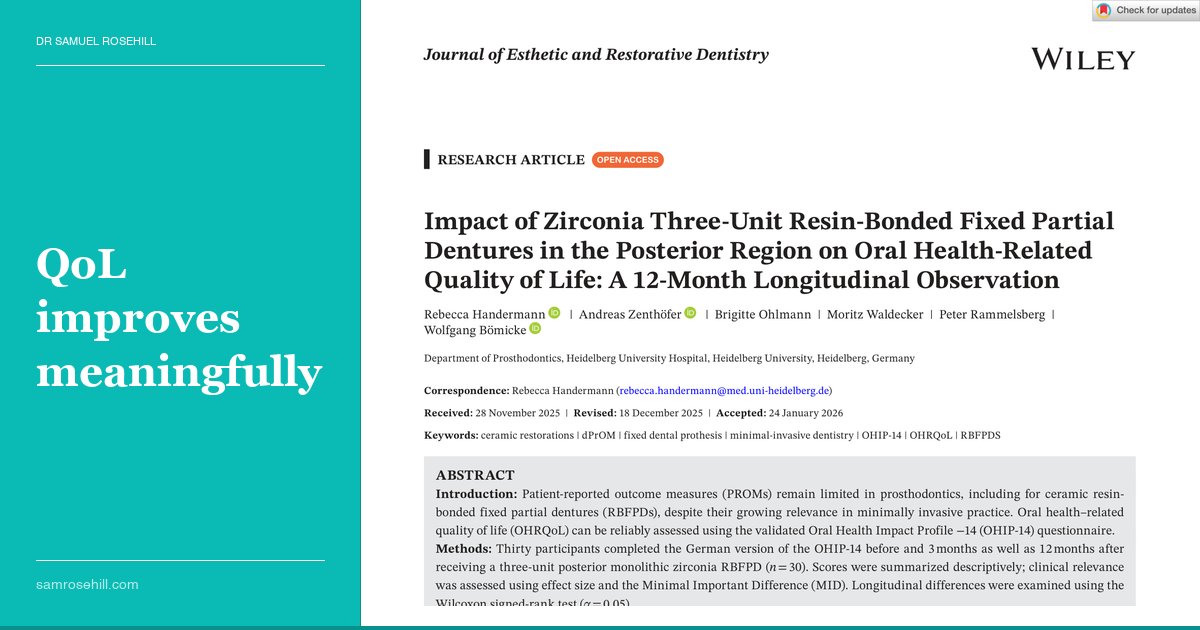
Impact of Zirconia Three-Unit Resin-Bonded Fixed Partial Dentures in the Posterior Region on Oral Health-Related Quality of Life: A 12-Month Longitudinal Observation
There is a principle in good restaurant design that says the room should do more work than the menu. Lighting, acoustics, the space between tables: these things determine whether a diner leaves feeling restored or merely fed, and yet they rarely appear on any critic’s star assessment. The food gets graded; the experience is assumed. Dentistry has operated on much the same logic for decades, tallying survival rates and marginal gaps while the patient’s lived experience went largely unmeasured. Handermann and colleagues at Heidelberg University Hospital set out to correct that imbalance with “Impact of Zirconia Three-Unit Resin-Bonded Fixed Partial Dentures in the Posterior Region on Oral Health-Related Quality of Life: A 12-Month Longitudinal Observation,” asking not whether the restoration survived, but whether the patient felt better.
The Data Anchor
This longitudinal study drew data from 30 participants in a randomised controlled pilot trial at Heidelberg’s Department of Prosthodontics. Each received a single three-unit posterior monolithic zirconia RBFPD (Cercon ht light/medium, DeguDent GmbH), inlay-retained or wing-retained by randomisation and then pooled for this analysis. Participants completed the German OHIP-14 questionnaire at baseline, 3 months, and 12 months (scores 0–56; lower is better). Clinical relevance was assessed via the Minimal Important Difference (MID, defined as a two-point change) and Cohen’s d effect size, with Wilcoxon signed-rank testing (α = 0.05). OHRQoL was a pre-specified secondary endpoint; no a priori power calculation was performed.
Design caveat: Because quality of life was a secondary outcome from a pilot RCT, the study was not powered for this endpoint. Findings are informative rather than definitive, and generalisability should be treated with appropriate caution.
Key Findings
- Total OHIP-14 scores improved significantly: mean fell from 4.2 ± 3.9 at baseline to 2.3 ± 3.2 at 3 months and 1.8 ± 2.9 at 12 months (p < 0.001 for baseline vs 12 months). The 12-month difference of −2.38 points exceeded the two-point MID, confirming clinical as well as statistical significance.
- Effect size was moderate at both time points (Cohen’s d = −0.59 at 12 months; d = −0.63 at 3 months), while the change from 3 to 12 months was small (d = −0.15), suggesting most quality-of-life gain arrives early.
- Orofacial pain improved significantly between baseline and 12 months (p = 0.010), domain mean falling from 1.37 to 0.62 points.
- Orofacial appearance also improved (p = 0.003 at 3 months; p = 0.035 at 12 months), consistent with patients’ relief at closing the gap, even in a posterior non-aesthetic zone.
- Psychosocial impact and oral function did not reach significance, consistent with low baseline burden in both domains (below 0.5), reflecting the limited functional toll of a single missing posterior tooth in an otherwise well-supported dentition.
- Limitations: Small sample (n = 30), secondary endpoint design with no power calculation, single-centre cohort, 12-month observation window, and one RBFPD failure reducing the 12-month dataset to 29 participants.
💡 The Clinical Bottom Line
The restaurant analogy holds in both directions: patients missing a single posterior tooth already show a measurable decline in how they feel about their mouth, and a minimally invasive zirconia RBFPD reverses most of it within three months. Handermann et al. will not settle the implant-versus-RBFPD debate; that is a question for a larger, powered study. What they provide is a patient-reported number for the shared decision-making conversation: clinically meaningful OHRQoL gains, concentrated in pain and appearance, maintained at 12 months. For a restoration requiring no grafting, no surgery, and minimal tooth preparation, that is worth knowing before you reach for the consent form.
Dr Samuel Rosehill is a general dentist with a prosthodontic focus, practising at Ethical Dental in Coffs Harbour, NSW. He holds a BDSc (Hons) from the University of Queensland, an MBA, an MMktg, and an MClinDent in Fixed & Removable Prosthodontics (Distinction) from King’s College London.
Clinical Relevance
Posterior zirconia RBFPDs produced a clinically meaningful OHIP-14 improvement (baseline 4.2 to 12-month 1.8, exceeding the two-point minimal important difference) with significant gains in orofacial pain and orofacial appearance. The data supports including patient-reported outcomes when counselling patients on minimally invasive tooth replacement options.
Disclosure: The author has no financial conflicts of interest related to the products or topics discussed in this review. This is an independent summary prepared for educational purposes.
Continue the conversation
This review is also published on Substack, where you can leave comments and join the discussion.
Read on Substack →