The Gingiva Has Been Narrating Your Implant's Future All Along
Breunig et al. follow 162 implants for up to twenty years and discover that gingival phenotype predicts crestal bone loss and peri-implantitis risk — with thick, flat tissue emerging as the long-term troublemaker nobody expected.
Phenotype predicts bone loss
Source Paper
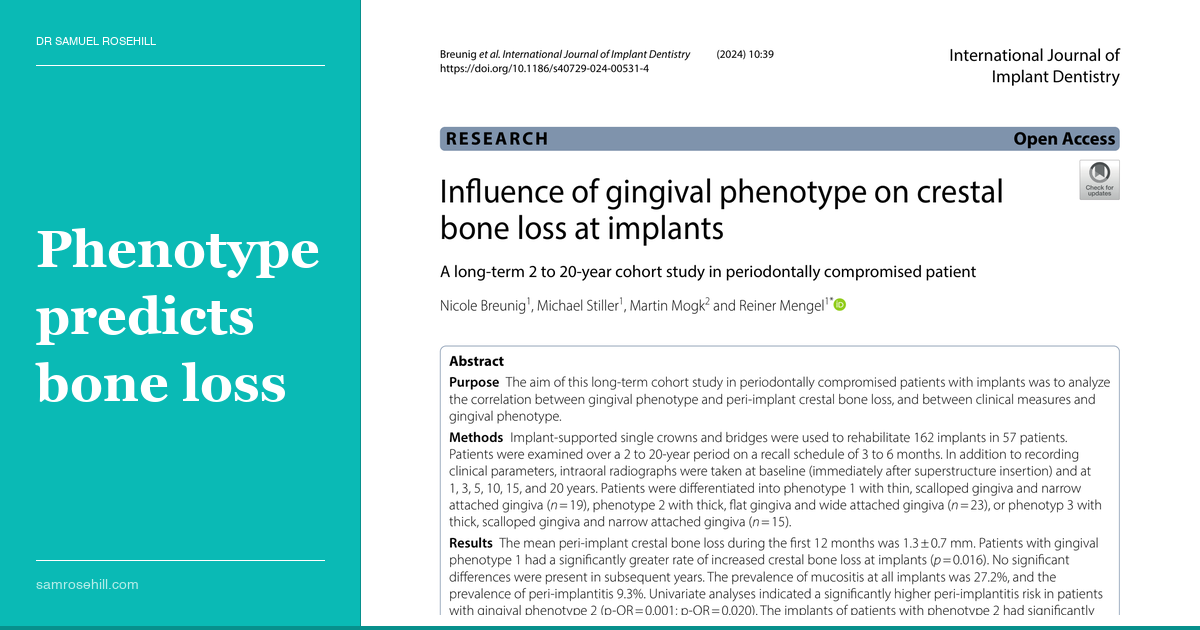
Influence of gingival phenotype on crestal bone loss at implants: A long-term 2 to 20-year cohort study in periodontally compromised patients
Every gingival tissue tells a story before the implant goes in — thin and scalloped, thick and flat, somewhere in between — and for decades, clinicians have been politely ignoring the narrator. Breunig et al.’s Influence of Gingival Phenotype on Crestal Bone Loss at Implants (International Journal of Implant Dentistry, 2024) is the first long-term cohort study to actually sit down and listen, tracking 162 implants across 57 periodontally compromised patients for up to twenty years. The punchline: gingival phenotype predicts peri-implant bone loss and disease risk — but not in the direction most clinicians would assume.
The Marburg team classified patients into three phenotype groups at baseline and then followed the plot. Phenotype 1 (thin, scalloped, narrow attached gingiva; n = 19) told a dramatic first chapter. Phenotype 2 (thick, flat, wide attached gingiva; n = 23) told a slow-burning saga. Phenotype 3 (thick, scalloped, narrow attached; n = 15) told — well, barely anything at all.
The Data Anchor
All 162 implants were Nobel Biocare platforms (Brånemark Mk II/III, Nobel Replace Straight Groovy, Nobel Speedy Replace), placed epicrestally and restored with single crowns (n = 123) or bridges (n = 19). Patients attended recall every 3–6 months, with radiographs at 1, 3, 5, 10, 15, and 20 years — a surveillance commitment that borders on the heroic.
Mean crestal bone loss in the first 12 months was 1.3 ± 0.7 mm across the cohort, but Phenotype 1 patients lost significantly more (p = 0.016). The narrator’s first chapter was loud and clear. After year one, however, the thin-tissue story quietened — no significant differences in subsequent years. The real twist belonged to Phenotype 2: those thick, flat-gingiva patients — the ones you’d instinctively file under “low risk” — carried significantly greater probing depths at years 1, 3, 10, and 15 (p < 0.001, p = 0.016, p = 0.027, p < 0.001) and a substantially elevated peri-implantitis risk (p-OR = 0.001).
The uncomfortable revelation: thick tissue isn’t universally protective. Phenotype 2 patients looked reassuring on the day of placement and spent the next two decades quietly accumulating trouble.
Overall, mucositis was present at 27.2% of implants and peri-implantitis at 9.3%.
Key Findings
- Early bone loss hits thin tissue hardest: Phenotype 1 patients showed significantly greater crestal bone loss in year one (p = 0.016), resolving thereafter — the narrator shouts early, then goes quiet.
- Thick and flat is the long-term risk profile nobody expected: Phenotype 2 patients had elevated probing depths across four timepoints and the highest peri-implantitis risk in the cohort (p-OR = 0.001). The “safe” phenotype is the one to watch.
- Thick and scalloped is the quiet achiever: Phenotype 3 showed no significantly elevated probing depths, inflammation, or bone loss at any timepoint across twenty years.
- Caveat: Phenotype was assessed at the anterior maxillary teeth, not at implant sites — a pragmatic compromise that may miss site-specific variation. Cohort size (n = 57) is modest for three-group stratification over two decades.
💡 The Clinical Bottom Line
Before placing implants in periodontally compromised patients, formally classify the gingival phenotype — because the tissue has been narrating the ending all along. Thin, scalloped patients warrant close monitoring through that first post-loading year; thick, flat patients deserve long-term vigilance for peri-implantitis despite their reassuring initial presentation. The assumption that thick equals safe has been running on reputation rather than evidence — and after twenty years of data, the narrator would like a word.
Dr Samuel Rosehill is a general dentist with a prosthodontic focus, practising at Ethical Dental in Coffs Harbour, NSW. He holds a BDSc (Hons) from the University of Queensland, an MBA, an MMktg, and an MClinDent in Fixed & Removable Prosthodontics (Distinction) from King’s College London.
Reference: Breunig N, Stiller M, Mogk M, Mengel R. Influence of gingival phenotype on crestal bone loss at implants: A long-term 2 to 20-year cohort study in periodontally compromised patients. Int J Implant Dent. 2024;10:39. https://doi.org/10.1186/s40729-024-00531-4
Clinical Relevance
Before placing implants in periodontally compromised patients, formally classify gingival phenotype. Thin, scalloped patients need close monitoring in the first post-loading year for crestal bone loss. Thick, flat patients warrant long-term peri-implantitis surveillance despite their reassuring initial presentation.
Disclosure: The author has no financial conflicts of interest related to the products or topics discussed in this review. This is an independent summary prepared for educational purposes.
Continue the conversation
This review is also published on Substack, where you can leave comments and join the discussion.
Read on Substack →