What If You Only Need to Fill Half the Socket?
Hsieh et al. compare half-grafted and full-grafted alveolar ridge preservation using serial CBCT over 12 months — and while the full graft holds its horizontal dimensions better, volumetric outcomes and implant health are equivalent.
Half-graft, full outcome
Source Paper
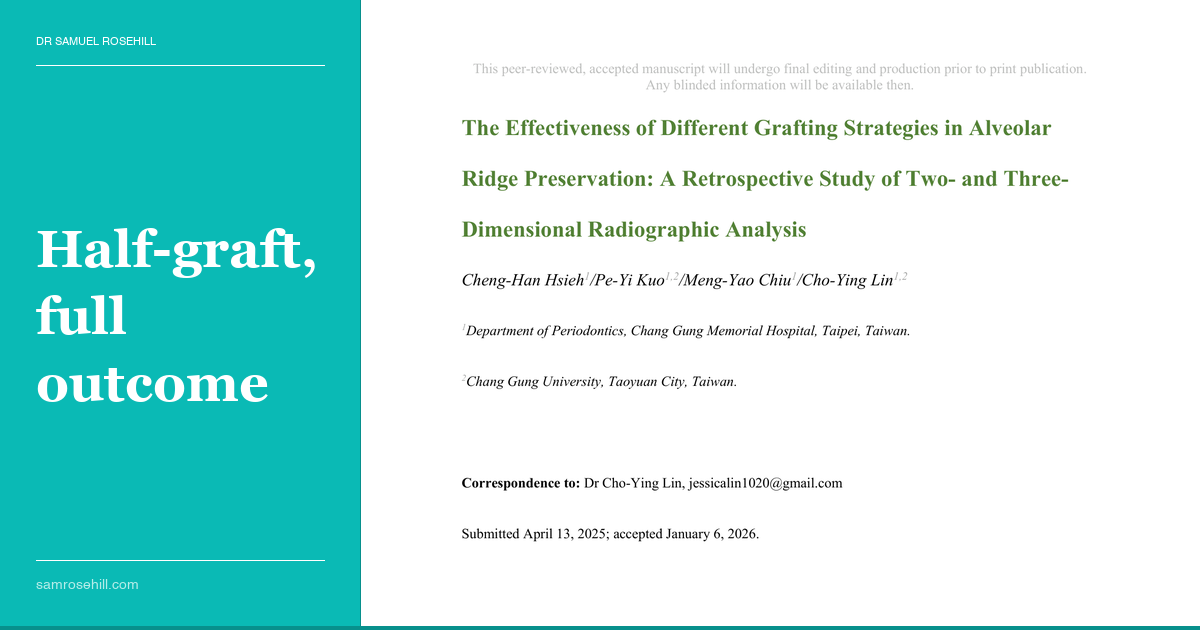
The Effectiveness of Different Grafting Strategies in Alveolar Ridge Preservation: A Retrospective Study of Two- and Three-Dimensional Radiographic Analysis
Every extraction socket presents the same uncomfortable negotiation: how much bone graft material do you actually need to put in there, and how much of what you put in will still be doing useful work six months later when you raise a flap for implant placement? The conventional answer — pack it full, cover it with a membrane, and hope the xenograft particles integrate rather than sitting there like expensive gravel — has served the profession well enough, but it has also left a lingering suspicion that we might be overdoing it.
Hsieh and colleagues, in a retrospective study published in the International Journal of Oral and Maxillofacial Implants, put that suspicion to a rather elegant test: what happens if you only fill the bottom half of the socket with graft material and let the coronal portion heal by blood clot? Their answer, tracked through serial CBCT and 3D volumetric analysis over 12 months, is more nuanced than either camp might like.
The Data Anchor
Twenty-eight sockets from patients at Chang Gung Memorial Hospital were divided across three groups: half-grafted with collagen membrane (TestC, n = 7), half-grafted with dPTFE membrane (TestD, n = 8), and full-grafted with collagen membrane (Control, n = 13). Grafting materials were either alloplastic substitute (Sinbone HT) or xenograft (Bio-Oss collagen, Geistlich).
CBCT scans were taken immediately post-extraction, at 6 months, during implant placement (after loose graft removal), and at least 6 months after loading. Measurements were independently calibrated across two examiners, with ICC values of 0.84–0.93.
Key Findings
- Half-grafted sockets lost significantly more horizontal width at all crestal levels during the first 6 months: ΔHRW1 was −2.45 ± 0.96 mm vs −1.21 ± 0.98 mm for full-grafted (P = 0.002), ΔHRW3 was −1.49 ± 1.34 mm vs −0.27 ± 0.68 mm (P = 0.002), and ΔHRW5 was −0.46 ± 0.27 mm vs −0.16 ± 0.41 mm (P = 0.033).
- After removal of poorly integrated graft at implant surgery, the half-grafted group showed greater area reduction — consistent with the interpretation that some of the full-grafted group’s apparent ridge preservation represents loosely attached particles rather than regenerated bone.
- Volume change was statistically equivalent between groups at both radiographic time points (ΔVo% P = 0.555 at T0–T6M; P = 0.118 at T6M–Timplant), and all implants demonstrated stable peri-implant health with no disease or progressive bone loss regardless of grafting strategy.
- Buccal bone thickness at the crest was the strongest independent predictor of ridge preservation success: sockets with initial buccal plate < 1 mm showed significantly greater height (P = 0.02) and area reduction (P = 0.047), regardless of technique.
- Collagen membrane outperformed dPTFE for dimensional preservation, with significantly less palatal bone height loss (P = 0.038) and horizontal shrinkage (P < 0.001 for ΔHRW1 and ΔHRW3).
- Limitations are substantial: retrospective design, small sample after significant dropout (61 enrolled, 28 analysed), uneven VRF distribution in the half-grafted group (which may have inflated dimensional losses), and no histological data on bone quality.
💡 The Clinical Bottom Line
The half-grafted technique is not the dimensional equivalent of full grafting — it trades crestal width for material economy and (arguably) a more honest post-healing assessment, since there are fewer loose particles masquerading as ridge on the pre-implant CBCT. But the volumetric equivalence and identical implant outcomes suggest the clinical endpoint that matters — can you place an implant and load it successfully? — is achievable with either approach.
The real takeaway may be less about how much graft you use and more about what you start with: if the buccal plate is thinner than 1 mm at the crest, no amount of socket grafting reliably compensates. That millimetre of bone is doing more work than the graft material ever will.
Dr Samuel Rosehill is a general dentist with a prosthodontic focus, practising at Ethical Dental in Coffs Harbour, NSW. He holds a BDSc (Hons) from the University of Queensland, an MBA, an MMktg, and an MClinDent in Fixed & Removable Prosthodontics (Distinction) from King’s College London.
Reference: https://doi.org/10.11607/jomi.11369
Clinical Relevance
Half-grafting the extraction socket — filling only the apical portion with xenograft and allowing the coronal half to heal by blood clot — produces equivalent volumetric outcomes and peri-implant health to full grafting at 12 months, despite greater horizontal ridge shrinkage in 2D analysis. The buccal bone plate thickness at the crest is the strongest independent predictor of ridge preservation success regardless of grafting strategy.
Disclosure: The author has no financial conflicts of interest related to the products or topics discussed in this review. This is an independent summary prepared for educational purposes.
Continue the conversation
This review is also published on Substack, where you can leave comments and join the discussion.
Read on Substack →