The Variable That Hides Until It Matters: Implant Macrodesign and Stability Under Bone Loss
An in vitro study by Medina-Madrid and colleagues placed parallel-walled and tapered implants in polyurethane blocks simulating D2 and D3 bone density, then created progressive peri-implant defects — finding that macrodesign makes no measurable difference to resonance frequency analysis stability scores until bone loss reaches two-thirds of implant length, at which point tapered implants lose substantially more stability than their parallel-walled counterparts.
Tapered implants fail harder later
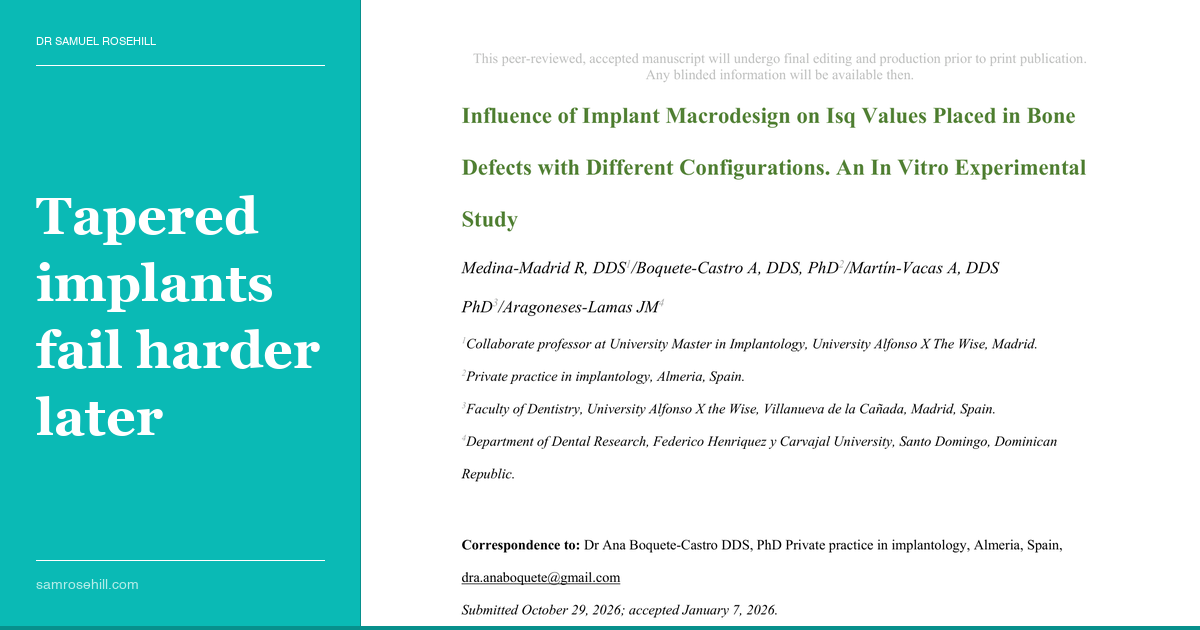
Source Paper
Influence of Implant Macrodesign on ISQ Values Placed in Bone Defects with Different Configurations. An In Vitro Experimental Study
The choice of implant macrodesign gets made when everything is going well: bone present, primary stability strong, implant stability quotient (ISQ) numbers reassuring, the difference between a parallel-walled and a tapered body looking like a preference rather than a prognosis. A choice whose consequences only emerge when conditions deteriorate.
Influence of Implant Macrodesign on ISQ Values Placed in Bone Defects with Different Configurations. An In Vitro Experimental Study, published in the International Journal of Oral and Maxillofacial Implants by Medina-Madrid, Boquete-Castro, Martín-Vacas and Aragoneses-Lamas, investigates exactly that deferred moment. Eighty implants (40 parallel-walled, PW; and 40 tapered-walled, TW) were placed in polyurethane blocks simulating two bone densities (D2 medium-dense and D3 lower-density, per Misch classification), then subjected to progressively deeper artificial defects while resonance frequency analysis (RFA) stability was measured at each stage.
The Data Anchor
Eighty GMI Dental (Lleida, Spain) implants (40 Frontier parallel-walled and 40 PEAK tapered-walled, both 4.25 mm × 11.5 mm) were placed in polyurethane blocks simulating D2 and D3 bone densities. The systems’ main structural difference is thread pitch: 1.5 mm in the PW Frontier versus 2.4 mm in the TW PEAK. Standardised insertion torque was 35 Ncm throughout.
Eight peri-implantitis scenarios were machined in: one-, two-, three-wall and circumferential defects at 4 mm (one-third) and 8 mm (two-thirds implant length), measured by Osstell Beacon in two perpendicular directions. Polyurethane blocks, machined defects, no biological variables: explicitly mechanical in scope.
At baseline, both designs achieved mean ISQ above 70 (PW 73.18 ± 2.39; TW 73.69 ± 2.61), with no significant difference at placement.
The Osstell classification places ISQ > 70 as high stability, 60–69 as medium, and < 60 as low. Those thresholds frame everything that follows.
Key Findings
- At one-third bone loss, macrodesign is statistically invisible. Across nearly all defect configurations at 4 mm depth, PW and TW ISQ values were indistinguishable. The single exception: two-wall loss in D2 bone, where TW implants performed slightly better (p = 0.023).
- At two-thirds bone loss, the divergence becomes stark. PW implants outperformed TW under one-wall, three-wall, and circumferential defects in both D2 and D3 bone (p values from 0.004 to < 0.001 depending on scenario).
- The headline numbers: PW implants dropped 20% from baseline under circumferential 2/3 loss in D2 bone (73.9 → 59.0 ISQ). TW implants dropped 47.7% (75.05 → 39.25 ISQ). An ISQ of 39 is frank low stability; 59 is marginal but not yet failed.
- Regression confirmed the hierarchy. Bone density and extent of loss dominated throughout; implant design only became significant from three-wall loss, and was the second-strongest predictor at circumferential loss (B = −6.0, p < 0.001).
- Probable mechanism. As bone recedes from a tapered body, bone-implant contact area falls faster than in a parallel-walled design; the PW system’s smaller thread pitch (1.5 mm vs 2.4 mm) preserves more contact per unit length.
- Limitation. Polyurethane blocks with machined defects eliminate the vascular biology and inflammatory remodelling of real peri-implantitis. These are mechanical findings under idealised conditions, not clinical outcomes data.
💡 The Clinical Bottom Line
The headline is not that tapered implants are inferior. At placement both designs perform identically on RFA. Equivalence holds only while bone support is adequate: once loss reaches two-thirds of implant length, parallel-walled implants retain measured stability substantially better, particularly under circumferential defects.
Whether that pattern carries clinical weight depends on whether RFA in a polyurethane block translates to an osseointegrated implant under peri-implantitis (a question this study cannot answer). What it does offer is reason to consider macrodesign at placement — and again when reviewing implants already compromised.
The variable hides early and charges interest late.
Dr Samuel Rosehill is a general dentist with a prosthodontic focus, practising at Ethical Dental in Coffs Harbour, NSW. He holds a BDSc (Hons) from the University of Queensland, an MBA, an MMktg, and an MClinDent in Fixed & Removable Prosthodontics (Distinction) from King’s College London.
Clinical Relevance
At shallow-to-moderate peri-implant bone loss (one-third of implant length), parallel-walled and tapered implants perform indistinguishably on resonance frequency analysis. The difference only emerges at advanced bone loss (two-thirds of implant length), where tapered implants show markedly greater ISQ reduction — particularly under circumferential defects. This is bench-top in vitro data and cannot be directly translated to clinical decision-making, but it suggests macrodesign may become a prognostically relevant variable in implants already compromised by advanced peri-implantitis.
Disclosure: The author has no financial conflicts of interest related to the products or topics discussed in this review. This is an independent summary prepared for educational purposes.
Continue the conversation
This review is also published on Substack, where you can leave comments and join the discussion.
Read on Substack →