The Goldilocks Drill Speed: 300 RPM Wins the Implant Stability Race
A randomised controlled trial of 100 patients comparing five osteotomy protocols finds that moderate-speed drilling at 300 rpm delivers the most consistent implant stability gains over three months, while bone condensation shows a worrying ISQ decline.
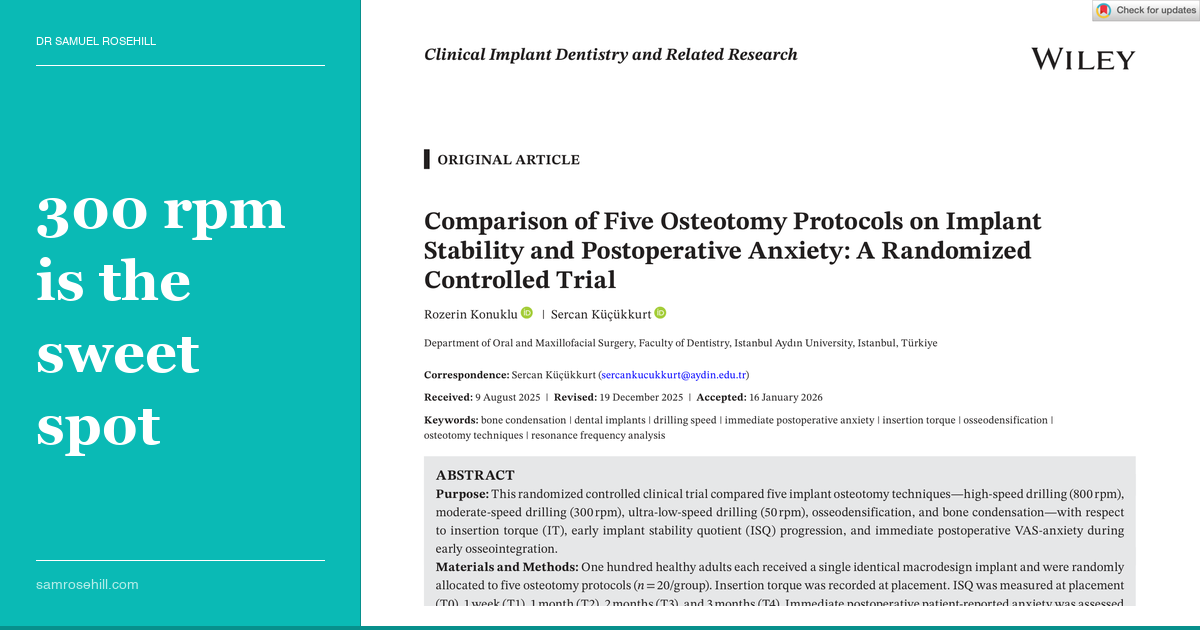
300 rpm is the sweet spot
Source Paper
Comparison of Five Osteotomy Protocols on Implant Stability and Postoperative Anxiety: A Randomized Controlled Trial
Everything we think we know about implant osteotomy technique might be less settled than the average surgical manual suggests. Ask five implantologists how they prepare a site and you will get five different answers, each delivered with the conviction of someone who has never lost an implant. High speed or low speed? Irrigated or dry? Subtractive drilling or bone-preserving condensation? Konuklu and Küçükkurt, in “Comparison of Five Osteotomy Protocols on Implant Stability and Postoperative Anxiety” (Clinical Implant Dentistry and Related Research, 2026), have done something remarkably useful: they tested all five approaches head-to-head in a single randomised trial and tracked stability for three months. The answer, it turns out, is neither the fastest nor the fanciest.
The Data Anchor
This prospective RCT enrolled 100 healthy adults, each receiving a single identical-macrodesign titanium implant (Implance, AGS Medikal), and randomised them equally across five osteotomy protocols (n = 20 per group): ultra-low-speed drilling at 50 rpm without irrigation, moderate-speed at 300 rpm with irrigation, conventional high-speed at 800 rpm with irrigation, osseodensification (Densah burs at 1200 rpm counterclockwise), and bone condensation (condenser drills at 50 rpm clockwise). Stratified randomisation balanced age, sex, implant site, dimensions, bone density, and smoking status. Insertion torque was recorded at placement. ISQ was measured buccolingually and mesiodistally at placement (T0), 1 week, 1 month, 2 months, and 3 months. Immediate postoperative anxiety was assessed via VAS. All surgeries were performed by a single surgeon.
Key Findings
- 300 rpm drilling produced the most consistent ISQ increase from placement to 3 months, achieving the highest final stability values (B-L ISQ 86.8, M-D ISQ 86.3 at T4; adjusted p < 0.05)
- 800 rpm drilling generated the highest initial insertion torque, particularly advantageous in high-density bone, but ISQ gains over time were less consistent than 300 rpm
- Osseodensification showed transient mid-healing ISQ gains that flattened by 3 months; its non-subtractive approach preserves bone but does not translate into superior long-term stability
- Bone condensation was the concerning outlier: ISQ values progressively declined from placement through the follow-up period, with buccolingual measurements dropping significantly (p = 0.004 for intra-group change)
- Ultra-low-speed drilling (50 rpm) performed respectably across all metrics, suggesting that extreme speed reduction is safe, though not superior to 300 rpm
- Osseodensification generated the highest residual postoperative anxiety (VAS scores), while bone condensation produced the greatest anxiety reduction (adjusted p < 0.05), possibly reflecting the perceived vibration and noise differences between techniques
- Limitation: 3-month follow-up does not capture long-term osseointegration outcomes, and the single-implant design may not generalise to multiple-implant or immediate-loading scenarios
Bone condensation’s declining ISQ trajectory is the finding that should give clinicians pause. A technique designed to preserve bone appears, paradoxically, to compromise the very stability it aims to enhance, possibly through pressure necrosis or delayed remodelling at the compressed interface.
💡 The Clinical Bottom Line
This trial provides the strongest evidence yet that osteotomy technique selection should be deliberate rather than habitual. Moderate-speed drilling at 300 rpm emerges as the Goldilocks protocol: fast enough for clinical efficiency, slow enough to minimise thermal trauma, and paired with the most favourable three-month stability trajectory. High-speed drilling remains appropriate for dense bone where initial torque matters, but clinicians relying on bone condensation as a default should reconsider. The best osteotomy, it seems, is neither the one that removes the most bone nor the one that removes the least; it is the one that respects the biology.
Dr Samuel Rosehill is a general dentist with a prosthodontic focus, practising at Ethical Dental in Coffs Harbour, NSW. He holds a BDSc (Hons) from the University of Queensland, an MBA, an MMktg, and an MClinDent in Fixed & Removable Prosthodontics (Distinction) from King’s College London.
Reference: Konuklu R, Küçükkurt S. Comparison of Five Osteotomy Protocols on Implant Stability and Postoperative Anxiety: A Randomized Controlled Trial. Clin Implant Dent Relat Res. 2026;28:e70125. doi:10.1111/cid.70125
Clinical Relevance
Moderate-speed drilling at 300 rpm provides the most balanced implant stability trajectory over 3 months — clinicians should consider this as a default protocol, reserving high-speed drilling for dense bone and approaching bone condensation with caution.
Disclosure: The author has no financial conflicts of interest related to the products or topics discussed in this review. This is an independent summary prepared for educational purposes.
Continue the conversation
This review is also published on Substack, where you can leave comments and join the discussion.
Read on Substack →