When the Gatekeeper Fails the Gate: ISQ, Narrow Implants, and a Protocol That Blocked Its Own Patients
A randomised clinical trial by Godoy-Reina and colleagues found that narrow-platform implants (3.0 mm) prepared with either piezoelectric osteotomy or conventional drilling consistently failed the ISQ ≥70 threshold for immediate loading despite achieving adequate insertion torque — raising a pointed question about whether resonance frequency analysis systematically underestimates stability in narrow-diameter implants.
ISQ undersells narrow implants
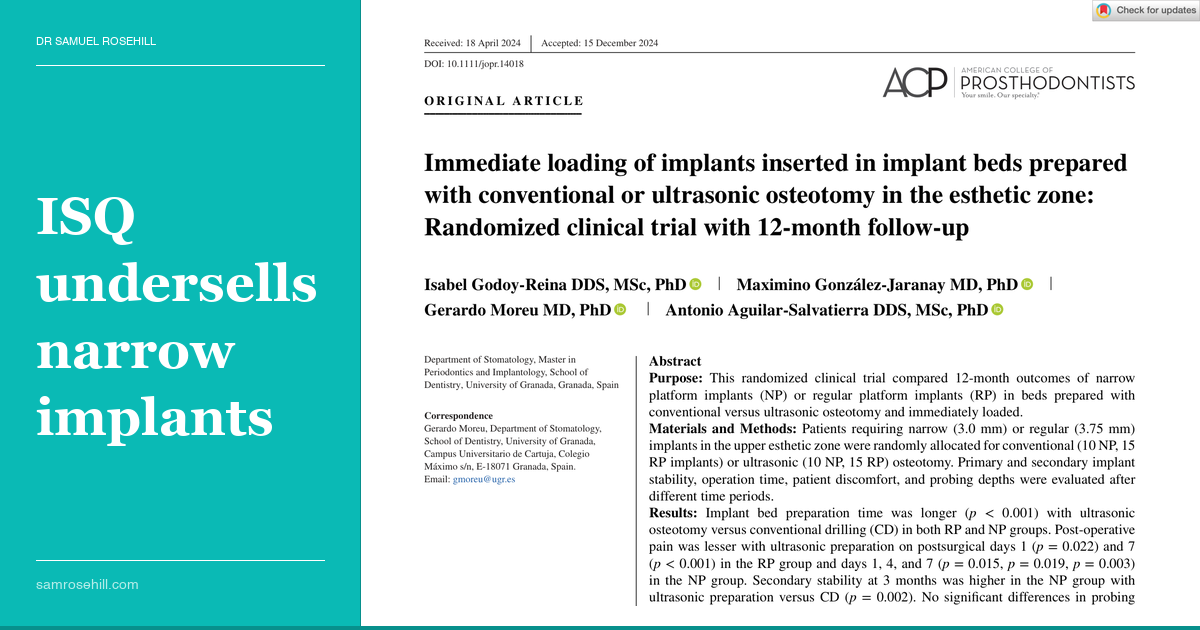
Source Paper
Immediate loading of implants inserted in implant beds prepared with conventional or ultrasonic osteotomy in the esthetic zone: Randomized clinical trial with 12-month follow-up
There is something quietly strange about a protocol that disqualifies every single subject it was designed to help. Implant stability quotient (ISQ) measurement via resonance frequency analysis (RFA) was developed to remove the guesswork from immediate loading: set a threshold, measure the implant, proceed or wait. Clean, standardised, defensible. Except that when Godoy-Reina and colleagues applied that threshold to narrow-platform (NP) implants in the anterior maxilla, not one implant cleared it, while simultaneously delivering perfectly adequate insertion torque. The gatekeeper, it turns out, may have been calibrated for a different gate.
“Immediate loading of implants inserted in implant beds prepared with conventional or ultrasonic osteotomy in the esthetic zone: Randomized clinical trial with 12-month follow-up” pursues this measurement paradox alongside its primary question: does piezoelectric osteotomy (PO) outperform conventional drilling (CD) for stability and postoperative comfort at 12 months?
The Data Anchor
Fifty patients requiring single-tooth replacement in the anterior maxilla were allocated by bone width to a regular-platform group (RP; 3.75 mm, n = 30) or narrow-platform group (NP; 3.0 mm, n = 20), then randomly assigned to PO or conventional drilling (CD) control. All received BEGO Semados implants in grade 4 titanium. Immediate loading required ISQ ≥70 and insertion torque ≥30 Ncm; anything short meant three months of submerged healing.
Insertion torque across all subgroups ranged from 38.0 to 41.0 Ncm, with no significant between-technique differences. ISQ at placement was comparable within each platform (RP means 74.6 vs 70.8; both NP subgroups 64.7). By three months, PO-prepared NP implants had a significantly higher ISQ: 63.7 versus 54.6 for CD (p = 0.002). Operating time ran roughly 2.5-fold longer with PO in both groups (both p < 0.001).
The pain visual analogue scale (VAS) advantage was consistent: PO produced significantly lower scores in RP implants on days 1 and 7, and in NP implants on days 1, 4, and 7. More preparation time, considerably less postoperative discomfort.
Key Findings
- Not one NP implant reached ISQ ≥70 at placement, under either technique. Both NP subgroups sat at mean 64.7 at baseline; the entire narrow cohort was deferred to submerged healing. Insertion torque exceeded 38 Ncm throughout. The authors characterise this as RFA “may underestimate the primary stability of NP implants” — a mild phrasing for a 100% miss rate.
- RP implants loaded immediately; 100% success at 12 months regardless of technique. Probing depths at 3 and 12 months showed no between-technique differences.
- Secondary stability favoured PO in the NP group (ISQ at 3 months: 63.7 vs 54.6, p = 0.002), suggesting more favourable osseointegration kinetics with ultrasonic preparation.
- Limitations: single centre, single operator, 50 implants, 12-month follow-up. The NP cohort is too small to define new thresholds.
💡 The Clinical Bottom Line
For RP implants in the anterior maxilla, the message is clean: PO produces comparable stability to CD, meaningfully less postoperative discomfort, and equivalent tissue health. The two-minute operating time premium is a fair trade.
The sharper message belongs to 3.0 mm implants. If your loading protocol requires ISQ ≥70 as a co-criterion, that threshold may systematically defer cases that insertion torque alone would clear. The authors are appropriately cautious (no implant failed despite deferred loading, no revised threshold proposed), but a 100% miss rate is not noise. Until diameter-adjusted thresholds are validated, the dual-criterion protocol may be the wrong instrument for this job.
The tool designed to expand access to immediate loading may, for narrow implants, be quietly doing the opposite.
Dr Samuel Rosehill is a general dentist with a prosthodontic focus, practising at Ethical Dental in Coffs Harbour, NSW. He holds a BDSc (Hons) from the University of Queensland, an MBA, an MMktg, and an MClinDent in Fixed & Removable Prosthodontics (Distinction) from King’s College London.
Clinical Relevance
This RCT confirmed that piezoelectric osteotomy is a safe and pain-reducing alternative to conventional drilling for regular-platform (3.75 mm) implants in the anterior maxilla, achieving equivalent primary stability and superior postoperative comfort. Critically, no narrow-platform (3.0 mm) implant in either group reached the ISQ ≥70 threshold for immediate loading despite adequate insertion torque, suggesting the current threshold may not be valid for narrow-diameter implants. Clinicians using resonance frequency analysis as the sole or dual gatekeeper for immediate loading of 3.0 mm implants should be aware this criterion may systematically defer loading that is mechanically justified.
Disclosure: The author has no financial conflicts of interest related to the products or topics discussed in this review. This is an independent summary prepared for educational purposes.
Continue the conversation
This review is also published on Substack, where you can leave comments and join the discussion.
Read on Substack →