The Infected Socket Wasn't the Villain.
A 7-year retrospective study of 143 immediate single-tooth implants in the anterior maxilla found comparable survival in non-infected, acutely infected, and chronically infected sites when the surgical and provisionalisation protocol was meticulous.
Infection didn't sink survival
Source Paper
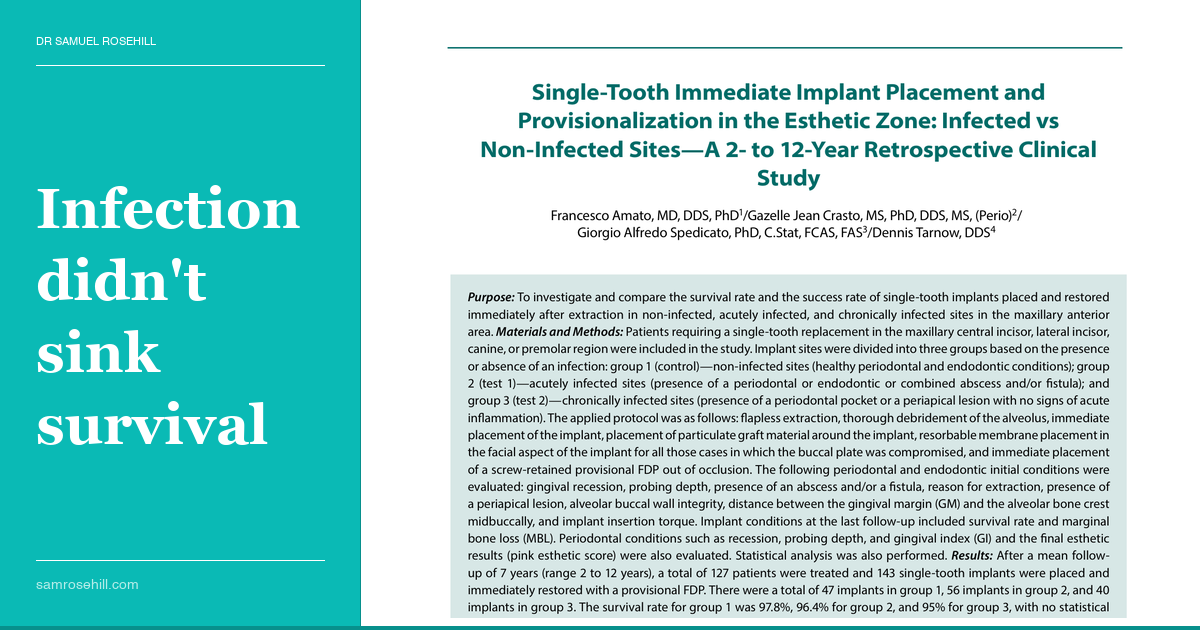
Single-Tooth Immediate Implant Placement and Provisionalization in the Esthetic Zone: Infected vs Non-Infected Sites—A 2- to 12-Year Retrospective Clinical Study
“You can’t place immediately into an infected socket,” said the colleague, with the tidy confidence of a rule that has been repeated so often it now travels without its footnotes. In Single-Tooth Immediate Implant Placement and Provisionalization in the Esthetic Zone: Infected vs Non-Infected Sites—A 2- to 12-Year Retrospective Clinical Study, Francesco Amato and colleagues suggest that this particular piece of clinical scripture may be due for a slightly less majestic frame. Immediate single-tooth implants in the anterior maxilla showed comparable survival whether the site was clean, acutely infected, or chronically infected.
That is not a permission slip for cowboy implantology. It is a more interesting conclusion than that. Infection, on these data, was not the decisive saboteur; protocol probably was.
The Data Anchor
This was a retrospective clinical study of 127 patients receiving 143 immediately placed and immediately provisionalised single implants in the maxillary anterior and premolar region, followed for a mean of 7 years, with a range of 2 to 12 years. The sites were divided into three groups: 47 implants in non-infected sockets, 56 in acutely infected sites, and 40 in chronically infected sites.
The protocol was not casual. The teeth were extracted flaplessly, the sockets were thoroughly debrided, implants were placed immediately, particulate graft was packed around the implant, a resorbable membrane was used on the facial aspect when the buccal plate was compromised, and the screw-retained provisional restoration was kept out of occlusion. In other words, this was not “infection does not matter”; it was “infection may not be fatal when the operator behaves like an adult.”
Key Findings
- Survival stayed high across all three groups. The non-infected sites returned a survival rate of 97.8%, the acutely infected sites 96.4%, and the chronically infected sites 95%, with no statistically significant difference between them (P = .8).
- The cumulative survival rate was still 96.5%. Across all 143 implants, only five failed: one in the clean-site group, two in the acute-infection group, and two in the chronic-infection group.
- The paper quietly shifts the clinical question. Instead of asking whether infection is present as though that alone settles the matter, it pushes the clinician toward the more useful questions: can the site be debrided properly, can primary stability be achieved, is the buccal wall manageable, and can the provisional be kept out of trouble?
- This was not a simplistic extraction-socket gamble. The study included grafting, selective membrane use, and immediate screw-retained provisionals, which means the favourable outcomes belong to a disciplined protocol, not to bravado.
- The limitation is obvious and important. This was a retrospective study, not a randomised trial, and it reflects one clinician’s system over time rather than a universal guarantee for every infected socket that wanders into a treatment room.
💡 The Clinical Bottom Line
If you are standing in the esthetic zone with a socket that is infected, this paper argues against reflexively retreating to a delayed protocol simply because the word “infection” is present in the chart. It argues for a sterner checklist instead: debridement, stability, buccal wall judgement, grafting strategy, and provisional control.
The infected socket, in other words, may not be the villain of the story. The villain may be the temptation to turn a nuanced surgical decision into a slogan.
Dr Samuel Rosehill is a general dentist with a prosthodontic focus, practising at Ethical Dental in Coffs Harbour, NSW. He holds a BDSc (Hons) from the University of Queensland, an MBA, an MMktg, and an MClinDent in Fixed & Removable Prosthodontics (Distinction) from King’s College London.
Clinical Relevance
Infection alone is not an automatic reason to abandon immediate implant placement in the esthetic zone. The practical test is whether the site can be debrided thoroughly, stabilised properly, grafted intelligently where needed, and restored with an out-of-occlusion provisional rather than wishful thinking.
Disclosure: The author has no financial conflicts of interest related to the products or topics discussed in this review. This is an independent summary prepared for educational purposes.
Continue the conversation
This review is also published on Substack, where you can leave comments and join the discussion.
Read on Substack →