When the Aesthetic Zone Says Wait
Deflorian and colleagues turn immediate anterior implant placement into a practical risk filter: primary stability first, then buccal plate integrity, gingival phenotype, and recession. The paper is not a guideline, but it is a useful reminder that implant timing should follow tissue risk rather than surgical enthusiasm.
Timing follows tissue risk
Source Paper
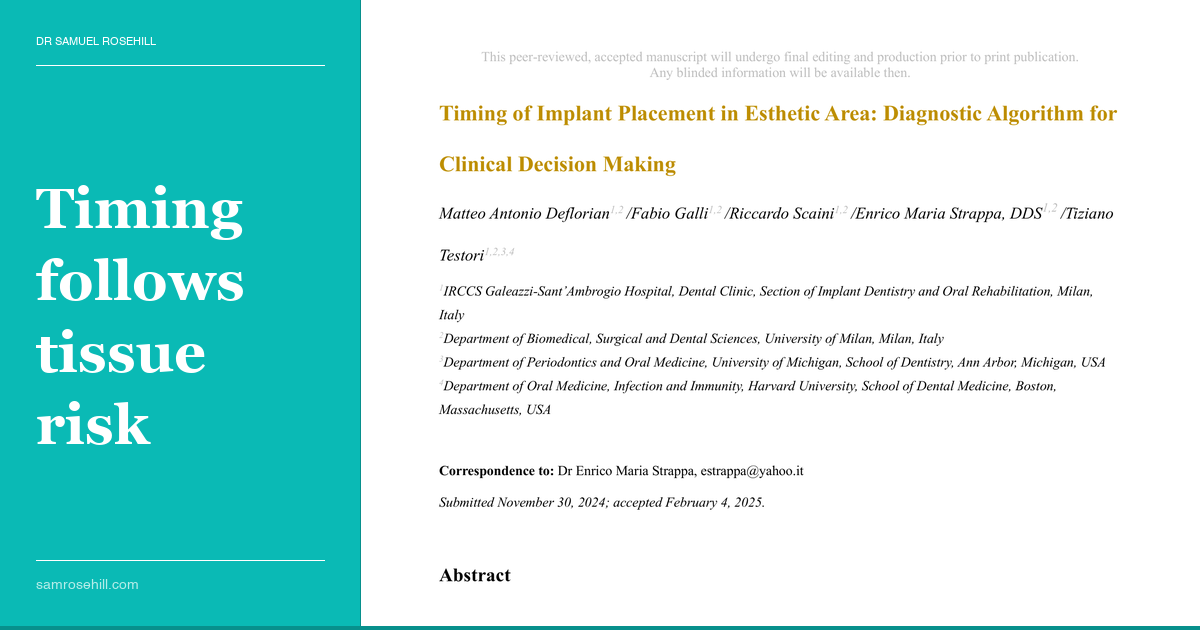
Timing of Implant Placement in Esthetic Area: Diagnostic Algorithm for Clinical Decision Making
There is a particular unfairness to the failing maxillary central incisor: it often looks most urgent at precisely the moment it is least forgiving. The patient wants the tooth gone and the gap solved; the clinician has a CBCT, a provisional plan, and just enough optimism to be dangerous. In “Timing of Implant Placement in Esthetic Area: Diagnostic Algorithm for Clinical Decision Making,” Deflorian and colleagues offer the antidote: a four-gate risk filter for anterior maxillary implant timing, built around primary stability, buccal bone integrity, gingival phenotype, and pre-existing recession.
The Data Anchor
This is not a randomised trial. The authors, from IRCCS Galeazzi-Sant’Ambrogio Hospital and the University of Milan, developed a procedural algorithm using heterogeneous evidence and AGREE-guideline principles for single-tooth implant rehabilitation in the anterior maxilla. The timing framework uses the standard sequence: type 1 placement on the day of extraction, type 2 at 4 to 8 weeks, type 3 at 12 to 16 weeks, and type 4 after 6 months in healed bone.
The algorithm starts with the least glamorous question, which is often the correct one: will primary stability be predictable after extraction? The paper highlights an apical anchor of at least 4 mm, palatal wall support, socket angulation, and buccal concavity. If stability is doubtful, the plan shifts away from immediate placement toward extraction, ridge preservation, healing, and delayed implant placement. In other words, the socket gets a vote.
Key Findings
- Primary stability comes before courage. If intraoperative stability is poor, the authors recommend submerged healing when insertion torque is < 35 Ncm. That is a useful threshold when the clinical room is quietly encouraging bravado.
- The ideal type 1 case is still rather particular. Immediate placement is most defensible with an intact buccal wall > 1 mm, a thick gingival phenotype, no purulent periapical lesion, and adequate apical and palatal bone for anchorage.
- Thin buccal plates are not sentimental. Systematic-review data cited in the paper show less horizontal resorption in thick buccal plates than thin plates (mean difference 1.17 mm versus 2.67 mm), with mid-facial height reduction also lower in thick sites (0.50 mm versus 1.17 mm).
- The buccal gap is not decorative space. Survival was higher with a jumping distance > 2 mm than < 2 mm (99% versus 95.9%, P = .04). For gap management, PRF alone produced more marginal bone loss than xenograft at 6 months (1.85 ± 0.89 mm versus 0.77 ± 0.32 mm, P = .002).
- Thin phenotypes usually need help. The cited meta-analysis found less mid-facial mucosal recession with soft tissue augmentation (0.34 mm; 95% CI: 0.13 to 0.56; P = .002) and greater soft tissue thickness (0.66 mm; 95% CI: 0.35 to 0.97; P < .001).
- The algorithm is not a guideline. The authors say this explicitly. Its value is as a decision scaffold, not as proof that following it will reduce failures in every clinical setting.
💡 The Clinical Bottom Line
The Monday-morning move is to stop asking, “Can I place this immediately?” as though immediacy itself were the clinical prize. Ask instead: can I predict stability, preserve or reconstruct the buccal wall, read the phenotype honestly, and manage recession before the gingival margin starts keeping receipts?
For thick phenotypes with intact or manageable buccal anatomy, type 1 placement remains a defensible pathway, usually with buccal-gap grafting and careful provisional planning. For thin phenotypes, missing buccal plates, recession, or doubtful primary stability, delay is not timidity. It is treatment planning with the biology left in the room.
The anterior maxilla will never be made simple by a flowchart. But it can be made harder to flatter, and that may be the more useful achievement.
Dr Samuel Rosehill is a general dentist with a prosthodontic focus, practising at Ethical Dental in Coffs Harbour, NSW. He holds a BDSc (Hons) from the University of Queensland, an MBA, an MMktg, and an MClinDent in Fixed & Removable Prosthodontics (Distinction) from King’s College London.
Clinical Relevance
For single-tooth implant rehabilitation in the anterior maxilla, timing should not be chosen by habit or optimism. This diagnostic algorithm puts primary stability, buccal wall integrity, gingival phenotype, and gingival recession ahead of the calendar; immediate placement is most defensible when stability is predictable, the buccal wall is preserved or augmentable, the phenotype is favourable, and the jumping distance can be maintained at ≥ 2 mm.
Disclosure: The author has no financial conflicts of interest related to the products or topics discussed in this review. This is an independent summary prepared for educational purposes.
Continue the conversation
This review is also published on Substack, where you can leave comments and join the discussion.
Read on Substack →