When the Surface Does the Heavy Lifting: Laser-Lok and the Emergence Profile Question
Laser-microtextured implant collars may neutralise the bone loss risks of wider emergence angles and convex profiles — a 10-year retrospective study suggests the surface treatment matters more than the restoration contour.
Surface trumps contour
Source Paper
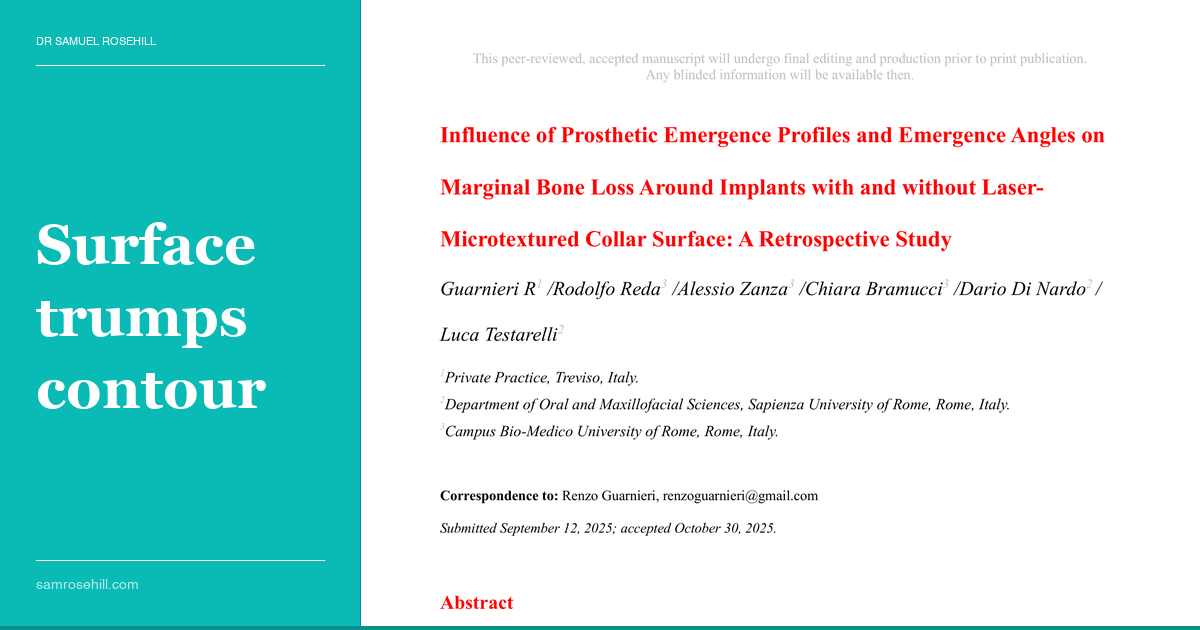
Influence of Prosthetic Emergence Profiles and Emergence Angles on Marginal Bone Loss Around Implants with and without Laser-Microtextured Collar Surface: A Retrospective Study
There is a particular flavour of clinical anxiety that arrives at the moment you’re designing the emergence profile on an anterior implant crown. Too convex and you’re compressing the soft tissue into submission; too wide an emergence angle and you’re practically inviting crestal bone to pack its bags. The textbooks are very clear about this. What they’re less clear about is whether the implant collar surface might quietly be doing more work than the contour you’ve spent twenty minutes agonising over.
Guarnieri and colleagues from Sapienza University of Rome and a private practice in Treviso have explored precisely this question in Influence of Prosthetic Emergence Profiles and Emergence Angles on Marginal Bone Loss Around Implants with and without Laser-Microtextured Collar Surface, a retrospective study comparing BioHorizons Laser-Lok (LMS) implants against their standard-collar siblings (noLMS) over up to a decade of clinical function.
The Data Anchor
The study evaluated 90 patients with 90 bone-level implants — 45 LMS and 45 noLMS — all restored with single screw-retained crowns in the molar region. The minimum observation period was 5 years, with a mean follow-up of 7.3 years and a maximum of 11.3 years. Emergence angle was dichotomised as narrow (≤ 30°) or wide (> 30°), and emergence profile was classified as concave, straight, or convex. Marginal bone loss was measured radiographically using standardised long-cone technique with customised film holders, and a single calibrated examiner performed all measurements (kappa = 0.937). The LMS implants featured a 1.8 mm high laser-ablated collar with 8-micron microgrooves; the noLMS implants had a resorbable blast-textured surface for 1.5 mm with 0.3 mm of machined collar.
Key Findings
- LMS implants showed significantly less mean marginal bone loss than noLMS — 0.8 mm versus 1.7 mm over the observation period (P = 0.017), with a cumulative success rate of 97.7% versus 91.1% (P < 0.05).
- For noLMS implants, emergence contour mattered enormously — narrow EA (≤ 30°) with concave EP produced the lowest bone loss (~1.4 mm), while wide EA (> 30°) with convex EP produced the highest (~2.2 mm), with statistically significant differences between groups (P = 0.002–0.007).
- For LMS implants, emergence profile and angle had no significant effect on bone loss — all four EP/EA combinations produced statistically comparable MBL values (P = 0.058–0.087), suggesting the laser-microtextured surface creates a soft tissue attachment that overrides contour-related risk.
- The honest limitation: this is a single-practice retrospective study with all implants placed by one surgeon. There is no randomisation, no blinding, and the sample — while followed for an impressive duration — represents a specific clinical context (molar region, screw-retained crowns) that may not generalise to anterior aesthetics cases.
The emergence profile literature has spent years telling clinicians that contour is destiny. This study suggests that for one particular surface treatment, destiny has a workaround.
💡 The Clinical Bottom Line
If you’re placing bone-level implants with a laser-microtextured collar surface, the data here suggest you can design the emergence profile based on soft tissue aesthetics and hygiene access without the usual anxiety about marginal bone consequences — the surface treatment appears to create a connective tissue seal robust enough to tolerate wider angles and convex contours. For standard-collar implants, however, the old rules still apply: keep the emergence angle at or below 30 degrees and favour concave profiles if bone preservation is the priority. The uncomfortable implication is that implant collar design may be doing more for long-term bone stability than the hours we spend perfecting the crown contour above it.
Dr Samuel Rosehill is a general dentist with a prosthodontic focus, practising at Ethical Dental in Coffs Harbour, NSW. He holds a BDSc (Hons) from the University of Queensland, an MBA, an MMktg, and an MClinDent in Fixed & Removable Prosthodontics (Distinction) from King’s College London.
Reference: Guarnieri, R. et al. Influence of Prosthetic Emergence Profiles and Emergence Angles on Marginal Bone Loss Around Implants with and without Laser-Microtextured Collar Surface: A Retrospective Study. Int J Prosthodont. 2025. https://doi.org/10.11607/ijp.9631
Clinical Relevance
Over up to 10 years, laser-microtextured collar implants showed half the marginal bone loss of standard implants (0.8 mm vs 1.7 mm) and were unaffected by emergence profile or angle — suggesting the surface treatment creates a soft tissue seal robust enough to override prosthetic contour effects.
Disclosure: The author has no financial conflicts of interest related to the products or topics discussed in this review. This is an independent summary prepared for educational purposes.
Continue the conversation
This review is also published on Substack, where you can leave comments and join the discussion.
Read on Substack →