Five Risk Factors That Predict Marginal Bone Loss Around Implant Prostheses
A multifactorial analysis of 404 implants identifies deep probing, absent keratinised mucosa, microgap abutments, inadequate transmucosal height, and periodontitis history as the key drivers of peri-implant bone loss.
Five risks, one maintenance checklist
Source Paper
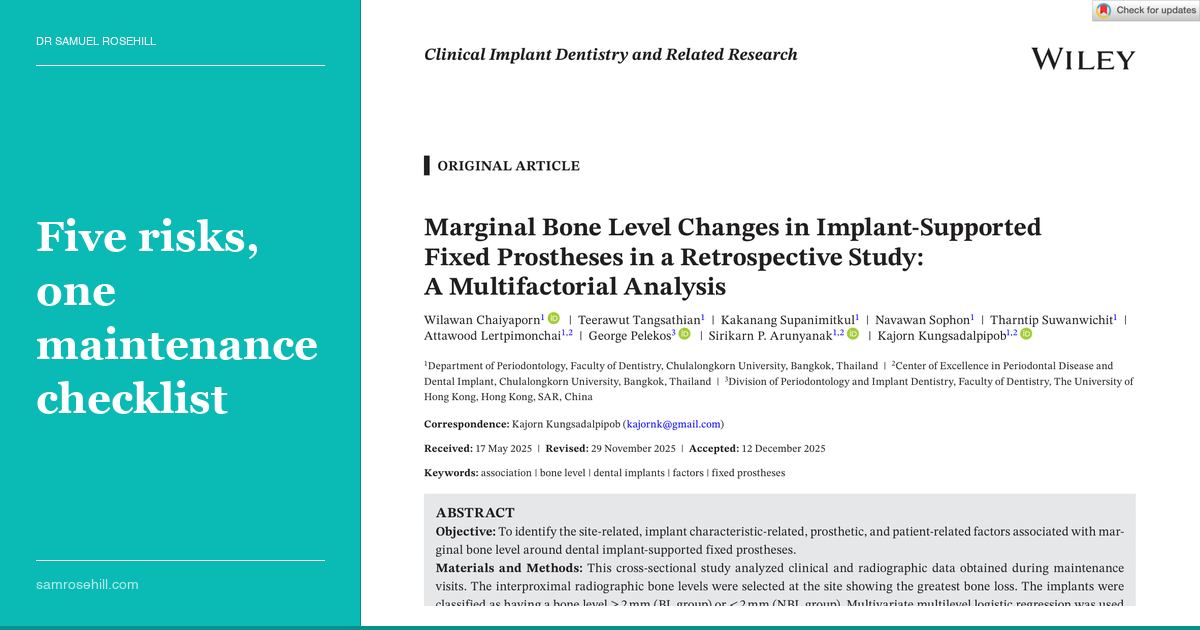
Marginal Bone Level Changes in Implant-Supported Fixed Prostheses in a Retrospective Study: A Multifactorial Analysis
We can place an implant with sub-millimetre accuracy using a digitally planned surgical guide, restore it with a CAD/CAM abutment milled to micron tolerances, and then watch the crestal bone quietly disappear over five years because nobody measured the keratinised mucosa width at the maintenance visit. Chaiyaporn and colleagues, in “Marginal Bone Level Changes in Implant-Supported Fixed Prostheses in a Retrospective Study: A Multifactorial Analysis” (Clinical Implant Dentistry and Related Research, 2026), have done what remarkably few studies attempt: they examined site-related, implant-related, prosthetic, and patient-related factors simultaneously, in a single multivariate model, to determine which combination of variables actually predicts clinically significant bone loss around implant-supported fixed prostheses. The result is a five-item risk checklist that every maintenance appointment should probably run through.
The Data Anchor
This cross-sectional study analysed clinical and radiographic data from 196 subjects with 404 implants, collected during periodontal maintenance visits at Chulalongkorn University. The mean follow-up was 5.21 years. Interproximal radiographic bone levels were measured at the site of greatest bone loss, and implants were classified into a bone loss group (BL, ≥ 2 mm) or a no bone loss group (NBL, < 2 mm). The ≥ 2 mm threshold was chosen following the Romandini et al. 2020 definition, which identifies moderate or severe peri-implantitis when combined with bleeding on probing. A multivariate multilevel logistic regression model accounted for the nested structure of multiple implants within patients, adjusting for a comprehensive range of covariates across four domains.
Key Findings
- Transmucosal height < 2 mm carried the highest adjusted odds ratio at 4.79 (95% CI 1.85–12.41, p = 0.001), making inadequate prosthetic vertical dimension the strongest prosthetic predictor of bone loss
- Probing depth ≥ 6 mm was the strongest site-level risk factor (adjusted OR 5.39, 95% CI 1.21–24.06, p = 0.027), though the wide confidence interval reflects the relatively small number of deep pockets in the cohort
- Absence of keratinised mucosa increased risk 3.54-fold (95% CI 1.11–11.28, p = 0.033), consistent with prior evidence that the soft tissue barrier matters more than many clinicians acknowledge
- Implant-abutment microgap — the butt-joint connection placing bacteria adjacent to bone — was associated with 2.82 times the risk (95% CI 1.12–7.12, p = 0.028), reinforcing the platform-switching rationale
- History of periodontitis remained significant at OR 2.80 (95% CI 1.08–7.24, p = 0.034), even after adjusting for all other variables
- Notably, implant type, length, diameter, position, bleeding on probing, plaque, and smoking were not independently significant in the multivariate model — a reminder that univariate associations can mislead when confounders are properly controlled
What makes this study particularly useful is its insistence on examining everything at once. Individual risk factors for peri-implant bone loss are well documented; the question of which ones survive when they are all competing in the same statistical model is far more clinically informative.
💡 The Clinical Bottom Line
At every maintenance visit, five things deserve your attention: probe the sulcus (flag anything ≥ 6 mm), check the keratinised tissue width, review the prosthetic transmucosal height, confirm whether the connection design has a microgap, and note the patient’s periodontal history. If three or more of these risk factors are present, that implant is not just being monitored — it is being watched. The data here suggest that bone loss around implant prostheses is not a mystery; it is a checklist waiting to be used.
Dr Samuel Rosehill is a general dentist with a prosthodontic focus, practising at Ethical Dental in Coffs Harbour, NSW. He holds a BDSc (Hons) from the University of Queensland, an MBA, an MMktg, and an MClinDent in Fixed & Removable Prosthodontics (Distinction) from King’s College London.
Reference: Chaiyaporn W, et al. Marginal Bone Level Changes in Implant-Supported Fixed Prostheses in a Retrospective Study: A Multifactorial Analysis. Clin Implant Dent Relat Res. 2026;28:e70115. DOI: 10.1111/cid.70115
Clinical Relevance
Clinicians now have a concise, evidence-weighted checklist of five modifiable and patient-related risk factors for peri-implant bone loss — each with a specific odds ratio — to guide prosthetic design decisions, maintenance protocols, and early risk stratification at the treatment planning stage.
Disclosure: The author has no financial conflicts of interest related to the products or topics discussed in this review. This is an independent summary prepared for educational purposes.
Continue the conversation
This review is also published on Substack, where you can leave comments and join the discussion.
Read on Substack →