Angled Screw Channels Deliver Parity — But Not Dominance — in the Aesthetic Zone
A 2025 systematic review and meta-analysis of four controlled trials (167 implant crowns) finds that angled-screw-channel-retained implant crowns in nonmolar sites produce comparable marginal bone levels, probing depths, and aesthetic scores to cement-retained crowns, with the one notable advantage being a statistically significant reduction in bleeding on probing.
Parity, with less bleeding
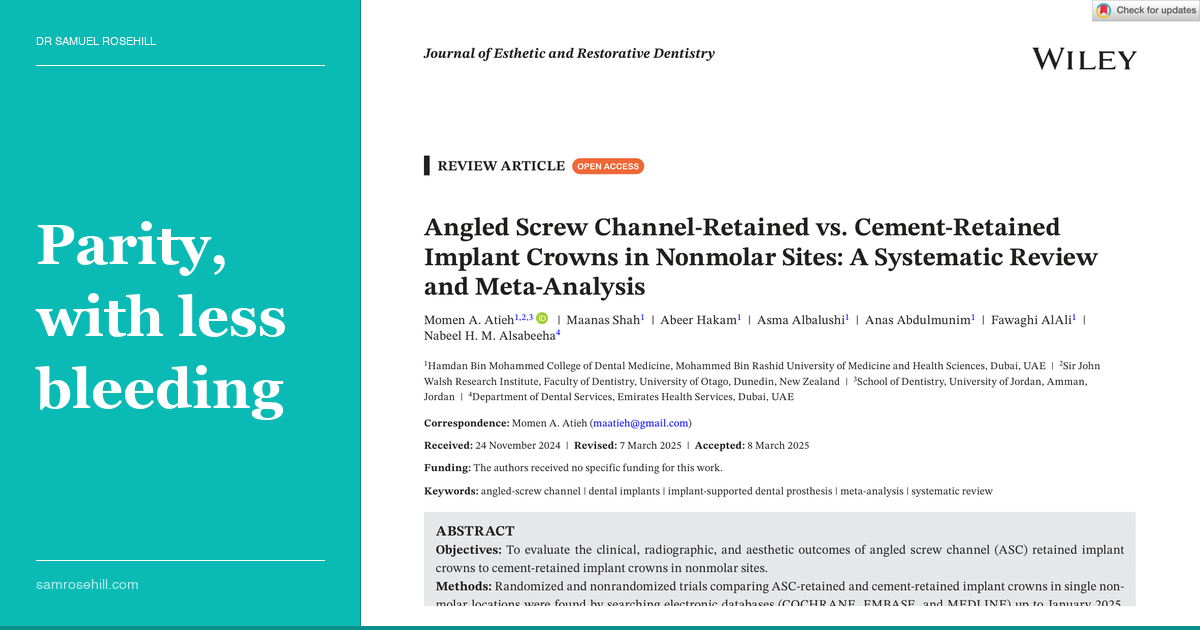
Source Paper
Angled Screw Channel-Retained vs. Cement-Retained Implant Crowns in Nonmolar Sites: A Systematic Review and Meta-Analysis
Subgingival cement excess has a well-established relationship with peri-implant inflammation — incidence rates for peri-implant mucositis sit around 43%, peri-implantitis around 22% — and the prosthetic logic of screw retention as the safer alternative is not in serious dispute. The difficulty has always been anatomical: in the anterior maxilla, a buccal screw-access hole is approximately as welcome as a grub screw in the middle of a Wedgwood plate. The angled screw channel (ASC) abutment was prosthodontics’ answer, redirecting the access hole up to 25° off-axis to land at the cingulum instead. “Angled Screw Channel-Retained vs. Cement-Retained Implant Crowns in Nonmolar Sites: A Systematic Review and Meta-Analysis,” published in the Journal of Esthetic and Restorative Dentistry in 2025 by Atieh, Shah, Hakam, and colleagues at Mohammed Bin Rashid University and the University of Otago, asks whether the clinical outcomes of ASC actually justify the switch.
The Data Anchor
Searching COCHRANE, EMBASE, MEDLINE, and ClinicalTrials.gov to January 2025, the review sifted 973 studies down to four eligible trials: one RCT (Lv et al., 2021) and three nonrandomised studies, collectively enrolling 167 patients with 167 nonmolar implant crowns (90 ASC-retained, 77 cement-retained). Follow-up ranged from 12 to 44 months; all four studies used the NobelProcera ASC system. Random-effects meta-analyses were run in RevMan 5.3; GRADE criteria applied throughout.
The primary outcome, marginal bone level change, was numerically trivial and statistically null: MD −0.03 mm (95% CI −0.12 to 0.06; p = 0.57), I² = 0%. Both groups lost under half a millimetre; clinically unremarkable at one to four years.
Key Findings
- Marginal bone level: no significant difference (MD −0.03 mm, p = 0.57). GRADE: moderate certainty.
- Bleeding on probing: ASC wins, significantly. MD −16.58% (95% CI −24.35 to −8.82; p < 0.0001); I² = 0%. The most biologically coherent explanation is the absence of residual subgingival cement in the ASC group. GRADE: moderate certainty.
- Probing pocket depth: no significant difference (MD −0.11 mm, p = 0.18).
- Pink aesthetic score: no significant difference (MD −0.18, p = 0.61), though substantial heterogeneity was present (I² = 71%). GRADE: low certainty.
- White aesthetic score: no significant difference (MD −0.07, p = 0.67; two studies only). GRADE: very low certainty.
- Technical complications: numerically higher with ASC (screw loosening, porcelain fracture) but not statistically so (RR 1.44; p = 0.57). Thinner porcelain in the ASC design is the proposed mechanism for the fracture signal.
- Implant failure: zero in both groups across all four studies.
- Limitation: four studies, three nonrandomised, with follow-up mostly at 12 months. Whether the bleeding-on-probing advantage ultimately translates into fewer peri-implantitis diagnoses at a decade is an open question this dataset cannot answer.
The GRADE ratings are candid: only the bone level and bleeding-on-probing outcomes achieve even moderate certainty. Aesthetic score findings rest on low-to-very-low evidence and should be read accordingly.
💡 The Clinical Bottom Line
This review supports ASC-retained crowns in the anterior and premolar zones without anxiety about peri-implant health or soft tissue aesthetics. The bleeding-on-probing advantage is the most statistically robust finding, and the rationale is simple: no subgingival cement, less inflammation. The technical complication signal (porcelain fracture in particular) warrants extra thought in patients with parafunction.
What four studies and 167 crowns cannot settle is the long game. ASC earns a confident equal standing here, and for a system that began life as the answer to an ugly buccal screw hole, parity at one to four years is a reasonable first return.
Dr Samuel Rosehill is a general dentist with a prosthodontic focus, practising at Ethical Dental in Coffs Harbour, NSW. He holds a BDSc (Hons) from the University of Queensland, an MBA, an MMktg, and an MClinDent in Fixed & Removable Prosthodontics (Distinction) from King’s College London.
Clinical Relevance
ASC-retained implant crowns in nonmolar sites produce comparable short-term outcomes to cement-retained crowns for marginal bone level, probing pocket depth, and aesthetic scores (PES and WES). The one statistically significant advantage for ASC is reduced bleeding on probing, likely attributable to the absence of residual subgingival cement. Technical complications (screw loosening, porcelain fracture) were numerically higher in the ASC group but not significantly so. Clinicians can use ASC retention in challenging aesthetic-zone implant sites without compromising peri-implant health or soft tissue aesthetics, though the evidence base remains small and long-term data are lacking.
Disclosure: The author has no financial conflicts of interest related to the products or topics discussed in this review. This is an independent summary prepared for educational purposes.
Continue the conversation
This review is also published on Substack, where you can leave comments and join the discussion.
Read on Substack →