The Injection Technique That Forgot to Have Layers
A case report from the International University of Catalunya introduces a multilayer flowable injection technique using three distinct 3D-printed models and separate dentin and enamel composite shades to produce optically stratified anterior restorations without the skill demands of freehand layering.
Layered injection, single case
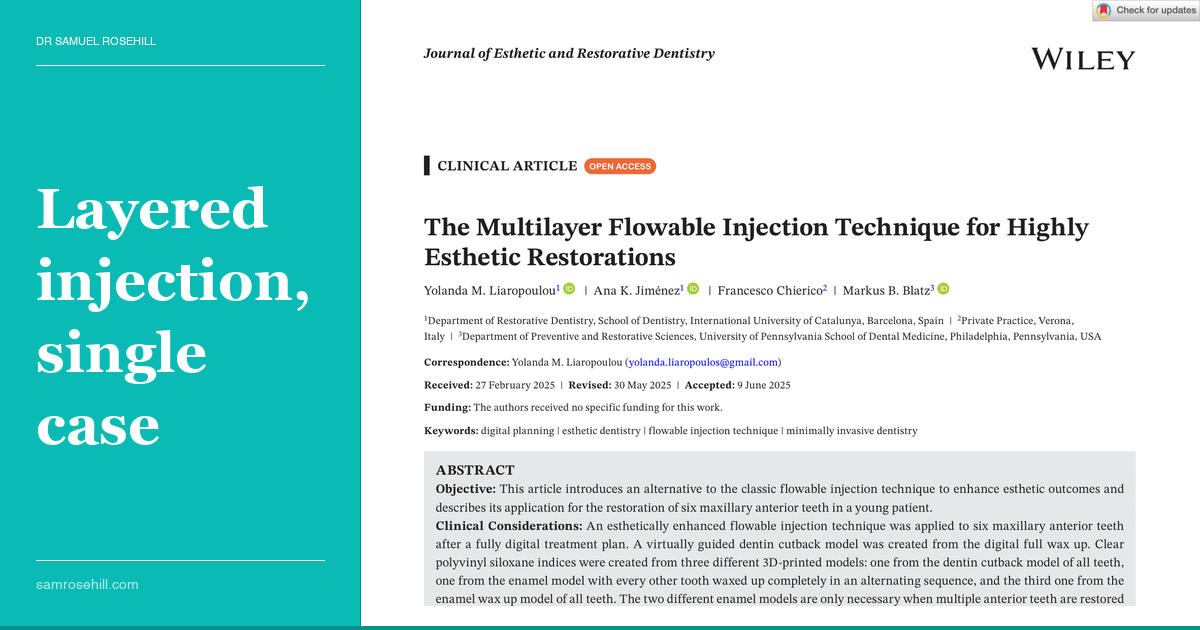
Source Paper
The Multilayer Flowable Injection Technique for Highly Esthetic Restorations
The flowable injection technique has a marketing problem with its own logic. The premise is that injecting composite into a silicone matrix from a digital wax-up gives you predictable aesthetics without the misery of freehand layering. Predictable is what it delivers.
Aesthetic, in the deeper sense, is more contested: a single shade of flowable resin injected into a tooth-shaped mould produces, reliably and precisely, a tooth-shaped monochrome restoration. Natural teeth have a dentin core, an enamel shell, and translucency gradients. They do not resemble tooth-shaped monochrome restorations.
“The Multilayer Flowable Injection Technique for Highly Esthetic Restorations,” by Liaropoulou, Jiménez, Chierico, and Blatz from the International University of Catalunya and the University of Pennsylvania, identifies this optical gap and documents a solution in one thoroughly photographed case.
The Data Anchor
The patient was a 23-year-old woman dissatisfied with the shape and size of her maxillary anterior teeth. Pre-operative records included intraoral scans and cone beam computed tomography (CBCT), which revealed altered passive eruption (APE): bone levels less than 2 mm apical to the cemento-enamel junction (CEJ). Guided crown-lengthening surgery spanned right to left first molar, using a 3D-printed perioguide. After 6 months, the restorative phase began.
Three distinct 3D-printed resin models drove the workflow: a dentin cutback model, a full-contour enamel model with alternating teeth, and a full-contour enamel model of all teeth. Three transparent polyvinyl siloxane (PVS) matrices (Matrix Flow 70 Clear, anax dent, Stuttgart, Germany) were made from these, with incisal access holes for the composite syringe.
The composite system offered separate dentin (Dentin A1, anax dent) and enamel (Enamel A1 S57, anax dent) shades at different opacities, verified with cross-polarised photography. The adhesive protocol used 53 μm aluminium oxide abrasion, 30-second orthophosphoric acid etch, and Optibond FL (Kerr, California). Three sequential injections followed: dentin across all six teeth, then enamel on alternating teeth, then the remaining three. At the 3-year follow-up, the authors report satisfactory esthetic integration with slight, expected gloss loss that repolishing readily addresses.
Key Findings
- The core innovation is structural. The single-shade injection technique fails optically because varying composite thickness over dentin creates unpredictable colour; the multilayer approach eliminates that by injecting each shade into a matrix designed specifically for its optical layer.
- The dentin injection covers all six teeth at once — no alternating-tooth strategy is needed at that stage because no interproximal contacts yet exist. Alternating matrices are reserved for the enamel steps where contact control matters.
- Digital cutback design happens entirely in computer-aided design (CAD) software, with the laboratory producing both full-contour and cutback models. The PVS matrices transfer this fidelity directly to the mouth.
- Rubber dam isolation is not feasible with this technique; sulcular fluid control is a genuine clinical constraint.
- This is a single case report (n = 1) with 3-year follow-up. No controlled clinical data, no survival curves, no comparative aesthetics scores. The authors explicitly state that calling this a “new standard” requires validation through long-term clinical studies.
💡 The Clinical Bottom Line
For a patient who cannot afford ceramic veneers but wants more than a monochromatic composite makeover, this workflow is worth understanding. The preparation demands are genuinely minimal; here, only old composite restorations were removed and line angles rounded. The optical logic is sound: design the dentin, design the enamel, inject them in sequence. One well-documented case with 3-year photographs is a proof of concept, not clinical evidence.
The technique’s real contribution may be conceptual: it makes the optical anatomy of a tooth the starting point of a digital design, rather than a hoped-for accident of freehand artistry.
Dr Samuel Rosehill is a general dentist with a prosthodontic focus, practising at Ethical Dental in Coffs Harbour, NSW. He holds a BDSc (Hons) from the University of Queensland, an MBA, an MMktg, and an MClinDent in Fixed & Removable Prosthodontics (Distinction) from King’s College London.
Clinical Relevance
The multilayer flowable injection technique uses three separate polyvinyl siloxane matrices derived from distinct 3D-printed models to inject separate dentin and enamel-shade composites in sequence. This produces optical stratification that the single-shade flowable technique cannot achieve, without requiring freehand layering skill. The current evidence is a single case report with a 3-year follow-up; controlled clinical data do not yet exist to validate long-term durability claims.
Disclosure: The author has no financial conflicts of interest related to the products or topics discussed in this review. This is an independent summary prepared for educational purposes.
Continue the conversation
This review is also published on Substack, where you can leave comments and join the discussion.
Read on Substack →