The Cylinder Nobody Thinks About: 3D-Printed Direct-to-MUA Components Streamline All-On-X Provisionalisation
A case report from Queiroz et al. describes replacing titanium temporary cylinders with 3D-printed resin components bonded directly to multi-unit abutments in a fully guided dual-arch All-On-X reconstruction, completing surgery and prosthetic delivery in four hours — addressing a well-documented failure point at the resin-to-titanium interface.
Resin cylinder, no titanium needed
Source Paper
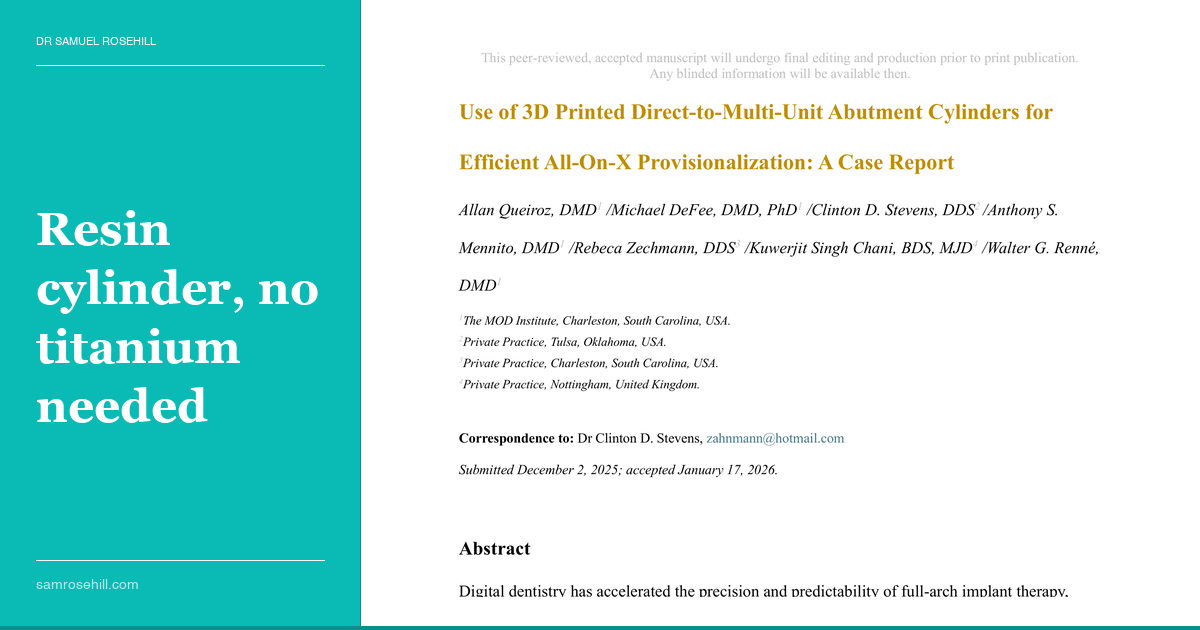
Use of 3D Printed Direct-to-Multi-Unit Abutment Cylinders for Efficient All-On-X Provisionalization: A Case Report
Every full-arch implant reconstruction relies on a small, structurally thankless part that nobody plans the case around: the temporary cylinder. It is the unremarkable titanium sleeve that links the provisional bridge to the multi-unit abutment, invisible and entirely taken for granted, right up until the provisional fractures away from it at the resin-to-titanium join. That failure tends to arrive at an awkward moment, weeks into healing, sending the patient back to the chair and the clinician back to the same tired question: why does the bond at that particular interface keep letting go?
Use of 3D Printed Direct-to-Multi-Unit Abutment Cylinders for Efficient All-On-X Provisionalization: A Case Report, published in the International Journal of Periodontics and Restorative Dentistry by Queiroz, DeFee, Stevens and colleagues, proposes a structurally significant substitution: replace the titanium temporary cylinder with a 3D-printed resin component made from the same material as the provisional. The logic is chemical. Resin bonds to resin; titanium does not reliably, and after ageing the primer-assisted bond degrades substantially, with fracture clustering predictably at that interface.
The Data Anchor
This is a single case report (n = 1) with one-week follow-up. The authors are explicit: this is technique-sharing, not outcomes data. The patient was a 55-year-old male with generalised stage IV periodontal disease, multiple non-restorable teeth, and bilateral posterior support loss. Treatment: complete dual-arch All-On-X rehabilitation.
A four-part stackable surgical guide was designed in Exocad Exoplan 3.1 (Align Technology): a metal-printed base with bone-reduction capability, a tooth-borne positioning guide, a metal-sleeved implant guide, and a prosthetic guide for intraoperative positioning. Jaw segmentation used an artificial intelligence (AI)-assisted program (Relu CBCT Segmentation). Both arch provisionals were pre-fabricated in OnX Tough 2.0 resin on a SprintRay Pro 2 printer. The novel direct-to-multi-unit abutment (MUA) cylinder was printed from the same resin, with geodesic macro-retentive features on its external surface to maximise mechanical interlocking with pickup composite. Surface preparation: 50-micron aluminium oxide air abrasion at 2 bar for 10 seconds, followed by Quick Up adhesive (Voco). Implants (Uris, TruAbutment) achieved insertion torque greater than 32 N·cm. Surgery-to-delivery: approximately four hours.
Key Findings
- Resin-to-resin bonding removes the degradation-prone interface. Traditional titanium temporary cylinders require alloy primers to bond to resin provisionals; that bond weakens with ageing, and fracture concentrates predictably at the cylinder-prosthesis junction. Same-material cylinders eliminate the mismatch.
- Preserved structural bulk at screw channels. Conventional titanium pickup requires large channel preparations in the provisional, thinning the structure at a high-stress zone. The printed cylinder, designed around the screw-access geometry, maintains material thickness there.
- No same-day design or printing required. Photogrammetry-based digital conversion adds more than an hour and demands on-site printers, curing equipment, and a designer booked for surgery day. This workflow uses entirely pre-fabricated components.
- Limitation — single case, one week. How these cylinders perform over weeks of occlusal loading compared to titanium is entirely unknown. Durability studies are the necessary next step.
Tooth-coloured resin cylinders also eliminate grey titanium show-through under thin provisional material in the buccal corridor — a small thing, but one fewer variable when managing appearance expectations on the day of surgery.
💡 The Clinical Bottom Line
For clinicians in a guided All-On-X workflow with pre-fabricated provisionals, this substitution is conceptually tidy. The resin-to-titanium bond failure at the provisional interface is a recognised, recurring problem; matching cylinder and prosthesis material addresses it at the chemistry level rather than with progressively more elaborate primers.
What this single case cannot provide is any evidence of longevity. The titanium temporary cylinder has decades of clinical use behind it. The printed resin version has four hours and a one-week check-up. That is not a reason to dismiss the concept; it is a reason to read the durability study carefully when it arrives.
Dr Samuel Rosehill is a general dentist with a prosthodontic focus, practising at Ethical Dental in Coffs Harbour, NSW. He holds a BDSc (Hons) from the University of Queensland, an MBA, an MMktg, and an MClinDent in Fixed & Removable Prosthodontics (Distinction) from King’s College London.
Clinical Relevance
This case report describes a fully guided dual-arch All-On-X reconstruction using novel 3D-printed direct-to-multi-unit abutment (MUA) temporary cylinders fabricated from the same OnX Tough resin as the provisional prosthesis. By eliminating titanium temporary cylinders, the technique avoids the resin-to-titanium bond degradation that contributes to provisional fracture at that interface, increases material bulk around screw channels, and removes the need for same-day printing or digital conversion. The entire surgical and prosthetic workflow was completed in four hours for one patient with one-week follow-up — preliminary, technique-sharing evidence that durability data will need to follow.
Disclosure: The author has no financial conflicts of interest related to the products or topics discussed in this review. This is an independent summary prepared for educational purposes.
Continue the conversation
This review is also published on Substack, where you can leave comments and join the discussion.
Read on Substack →