Mill It Low for Strength, High for Looks
Imaemporn and colleagues milled 80 strength-gradient multilayer zirconia crowns from four depths within the same KATANA YML disc, with and without simulated five-year ageing, finding crowns cut from the lower, stronger region resisted significantly higher fracture forces and failed in milder modes than those from the translucent top — though every group still survived well beyond physiological bite force.
Lower block, stronger crown
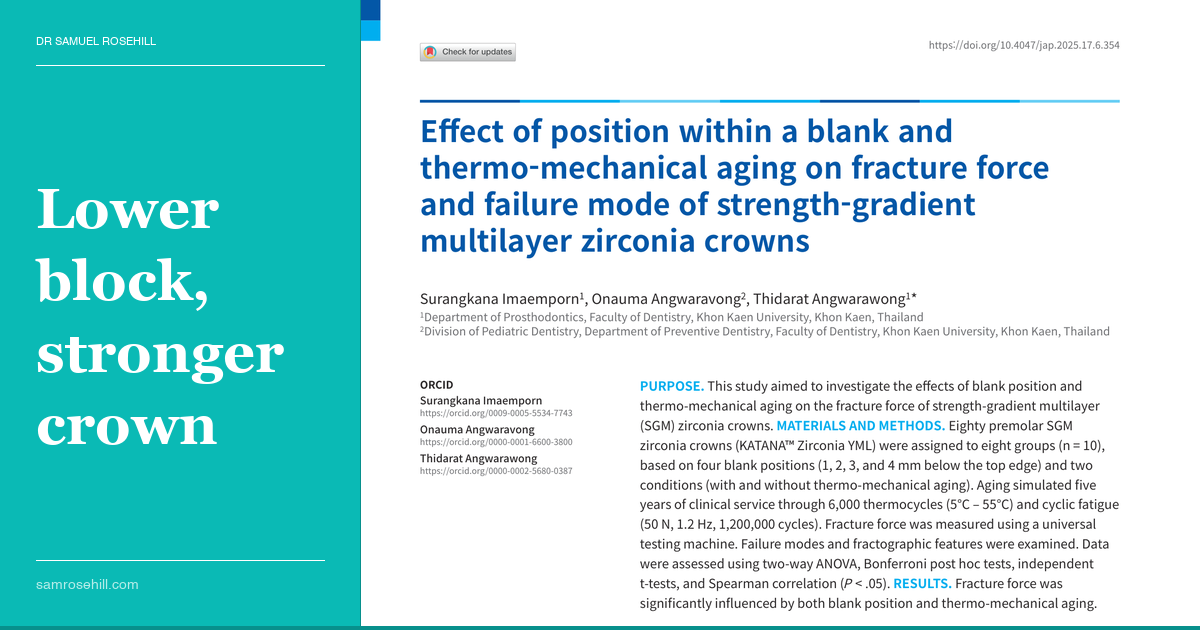
Source Paper
Effect of position within a blank and thermo-mechanical aging on fracture force and failure mode of strength-gradient multilayer zirconia crowns
A strength-gradient multilayer zirconia disc is a stack of strata. The bottom layer is dense, tough, and plain; the top is translucent and pretty and rather weaker; the middle is a negotiated blend of the two. When the milling software nests your crown into that disc, it is also, without announcing it, choosing which strata your crown will be cut from. Most of us never see that decision, let alone question it.
Effect of position within a blank and thermo-mechanical aging on fracture force and failure mode of strength-gradient multilayer zirconia crowns, published by Imaemporn and colleagues in the 2025 Journal of Advanced Prosthodontics, asks what that invisible decision costs. The short answer: where the crown sits in the block significantly changes both how strong it is and how badly it breaks.
The Data Anchor
The team milled 80 premolar crowns from a single multilayer material (KATANA Zirconia YML), drawing them from four depths (1, 2, 3, and 4 mm below the top edge of the disc) and splitting each depth into aged and unaged halves (n = 10). Ageing meant 6,000 thermocycles plus 1.2 million fatigue cycles at 50 N, a stand-in for roughly five years of service. Each crown was then loaded until it fractured.
Depth mattered, and significantly (P < .001). Mean fracture force climbed steadily from the top of the disc to the bottom: 2531 N at 1 mm, rising to 3509 N at 4 mm in the unaged crowns. Ageing pulled every group down (P < .001); the weakest of all, the aged top-of-block crowns, still managed 2138 N. The upper-region crowns also failed worse, producing the severe, catastrophic fracture modes, while the lower-region crowns mostly cracked in repairable ones — a substantial negative correlation between depth and failure severity (rs = -0.59).
Key Findings
- Lower in the block means stronger. Fracture force rose steadily with depth; the bottom region produced the toughest crowns, the translucent top the weakest.
- It also means safer failures. Upper-region crowns broke in severe, catastrophic modes; lower-region crowns stayed in the repairable Burke classes (Modes I to III).
- Ageing is real and universal. Five simulated years cut fracture force at every depth, and coarsened the failure modes along with it.
- But nobody is actually at risk. Even the weakest aged crowns exceeded 2000 N, well above average chewing (about 322 N) and even bruxism forces (around 660 N). This is an optimisation, not a rescue.
- It is in vitro and single-brand. One material (KATANA YML), perpendicular loading only, and 3D-printed resin dies rather than teeth. The mechanism is sound; the exact numbers are brand-specific.
💡 The Clinical Bottom Line
The practical move is one you make on the lab prescription, not at the chair: for a posterior crown, or any crown destined for a bruxer — ask that it be milled from the lower, stronger region of the multilayer disc. For an anterior unit where translucency is the whole point, the upper region is the right trade. The same disc gives you either crown; the only variable is where it is nested.
None of this should frighten anyone away from multilayer zirconia, since every crown in the study survived forces it will almost never meet in a mouth. But strength here is free if you ask for it, and forfeited by default if you do not.
Dr Samuel Rosehill is a general dentist with a prosthodontic focus, practising at Ethical Dental in Coffs Harbour, NSW. He holds a BDSc (Hons) from the University of Queensland, an MBA, an MMktg, and an MClinDent in Fixed & Removable Prosthodontics (Distinction) from King’s College London.
Clinical Relevance
In strength-gradient multilayer zirconia, a crown's mechanical fate is partly set by where in the disc it is nested. Crowns milled from the lower 3-4 mm (richer in high-strength 3Y-TZP) resisted significantly higher fracture forces and failed in more repairable modes than crowns from the translucent upper 1-2 mm. For posterior or bruxer crowns, prioritise the lower block region for strength; reserve the upper, more translucent region for anterior aesthetic units. Every position still exceeded normal and parafunctional bite forces in vitro, so this is an optimisation, not a safety threshold.
Disclosure: The author has no financial conflicts of interest related to the products or topics discussed in this review. This is an independent summary prepared for educational purposes.
Continue the conversation
This review is also published on Substack, where you can leave comments and join the discussion.
Read on Substack →