The Composite That Breaks Better
Fernández and colleagues systematically review 28 studies on short fibre-reinforced composites in large posterior and endodontically treated teeth, finding consistently higher fracture resistance and more repairable failure patterns in the laboratory, but no clear clinical superiority over conventional composite across follow-ups of up to four years.
Tougher in vitro, evidence thin
Source Paper
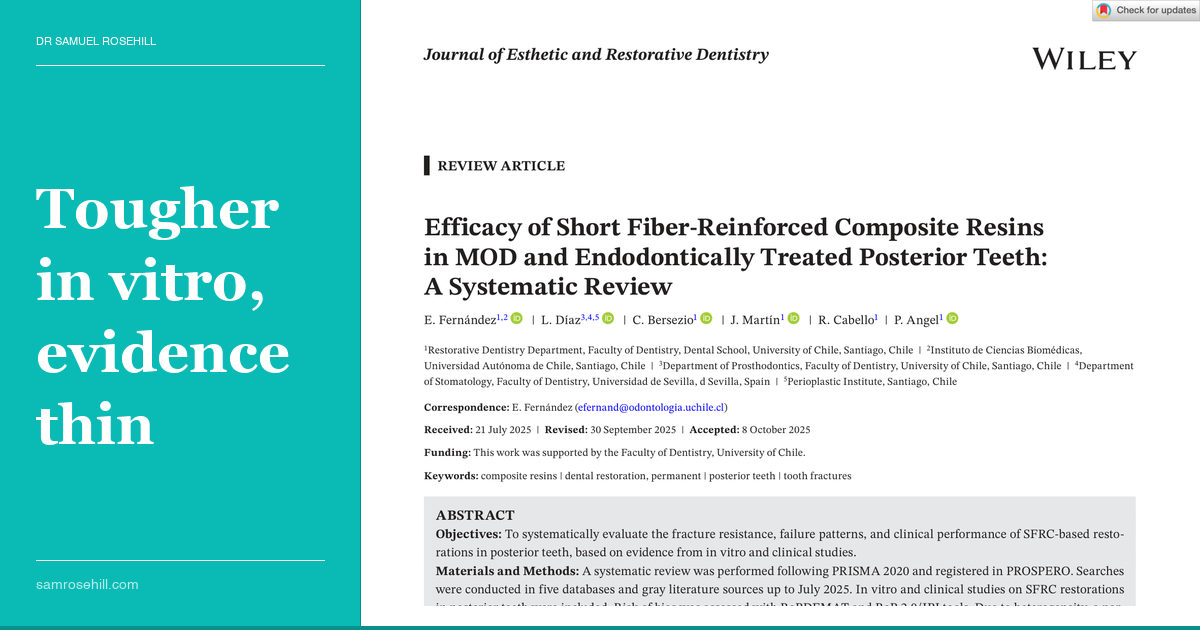
Efficacy of Short Fiber-Reinforced Composite Resins in MOD and Endodontically Treated Posterior Teeth: A Systematic Review
The most useful thing about short fibre-reinforced composite is not that it is stronger than ordinary composite, though it usually is. It is that it breaks differently. A conventional composite in a battered molar tends to fail the way a dropped plate fails: completely, and often taking a cusp with it. Put a core of randomly oriented glass fibres underneath, and the crack has to negotiate its way around them, which more often leaves you a fracture you can actually repair.
That distinction sits at the centre of Efficacy of Short Fiber-Reinforced Composite Resins in MOD and Endodontically Treated Posterior Teeth: A Systematic Review, published by Fernández and colleagues in the 2026 Journal of Esthetic and Restorative Dentistry. They pooled the evidence on short fibre-reinforced composites (SFRCs) in large mesio-occluso-distal (MOD) and endodontically treated posterior teeth, and the headline is a familiar one in dentistry: the laboratory is convinced, and the mouth is still waiting for proof.
The Data Anchor
The review followed PRISMA and gathered 28 studies, 23 in vitro and 5 clinical. The materials, cavities, and test rigs varied so widely that no meta-analysis was possible, so the synthesis is narrative.
In the laboratory, the pattern is consistent. Bijelic-Donova reported bilayered SFRC molar restorations failing at 2889 N against 1966 N for conventional composite; Lassila’s plain SFRC crowns reached the highest load in the set at 3866 N. Across MOD models the fibre-reinforced groups generally cleared the commonly cited 1200 N benchmark and, more to the point, produced a larger share of repairable rather than catastrophic fractures.
The clinic is the more cautious story. Survival ran from 78.6% for everX Posterior in endodontically treated molars at three years to 100% retention in two- and one-year trials, but in none of the controlled trials did SFRC convincingly beat conventional composite. One four-year study even logged secondary caries in 18.2% of SFRC restorations against zero for ceramic endocrowns, a difference that did not reach significance (p = 0.515) but is not nothing.
Key Findings
- The real advantage is failure mode, not raw strength. Across in vitro studies, fibre cores shifted fractures toward the repairable, leaving more tooth to restore again rather than extract.
- As a dentin replacement, it earns its place. The benefit is clearest when SFRC sits as a base layer under a conventional composite surface in large MOD or endodontically treated teeth, not as a one-shot bulk material used everywhere.
- Clinically, it matches rather than beats. Out to four years, survival and marginal outcomes were comparable to conventional composite; no trial showed clear superiority.
- Watch the margins. The lone secondary-caries signal (18.2% in one four-year cohort) is a reminder that a tougher core does not police its own margins.
- The evidence is thin and low-certainty. Five clinical studies, a maximum four-year follow-up, and no meta-analysis. The in vitro confidence outruns the clinical proof.
💡 The Clinical Bottom Line
Tomorrow morning, the sensible use of short fibre-reinforced composite is narrow and specific: as a dentin-replacing base in the big, structurally compromised posterior cases where a catastrophic fracture would cost you the tooth. There the failure-mode advantage is worth having, and the laboratory data are genuinely reassuring.
What the evidence does not yet support is treating it as a longevity upgrade you can promise a patient. On current trials it survives about as well as the composite you already use; its case rests on how it fails — not on how long it lasts. That is a real benefit, but a more modest one than the marketing suggests.
Dr Samuel Rosehill is a general dentist with a prosthodontic focus, practising at Ethical Dental in Coffs Harbour, NSW. He holds a BDSc (Hons) from the University of Queensland, an MBA, an MMktg, and an MClinDent in Fixed & Removable Prosthodontics (Distinction) from King’s College London.
Clinical Relevance
Short fibre-reinforced composite used as a dentin-replacing base layer reliably raises fracture resistance in vitro and shifts failures toward repairable rather than catastrophic patterns, which matters most in large MOD and endodontically treated posterior teeth. Clinically, however, survival and marginal outcomes so far match conventional composite rather than beating it, on low-certainty evidence with a maximum four-year follow-up. It is reasonable to adopt as a base layer in high-stress cases for the failure-mode advantage, but not as a proven longevity upgrade.
Disclosure: The author has no financial conflicts of interest related to the products or topics discussed in this review. This is an independent summary prepared for educational purposes.
Continue the conversation
This review is also published on Substack, where you can leave comments and join the discussion.
Read on Substack →