The Implant Surface Paradox the Field Has Lived With for Thirty Years
A 2024 review from UCLA's Weintraub Center documents the central biological paradox of modern implantology: the microrough titanium surfaces that became the clinical standard in the 1990s halve to quarter osteoblast attachment and proliferation compared to smooth machined titanium, even as they accelerate differentiation — and the current generation of nanofeatured commercial implants has not solved it.
Nano surfaces: evolutionary, not transformative
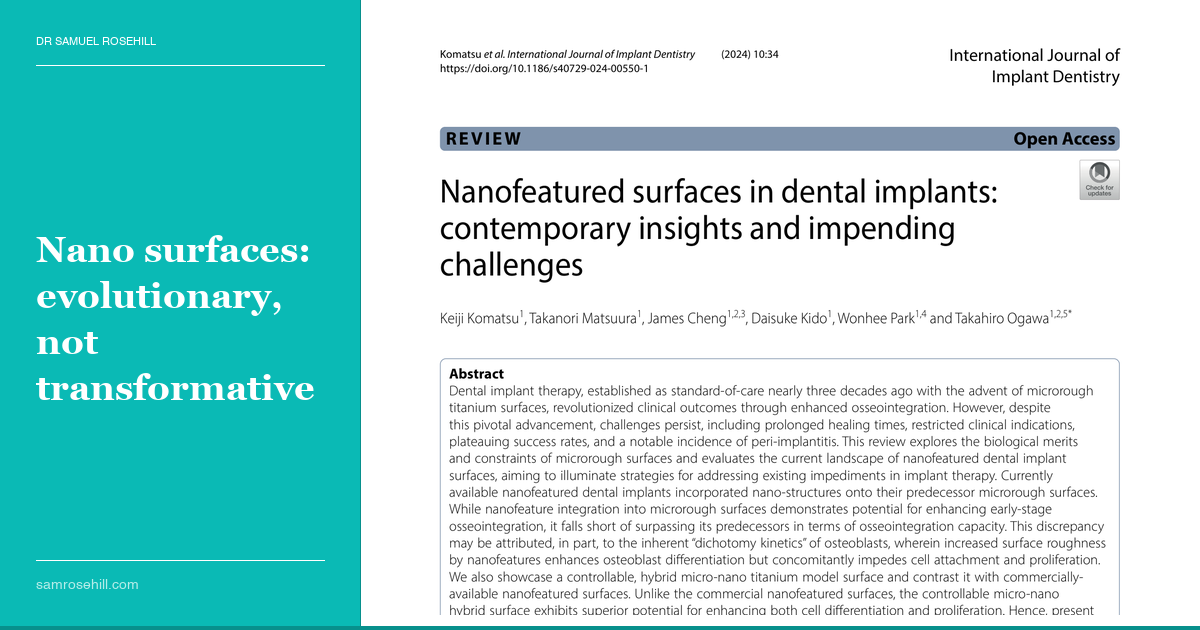
Source Paper
Nanofeatured surfaces in dental implants: contemporary insights and impending challenges
The microrough titanium surface is on virtually every implant placed today and is credited with transforming osseointegration outcomes. It also, according to the in vitro evidence, halves to quarters osteoblast attachment and proliferation relative to smooth machined titanium. The field has known this for some time and elected to live with it. “Nanofeatured surfaces in dental implants: contemporary insights and impending challenges,” published in the International Journal of Implant Dentistry in 2024 by Komatsu, Matsuura, Cheng, Kido, Park, and Ogawa at UCLA, is a thorough accounting of what that accommodation has cost.
The core problem is the “dichotomy kinetics” of osteoblasts: roughness promotes differentiation while inhibiting the proliferation that determines bone volume. Bone-implant contact for modern titanium implants plateaus between 47.8 and 75%, well below ideal; the overall implant success rate has been parked at approximately 92% for years.
The Data Anchor
Microrough acid-etched titanium permits roughly half to one-quarter the primary osteoblasts to attach compared to smooth surfaces; a study using MG63 cells found four times more adhering to machined titanium at 24 hours. Proliferation follows: machined surfaces achieve twice the BrdU incorporation at day two, with one study reporting a three-fold attachment and five-fold proliferation advantage over acid-etched surfaces.
The review then evaluates three commercially available nanofeatured implants: SLActive (Straumann), OsseoSpeed (Astra Tech), and NanoTite (Zimmer Biomet). Each adds nanostructures to an existing microrough base, with differing chemistry: NaCl on SLActive, titanium fluoride on OsseoSpeed, and discrete calcium phosphate on NanoTite. These are contrasted with a hybrid micro-nano model in which 300-nm TiO2 nanonodules self-assemble within micropits, composed entirely of titanium oxide.
Key Findings
- SLActive shows reduced cell attachment and proliferation versus standard SLA; counts were 30% lower at 24 hours. Differentiation is significantly enhanced (ALP, osteocalcin, osteoprotegerin), but the dichotomy persists. The hydrophilicity claim warrants scrutiny: the near-zero contact angle may reflect saline wetting rather than genuine surface modification.
- OsseoSpeed’s fluoride chemistry improves differentiation (elevated osteopontin at day 7), yet proliferation declined as fluorine concentration increased.
- NanoTite’s evidence base is sparse. Multiple in vivo studies show no statistically significant BIC improvement over Osseotite, or early advantages that fade by weeks six to eight.
- None of the three commercial surfaces surpasses microrough implants in final osseointegration capacity. Early-stage gains are present and clinically useful; the biological problem remains unaddressed.
- The UCLA hybrid surface achieved four-fold and two-fold greater cell attachment at 6 and 24 hours versus microrough, exceeding smooth machined titanium. Osseointegration strength in rat femurs was more than three times higher; fibroblast proliferation was selectively suppressed.
- Limitation: this surface is a research model; commercial translation is not addressed.
All three commercial surfaces deposit non-titanium oxide chemistry onto their microrough base: salt crystals, fluoride, calcium phosphate. The UCLA model adds titanium oxide only — and achieves superior results. What you add appears to matter as much as the act of adding.
💡 The Clinical Bottom Line
The three major nanofeatured systems offer genuine, if modest, improvements in early osseointegration speed. For cases requiring accelerated healing, that advantage is real. The expectation that they alter the final osseointegration ceiling should, however, be adjusted; the evidence does not support it.
The more searching implication here is that the implant field has spent three decades optimising around a constraint rather than eliminating it. A surface that simultaneously enhances proliferation and differentiation is biologically achievable — the TiO2 hybrid model shows this clearly. That commercial products have not reached it is a statement about development priorities, not about what bone can do.
Dr Samuel Rosehill is a general dentist with a prosthodontic focus, practising at Ethical Dental in Coffs Harbour, NSW. He holds a BDSc (Hons) from the University of Queensland, an MBA, an MMktg, and an MClinDent in Fixed & Removable Prosthodontics (Distinction) from King’s College London.
Clinical Relevance
Current microrough titanium implant surfaces reduce osteoblast attachment to half to one-quarter of levels seen on smooth machined surfaces, with proliferation similarly compromised. Three commercially available nanofeatured implants (SLActive, OsseoSpeed, NanoTite) offer incremental early-osseointegration improvements but do not overcome the proliferation-differentiation dichotomy or achieve meaningful gains in final BIC. A controllable hybrid micro-nano TiO2 surface demonstrated four-fold greater cell attachment at 6 hours and more than three-fold stronger osseointegration in rat femur models, pointing toward what genuinely optimised surfaces would need to achieve.
Disclosure: The author has no financial conflicts of interest related to the products or topics discussed in this review. This is an independent summary prepared for educational purposes.
Continue the conversation
This review is also published on Substack, where you can leave comments and join the discussion.
Read on Substack →