Immediate, Early or Late? The Implant Timing Map Gets Updated
Gallucci and colleagues synthesised 140 studies and 10,456 implants, showing that several placement/loading combinations are now scientifically and clinically validated while early loading remains the shakier corner of the map.
Early loading wobbles
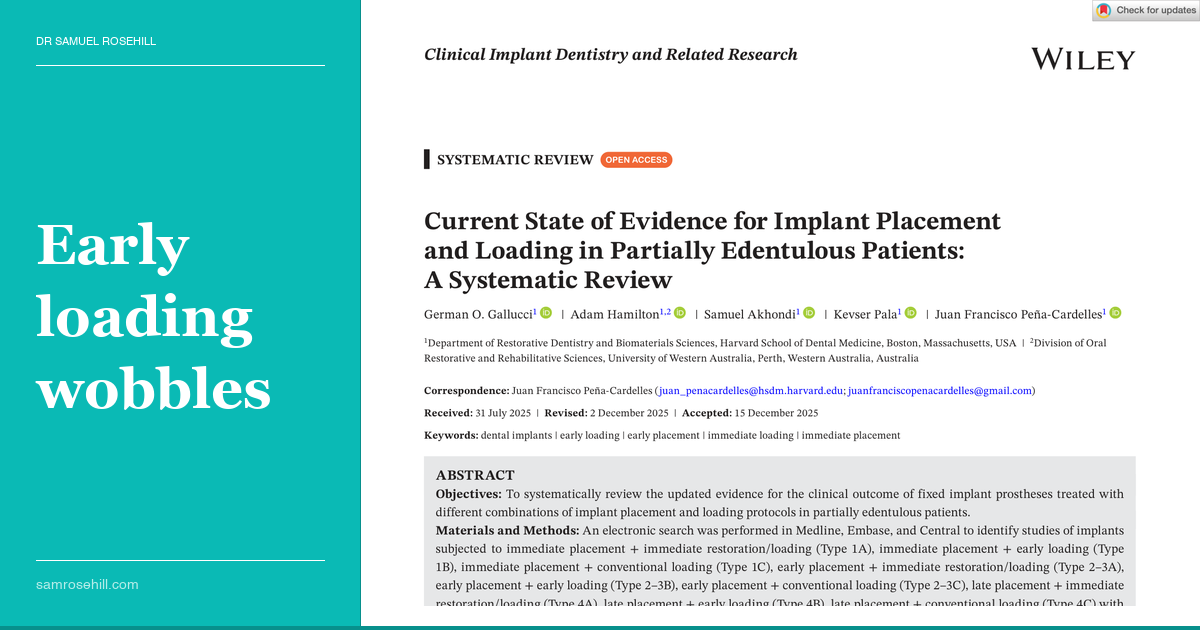
Source Paper
Current State of Evidence for Implant Placement and Loading in Partially Edentulous Patients: A Systematic Review
Implant timing used to resemble travel advice from a nervous relative: leave early, avoid risk, and under no circumstances rush the connection. Then immediate placement arrived, immediate loading followed, and the profession began collecting protocol combinations like airport lounge memberships. Current State of Evidence for Implant Placement and Loading in Partially Edentulous Patients: A Systematic Review is Gallucci and colleagues’ attempt to redraw the map. The key update is reassuring but not permissive: several faster routes are now validated, while early loading remains the lane with the most potholes.
The Data Anchor
The review searched Medline, Embase, and Central and reduced 11,427 records to 140 studies: 42 randomised controlled trials and 98 controlled clinical or cohort studies, covering 10,456 implants in partially edentulous patients. The authors classified protocols by placement timing (Type 1 immediate, Type 2-3 early, Type 4 late) and loading timing (A immediate restoration/loading, B early loading, C conventional loading).
| Type | Description |
|---|---|
| Type 1A | Immediate implant placement into the extraction socket with immediate restoration or loading |
| Type 1B | Immediate implant placement with early loading |
| Type 1C | Immediate implant placement with conventional loading after healing |
| Type 2-3A | Early implant placement after soft tissue or partial bone healing, with immediate restoration or loading |
| Type 2-3B | Early implant placement with early loading |
| Type 2-3C | Early implant placement with conventional loading |
| Type 4A | Late implant placement after complete bone healing, with immediate restoration or loading |
| Type 4B | Late implant placement with early loading |
| Type 4C | Late implant placement with conventional loading |
Survival rates were weighted by follow-up duration and implant number. The headline figures were: 98.0% for Type 1A, 91.6% for Type 1B, 95.0% for Type 1C, 97.8% for Type 2-3A, 100% for Type 2-3B, 94.0% for Type 2-3C, 97.2% for Type 4A, 97.9% for Type 4B, and 97.5% for Type 4C.
Key Findings
- Immediate placement is no longer the reckless cousin. Type 1A and Type 1C now meet scientific and clinical validation thresholds, provided case selection is strict.
- Early loading is the weak link. Type 1B fell to 91.6% survival from only 70 implants across 2 studies, and Type 2-3B remains thinly documented despite a reported 100% survival from 82 implants.
- Late placement still earns its cardigan. Type 4A, 4B, and 4C all remain scientifically and clinically validated, with survival clustered around 97%.
- Early placement has matured. Type 2-3A now shows 97.8% survival across 7 clinical trials, while Type 2-3C is validated at 94.0% across 690 implants.
- The limitation is not subtle. Heterogeneity prevented meta-analysis; success definitions, follow-up periods, prosthetic designs, grafting approaches, and reporting quality varied enough to make pooled precision look more official than it would be.
💡 The Clinical Bottom Line
The useful shift is to stop asking whether immediate implants “work” and start asking which placement-loading pair is being proposed, in which socket, for which patient, with what primary stability and prosthetic plan. The study validates speed only when biology, mechanics, and selection criteria line up.
For tomorrow’s treatment plan, Type 4C remains the conservative reference point; Type 1A and Type 1C are legitimate in carefully selected cases; Type 1B and Type 2-3B deserve the raised eyebrow usually reserved for a provisional with no occlusal clearance. Faster is sometimes fine. Biologically awkward is still biologically awkward.
Dr Samuel Rosehill is a general dentist with a prosthodontic focus, practising at Ethical Dental in Coffs Harbour, NSW. He holds a BDSc (Hons) from the University of Queensland, an MBA, an MMktg, and an MClinDent in Fixed & Removable Prosthodontics (Distinction) from King’s College London.
Clinical Relevance
Implant timing should be planned as a combined placement/loading decision, not as two independent preferences. This review supports immediate placement with immediate or conventional loading in selected cases, validates early placement with immediate or conventional restoration, and reinforces late placement protocols as the conservative benchmark.
Disclosure: The author has no financial conflicts of interest related to the products or topics discussed in this review. This is an independent summary prepared for educational purposes.
Continue the conversation
This review is also published on Substack, where you can leave comments and join the discussion.
Read on Substack →