Metal-Free, Yes. Complication-Free, No: A 10-Year Verdict on One-Piece Zirconia Implants
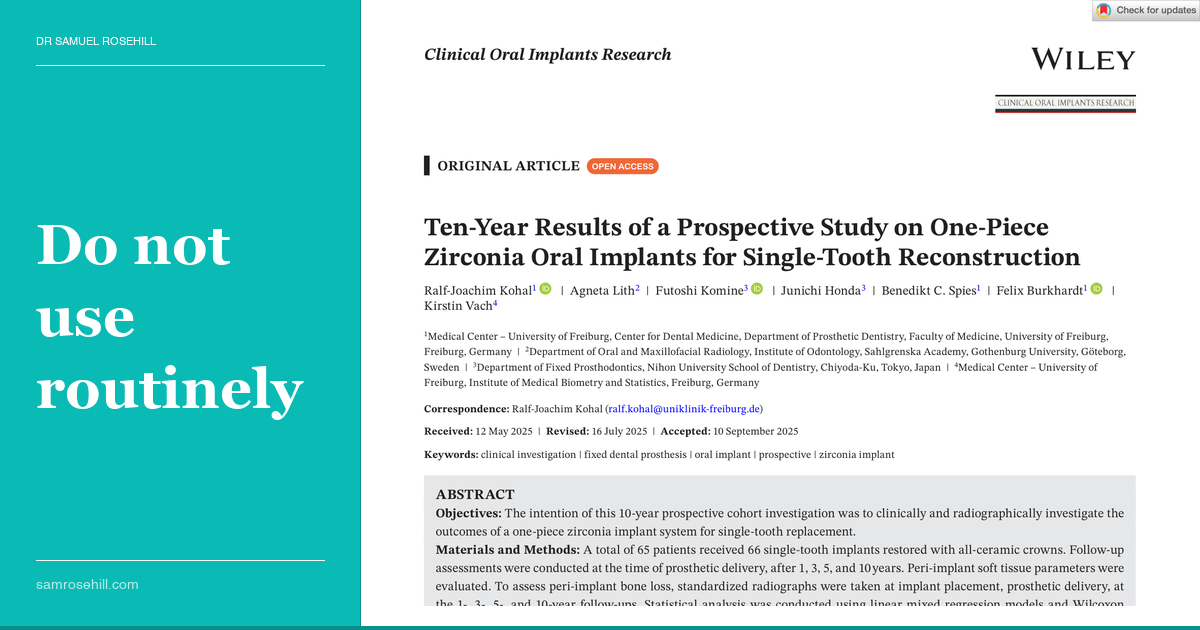
A 10-year prospective multi-centre study on one-piece 3Y-TZP zirconia implants reports a cumulative survival rate of just 73.3% and an implant success rate of 56.75%, driven largely by peri-implantitis. The authors explicitly recommend against routine clinical use of this system — a rare and important negative verdict from the researchers who ran the study.
Do not use routinely
Source Paper
Ten-Year Results of a Prospective Study on One-Piece Zirconia Oral Implants for Single-Tooth Reconstruction
The zirconia implant pitch has been running for more than a decade, and it is a good pitch. Metal-free. Biocompatible. Colour of natural tooth structure. No titanium particles to set off a macrophage cascade. The arguments accumulate with the logic of a product that has decided the evidence is behind it.
Ten-Year Results of a Prospective Study on One-Piece Zirconia Oral Implants for Single-Tooth Reconstruction, published in Clinical Oral Implants Research by Kohal, Lith, Komine and colleagues, does something academic researchers rarely do in print: it tells you to stop. Not “proceed with caution.” Not “further research is warranted.” The researchers who designed and ran this study arrive at year ten and write, plainly, that the implant system is not recommended for routine clinical use. That is a striking conclusion to reach about a product you spent a decade investigating.
The Data Anchor
A prospective cohort study across three university centres in Germany (Freiburg), Sweden (Gothenburg), and Japan (Tokyo). Sixty-five patients received 66 single-tooth implants using a conical, one-piece system fabricated from 3 mol% yttria-stabilised tetragonal zirconia polycrystal (3Y-TZP) with a porous surface (ZiUnite, Nobel Biocare AB), restored with all-ceramic crowns cemented with glass ionomer cement. Follow-up ran at prosthetic delivery and at 1, 3, 5, and 10 years.
The 10-year cumulative implant survival rate was 73.3% (95% confidence interval: 60.0%–82.8%). Sixteen of 66 implants were lost; 15 patients were lost to follow-up; 35 patients attended at year 10.
Key Findings
- 16 implants lost over 10 years. The heaviest failure cluster fell between years 3 and 5: seven implants removed for peri-implant infection, one fractured after a history of peri-implantitis.
- Mean marginal bone loss: 1.09 mm at 10 years in surviving implants. Among 34 implants with radiographic data, 7 (20.5%) exceeded 2 mm bone loss, the study’s own success threshold.
- Strict success rate: 56.75% (95% confidence interval: 41.75%–69.26%), based on probing depth ≤ 5 mm, no bleeding on probing (BOP), no suppuration, and bone loss ≤ 2 mm.
- Crown survival: 85.7%; crown success: only 11.4%. Near-universal ceramic veneer chipping by decade’s end, reflecting standard practice when the study was designed.
- Peri-implantitis drove most failures. Probing depth (PD) and BOP increased significantly at implant sites compared to reference teeth throughout the follow-up period.
- The authors implicate the porous ZiUnite surface. Low-temperature degradation (LTD), an ageing phenomenon inherent to 3Y-TZP in wet environments, likely caused the porous coating to delaminate, disrupting bone contact and releasing pro-inflammatory debris.
- Limitation: No control group, variable surgical technique, and 47% attrition by year 10 constrain the generalisability of these results.
The lower mean bone loss at year 10 (1.09 mm) than at year 3 (1.46 mm) is not recovery. It is survivorship bias: the worst-performing implants were already gone by year 5.
💡 The Clinical Bottom Line
The “not recommended” verdict belongs to this one-piece 3Y-TZP design with its porous ZiUnite surface, not to the broader zirconia implant category, which includes two-piece bone-level designs with different geometries and surface chemistries.
What it does mean is that zirconia implant marketing and zirconia implant evidence are not in the same conversation. A 73.3% survival rate at 10 years compares poorly with the 90–95% benchmark for titanium. If a patient asks about the metal-free option, the honest answer now has a very long study and a very clear conclusion behind it.
The implant field accumulates positive data with enthusiasm and negative data with reluctance. Kohal and colleagues have provided something useful: a decade of follow-up that ends not in a press release, but in a recommendation to reconsider.
Dr Samuel Rosehill is a general dentist with a prosthodontic focus, practising at Ethical Dental in Coffs Harbour, NSW. He holds a BDSc (Hons) from the University of Queensland, an MBA, an MMktg, and an MClinDent in Fixed & Removable Prosthodontics (Distinction) from King’s College London.
Clinical Relevance
After 10 years, this one-piece 3 mol% yttria-stabilised tetragonal zirconia polycrystal (3Y-TZP) implant system showed a cumulative survival rate of 73.3% (16 of 66 implants lost) and a strict success rate of 56.75%. Most failures were driven by peri-implantitis, concentrated between years 3 and 5. The authors, who ran the study, explicitly state the implant is not recommended for routine clinical use. This finding is specific to this one-piece system with its porous ZiUnite surface; it does not indict two-piece zirconia designs or the broader material category. Clinicians considering zirconia implants should distinguish system design carefully and require long-term prospective data before adoption.
Disclosure: The author has no financial conflicts of interest related to the products or topics discussed in this review. This is an independent summary prepared for educational purposes.
Continue the conversation
This review is also published on Substack, where you can leave comments and join the discussion.
Read on Substack →