Same Material, Different Planet: ZLA Surface Gives One-Piece Zirconia 97.7% Survival at 10 Years
A 10-year prospective multicentre study on the Straumann PURE Ceramic implant with a sandblasted, large-grit, acid-etched (ZLA) surface reports 97.7% survival and 91.4% success — results comparable to titanium benchmarks and in striking contrast to other one-piece zirconia systems.
97.7% survival at 10 years
Source Paper
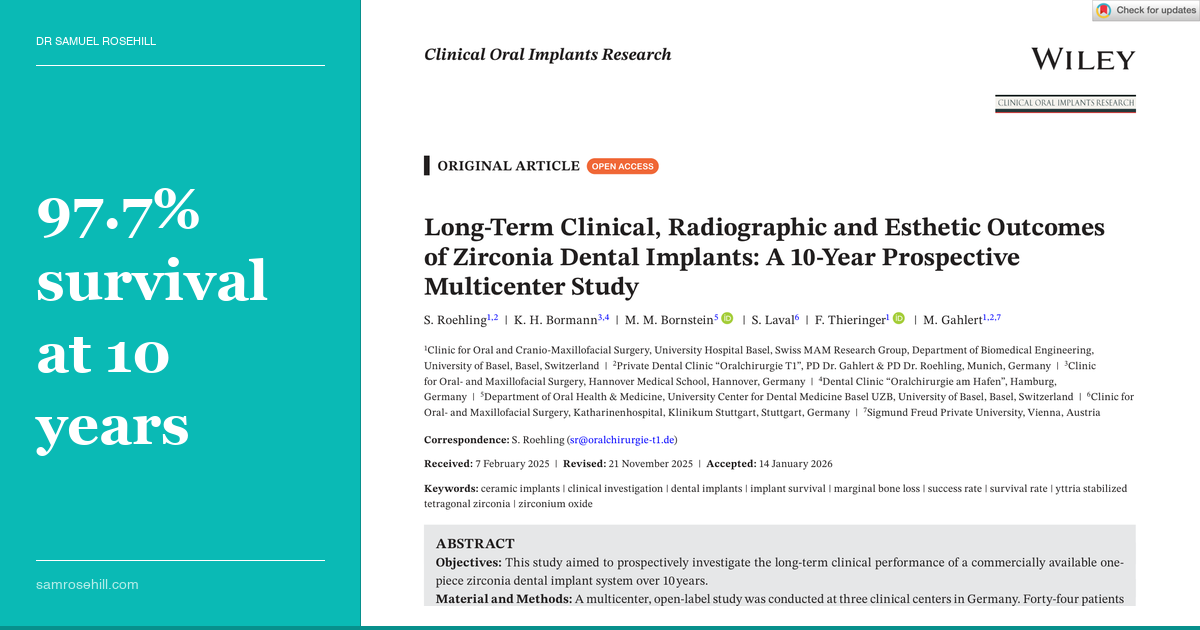
Long-Term Clinical, Radiographic and Esthetic Outcomes of Zirconia Dental Implants: A 10-Year Prospective Multicenter Study
In wine, the same grape grown in different soils produces wines so unlike that experienced tasters disagree about which grape it is. Dental implant researchers have spent two decades debating titanium versus zirconia as though the argument were settled at the elemental level. It is increasingly clear that it is not.
Long-Term Clinical, Radiographic and Esthetic Outcomes of Zirconia Dental Implants: A 10-Year Prospective Multicenter Study, published in Clinical Oral Implants Research by Roehling, Bormann, Bornstein and colleagues, reports a 10-year survival rate of 97.7% for a one-piece yttria-stabilised zirconia (Y-TZP) implant with a sandblasted, large-grit, acid-etched (ZLA) surface treatment.
Another 10-year prospective study published this year on a different one-piece zirconia system — with a porous surface coating rather than ZLA — reported 73.3% survival and concluded against routine use. Same material, same design, same decade of follow-up. The gap comes down almost entirely to what is on the surface.
The Data Anchor
Forty-four patients at three German centres received 44 one-piece Straumann PURE Ceramic implants between October 2011 and July 2012. The implants were fabricated from Y-TZP zirconia with a ZLA surface treatment and incorporated a 1.8 mm polished collar for tissue-level positioning. Implants were 4.1 mm in diameter, 8–12 mm in length. Crowns were predominantly lithium disilicate glass-ceramic or zirconia, cemented with glass ionomer.
Follow-up visits occurred at 1, 3, 5, and 10 years. By the 10-year mark, 35 patients with 35 implants remained for analysis; 9 were lost to follow-up for non-implant reasons, with no failures in that group. Survival was estimated by Kaplan-Meier method. Aesthetic outcomes used the combined Pink Esthetic Score (PES) and White Esthetic Score (WES), assessed by an independent clinician from standardised photographs.
Key Findings
- 97.7% survival at 10 years (95% confidence interval: 97.27–98.13). One implant was lost before loading, a single early failure in the anterior maxilla. No further losses over the decade.
- Success rate: 91.4% (95% CI: 76.9–97.8). Three implants developed biological complications: peri-implant mucositis (two implants, 5.7%) and peri-implantitis with radiolucency (one implant, 2.9%). All occurred in the anterior maxilla, unlinked to patient-level risk factors.
- Mean marginal bone loss: 1.20 mm ± 0.61 at 10 years, in line with titanium literature. Notably, 82.5% of that bone loss occurred within the first five years; levels stabilised thereafter.
- Aesthetic scores held. Combined PES/WES was 14.5 at both 5 and 10 years. The PES improved from 7.4 to 7.8; the WES dipped from 7.0 to 6.7, consistent with titanium comparator data.
- No implant fractures over 10 years. One ceramic crown chip, documented between years 5 and 10, was resolved.
- Limitation: n = 35 at 10 years, single-arm, no titanium control, predominantly anterior maxilla placements. Generalisability is restricted and direct material comparisons inferential.
The 20.5% dropout rate is within the range reported by comparable long-term implant studies, and no implant failures occurred in the patients who left.
💡 The Clinical Bottom Line
A 97.7% survival rate at decade puts this specific zirconia system in the same statistical range as titanium (literature benchmark: 95.1–98.9% at 10 years). The case for metal-free implants in appropriately selected patients is no longer theoretical.
What clinicians should resist is filing all one-piece zirconia implants under a single verdict. Two 10-year prospective studies of one-piece Y-TZP systems published in 2026 report outcomes that differ by 24 percentage points in survival; the variable that most plausibly explains the gap is surface treatment, not the zirconia.
For patients asking about metal-free options, the honest answer is now more precise: the ZLA surface design has the data behind it. The category label does not.
Dr Samuel Rosehill is a general dentist with a prosthodontic focus, practising at Ethical Dental in Coffs Harbour, NSW. He holds a BDSc (Hons) from the University of Queensland, an MBA, an MMktg, and an MClinDent in Fixed & Removable Prosthodontics (Distinction) from King’s College London.
Clinical Relevance
This prospective multicentre study of 44 patients receiving one-piece yttria-stabilised zirconia (Y-TZP) implants with a sandblasted, large-grit, acid-etched (ZLA) surface found a 10-year Kaplan-Meier survival rate of 97.7% and a success rate of 91.4%, with mean marginal bone loss of 1.20 mm. These results are comparable to titanium implant benchmarks in the literature. Crucially, the outcome appears heavily influenced by surface engineering: a different one-piece zirconia system with a porous surface reported only 73.3% survival over the same period in a study published the same year. Clinicians evaluating metal-free options should scrutinise the specific surface treatment, not just the material category.
Disclosure: The author has no financial conflicts of interest related to the products or topics discussed in this review. This is an independent summary prepared for educational purposes.
Continue the conversation
This review is also published on Substack, where you can leave comments and join the discussion.
Read on Substack →