Can One Retainer Carry a Molar?
Attal and colleagues describe a posterior single-retainer cantilever zirconia bridge for a missing mandibular molar and show that, in a very carefully selected case, the idea is less reckless than it sounds. The paper is only a case report, but the protocol is detailed enough to be genuinely useful.
One retainer can work
Source Paper
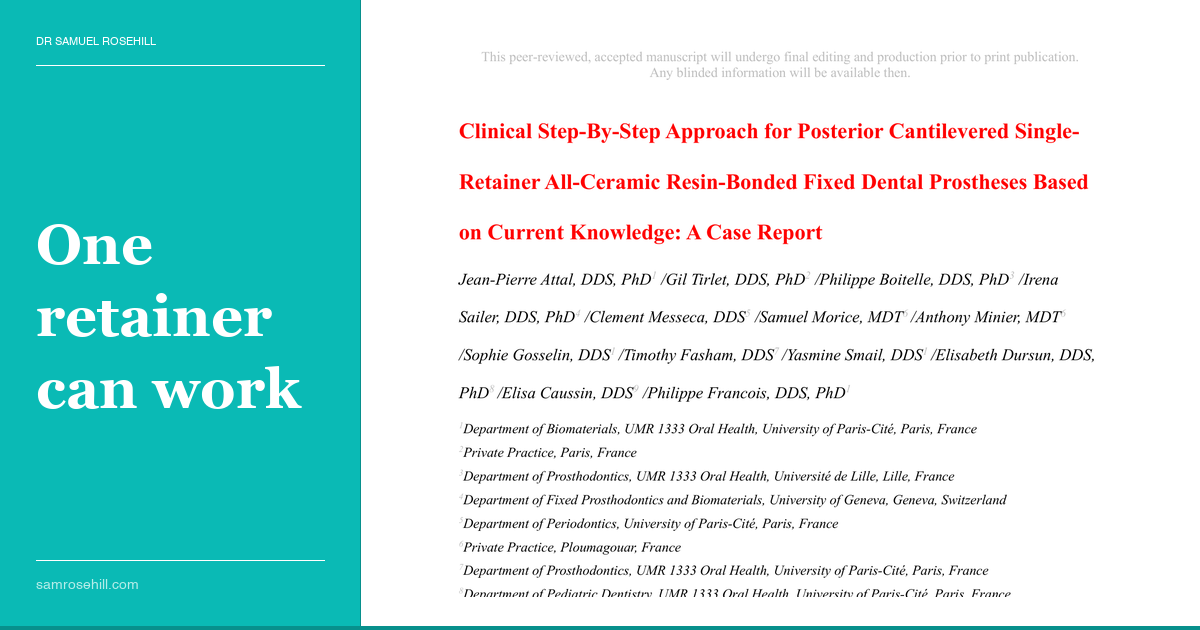
Clinical Step-By-Step Approach for Posterior Cantilevered Single-Retainer All-Ceramic Resin-Bonded Fixed Dental Prostheses Based on Current Knowledge: A Case Report
Posterior molars are, by long professional agreement, supposed to be replaced either with implants or with bridges that involve enough tooth preparation to make everyone feel industrious. The idea that one bonded piece of zirconia might hang off a single molar and manage the job has always sounded faintly like a dare. In “Clinical Step-By-Step Approach for Posterior Cantilevered Single-Retainer All-Ceramic Resin-Bonded Fixed Dental Prostheses Based on Current Knowledge: A Case Report,” Attal and colleagues argue that, in a carefully selected case, it is not a dare. It is a protocol.
This matters because posterior cantilever resin-bonded bridges have lived for years in the professional category marked interesting, but perhaps not on your patient. Anterior single-retainer bridges have respectable long-term credentials; posterior versions have heavier occlusion and much less literature behind them. So a detailed workflow for a molar replacement case, especially one for the patient who wants fixed teeth but not surgery, is useful because it forces the question into the open.
The Data Anchor
This is a case report, not a trial, and the hierarchy-of-evidence police are entitled to keep their notebook open. The patient was a 32-year-old woman missing a mandibular first molar, extracted 10 weeks earlier after endodontic-periodontal complications. Implant therapy remained the gold standard, but alveolar resorption made grafting likely and the patient declined it. The authors used the nearly intact second molar as the sole abutment and designed a posterior cantilevered single-retainer all-ceramic resin-bonded fixed dental prosthesis in 3Y-TZP zirconia with a feldspathic buccal veneer and a compressive pontic.
Preparation was kept within enamel; the intaglio surface was sandblasted with 50 μm aluminium oxide, treated with a universal primer, and luted with preheated resin composite under rubber dam using a strictly light-cured no-finishing protocol. Case selection is doing a great deal of the lifting here: no occlusal parafunction, no active periodontal disease, probing depths < 3 mm, and a very suitable abutment tooth. The broader literature the authors cite is still sparse, although one retrospective series in their introduction reported 100% survival with no debonding or fracture over a mean 53-month follow-up.
Key Findings
- This is a minimalist prosthesis with maximal dependence on selection. The site had adequate restorative space, the abutment was vital and largely intact, and the occlusion was favourable enough that a single molar retainer could be contemplated without theatre-level optimism.
- Adhesive discipline is the whole plot. The protocol relies on enamel-dominant preparation, air abrasion of the zirconia, universal priming, preheated composite, rubber dam isolation, and light-curing rather than on heroic mechanical retention.
- Early performance was tidy. Postoperative assessment showed correct seating, acceptable aesthetics, clean occlusal integration, and no excess luting material; maintenance was helped by the compressive pontic design.
- The evidence ceiling remains low. This paper follows one patient for three months. Useful protocol, yes. Proof of long-term posterior reliability, not yet.
💡 The Clinical Bottom Line
If a patient declines implant surgery, a posterior single-retainer cantilever resin-bonded bridge is not automatically eccentric; in the right mouth it may be the most conservative fixed option on the table. But the indication is narrow. You need enamel, space, periodontal stability, a compliant occlusion, and the sort of adhesive isolation that makes everyone in the room suddenly much more interested in the rubber dam.
The paper’s quiet contribution is not that it topples implants from their perch; it doesn’t. It is that it gives clinicians a worked example of how to attempt this restoration without pretending the connector geometry alone will save them. One retainer can carry a molar. It just cannot carry wishful thinking.
Dr Samuel Rosehill is a general dentist with a prosthodontic focus, practising at Ethical Dental in Coffs Harbour, NSW. He holds a BDSc (Hons) from the University of Queensland, an MBA, an MMktg, and an MClinDent in Fixed & Removable Prosthodontics (Distinction) from King’s College London.
Clinical Relevance
Posterior single-retainer cantilever RBFDPs are not routine replacements for implant therapy, but they may be defensible when a patient wants fixed treatment without surgery and the abutment tooth offers generous enamel, stable occlusion, and no parafunction. This paper is most useful as a protocol piece: enamel-limited preparation, strict adhesive isolation, and careful pontic design are doing the heavy lifting. The indication is narrow, but the option is real.
Disclosure: The author has no financial conflicts of interest related to the products or topics discussed in this review. This is an independent summary prepared for educational purposes.
Continue the conversation
This review is also published on Substack, where you can leave comments and join the discussion.
Read on Substack →