No Drill, No Implant: Zirconia Bonded Bridges Hold Up Even in Bruxists
A single-operator case series from the University of Liège reports 100% survival across 16 no-preparation zirconia cantilever resin-bonded fixed dental prostheses in 11 patients over a mean follow-up of 3.0 years — with 81% of patients exhibiting bruxism — suggesting the implant-default for young patients with congenitally missing lateral incisors deserves a harder look.
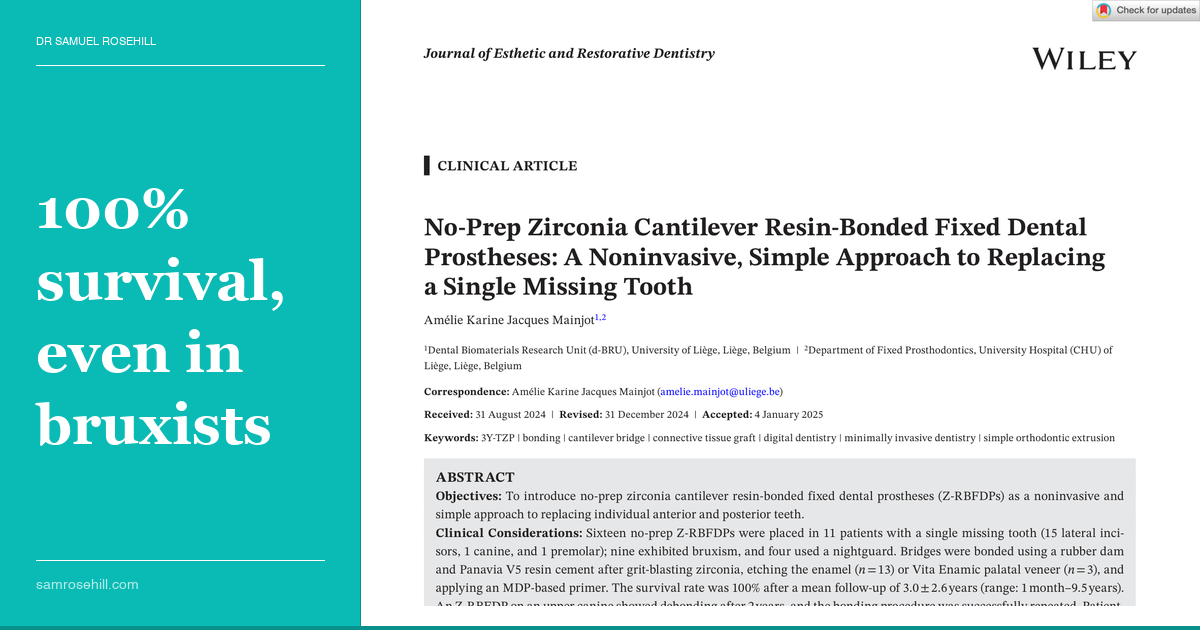
100% survival, even in bruxists
Source Paper
No-Prep Zirconia Cantilever Resin-Bonded Fixed Dental Prostheses: A Noninvasive, Simple Approach to Replacing a Single Missing Tooth
Think for a moment about the patient who has been waiting since they were twelve: lateral incisor agenesis, orthodontics finished, retainer space held open with a wire or a flipper they despise. They were told an implant would come once the bone was ready, once they were old enough. Now they are old enough and the cone beam reveals the bone is slightly narrow. The default answer has been “removable prosthesis and wait.” It serves these patients poorly.
“No-Prep Zirconia Cantilever Resin-Bonded Fixed Dental Prostheses: A Noninvasive, Simple Approach to Replacing a Single Missing Tooth,” published in the Journal of Esthetic and Restorative Dentistry in 2025 by Amélie Mainjot at the University of Liège, presents a case series of 16 no-preparation Z-RBFDPs in 11 patients. The results are more persuasive than the acronym.
The Data Anchor
The 11 patients (mean age 26.3 years; range 19.2–63.3) were mostly referred by dental surgeons or orthodontists because implants were contraindicated: insufficient bone width, angulated adjacent roots, or simply age. The series comprised 17 missing teeth (15 upper and lower lateral incisors, 1 canine, 1 premolar) replaced by 16 prostheses — including one double-retainer bridge replacing two lower laterals simultaneously. Mean follow-up was 3.0 ± 2.6 years, with the longest case reaching 9.5 years.
The figure that commands attention: 81.3% of restorations were placed in patients with clinical bruxism (13 of 16), and only four patients wore a nightguard. Bruxism is, in the conventional teaching of resin-bonded bridges, a relative-to-absolute contraindication. The bonding protocol was meticulous regardless: grit-blasting with 50-μm alumina at 2.5 bar, MDP-based ceramic primer, Panavia V5 under rubber dam, and phosphoric acid etching of enamel. The material was 3Y-TZP zirconia (Prettau 1 or 2, Zirkonzahn) in 15 of 16 cases.
Key Findings
- Survival rate: 100% across all 16 restorations over a mean follow-up of 3.0 ± 2.6 years (max 9.5 yr).
- One debond, fully recovered: the canine bridge (bruxism, no nightguard, canine guidance on the pontic) debonded at 2 years. Bonding was repeated; the restoration held for a further 6.5 years. The author identifies a retainer-wing design error retrospectively.
- Patient satisfaction was high: a questionnaire across 5 patients (8 restorations) returned 5/5 for aesthetics and function. Non-surgical treatment scored 4.25/5 vs implant surgery.
- Limitation — single operator, small n: this is a proof-of-principle case series from the technique’s originator. Posterior applications have even less data; long-term studies with larger cohorts are needed.
💡 The Clinical Bottom Line
For the young patient with lateral agenesis who has been waiting, the no-prep Z-RBFDP is a serious option. Bonded correctly (grit-blasting, MDP primer, rubber dam, Panavia V5, 3Y-TZP zirconia), these restorations held in a cohort where eight in ten patients had bruxism. The one failure was re-bondable, and it held.
The abutment tooth is untouched throughout — and that matters. If the bridge eventually fails, conventional options remain open. There are very few restorative decisions that preserve every future pathway; this is one of them.
What this paper asks us to change is not technique but reflex. “Too young for an implant” has defaulted too readily to “removable prosthesis and wait.” Mainjot’s 9.5-year case is a quiet argument that it does not have to.
Dr Samuel Rosehill is a general dentist with a prosthodontic focus, practising at Ethical Dental in Coffs Harbour, NSW. He holds a BDSc (Hons) from the University of Queensland, an MBA, an MMktg, and an MClinDent in Fixed & Removable Prosthodontics (Distinction) from King’s College London.
Clinical Relevance
For young patients with congenitally missing maxillary laterals who are not yet implant candidates — or who decline surgery — no-prep zirconia cantilever RBFDPs bonded with Panavia V5 after grit-blasting and MDP primer appear to perform comparably to prepared variants in the short term. Bruxism, present in over 80% of this series, did not cause catastrophic failure. One debond on a canine bridge was successfully re-bonded and held for a further 6.5 years. Use 3Y-TZP (not high-translucent) zirconia; posterior applications and longer follow-up remain under-studied.
Disclosure: The author has no financial conflicts of interest related to the products or topics discussed in this review. This is an independent summary prepared for educational purposes.
Continue the conversation
This review is also published on Substack, where you can leave comments and join the discussion.
Read on Substack →