The Numbers Against the Default: Why Lateral Incisor Implants Deserve a Second Opinion
A 2025 narrative review by Robbins, Alvarez, and Tokutomi in the International Journal of Periodontics and Restorative Dentistry compiles longitudinal implant-failure data for the anterior maxilla and argues the zirconia single-wing resin-bonded bridge — not the implant — should be the first-line protocol for missing maxillary lateral incisors in most patients.
Implant not the default here
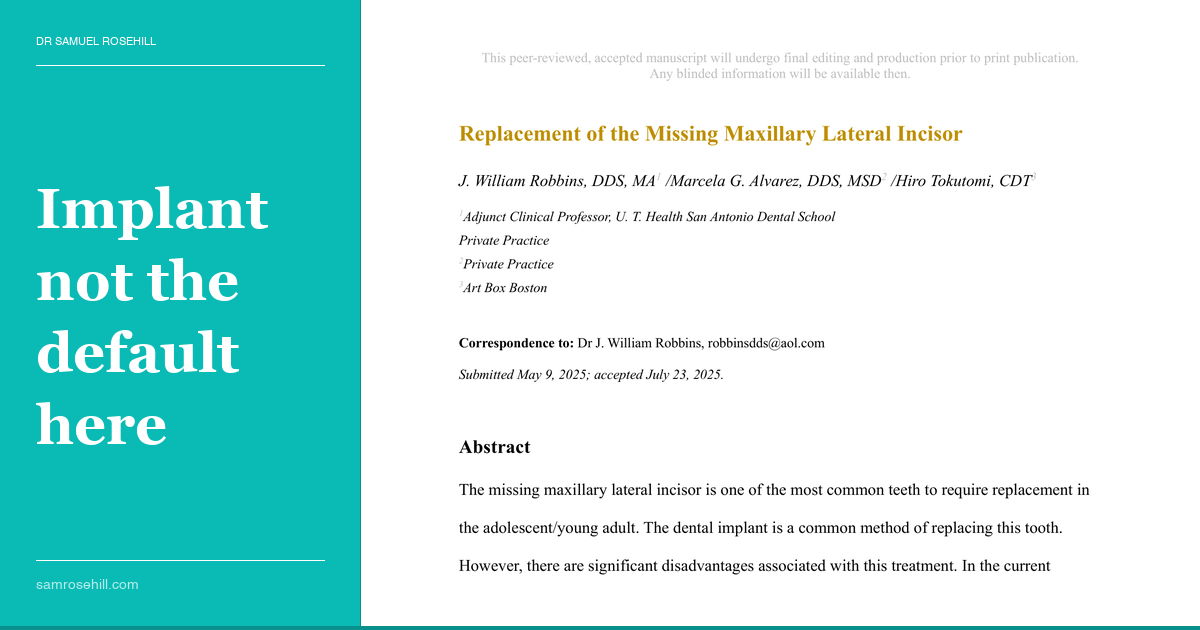
Source Paper
Replacement of the Missing Maxillary Lateral Incisor
Consider the arithmetic before the default. Infraocclusion in 58% of anterior maxillary implants at eight years; 30% with greater than one millimetre of drop at 14-to-20-year follow-up. Peri-implantitis in roughly 22% by systematic review. SSRI users failing at 12.5% versus 3.3% in non-users. Proton pump inhibitors, low vitamin D, clindamycin, azithromycin: each associated with early failure. And the profession has been recommending this site, in this age group, as routine.
“Replacement of the Missing Maxillary Lateral Incisor,” published in the International Journal of Periodontics and Restorative Dentistry in 2025 by Robbins, Alvarez, and Tokutomi, assembles the longitudinal case against implant-as-default for this site, then details what to do instead. The core argument fits on a business card: an implant placed at twenty must function for eight decades. The data suggest, with uncomfortable regularity, that it won’t.
The Data Anchor
Infraocclusion is the problem that accumulates most persuasively. Chang’s eight-year retrospective reported it in 58% of cases; Winitsky et al.’s 14-to-20-year follow-up found greater than 1 mm infraocclusion and palatal movement in 30%, with dolichocephalic growth the greatest risk factor. No occlusal appliance prevents it. The mechanism is straightforward: teeth move with the bone; the implant does not.
The drug data is newer and more actionable. Chrcanovic et al. reported a 12.5% early failure rate in SSRI users versus 3.3% in non-users. A systematic review found a 7.5% increased early failure rate in the same group. Clindamycin and azithromycin — the alternatives a surgeon reaches for in a penicillin-allergic patient — are themselves associated with elevated early failure. Sidestepping one risk may install another.
Key Findings
- Infraocclusion in 30–58% of anterior maxillary implants at 8–20 years, across both young and mature adult cohorts.
- Peri-implantitis ~22% (Derks and Tomasi); over an 80-year prosthetic horizon, that is not a manageable baseline.
- Medication interactions are under-screened. SSRIs, PPIs, low vitamin D, clindamycin, and azithromycin each associate with early failure; cumulative risk in a medicated young adult is poorly characterised.
- Two alternatives advanced: canine substitution (cervical width under 8 mm, acceptable colour, protractive orthodontics planned) and the one-wing 3Y zirconia resin-bonded bridge bonded to enamel, with canine preferred as abutment.
- Material specification matters: 3Y zirconia at 1,194 MPa versus 688 MPa for 5Y zirconia and 450 MPa for lithium disilicate. Groove preparation for anti-rotation; unbonded pontic extension onto the central incisor.
- Illustrative case: 30-year-old female, failed implants replaced with one-wing zirconia bonded bridge after connective tissue grafting. Stable at 18 months.
- Limitation: narrative review with one case report; protocol recommendations are expert opinion.
💡 The Clinical Bottom Line
The authors state it plainly: the implant in the anterior maxilla should be a secondary option when the alternatives are not viable or have failed. For a site where the implant has been the reflexive answer for thirty years, this asks for a recalibration starting at the orthodontic planning stage.
The one-wing zirconia bridge is not provisional and not a consolation. Bonded to enamel, seated with a groove preparation, placed on the canine with an unbonded anti-rotation extension, fabricated in 3Y zirconia with a glass ceramic veneer — it is, in appropriate cases, the primary strategy. The connective tissue graft three months before preparation and the bonded lingual wire stabilising the central incisors post-orthodontics are protocol steps, not refinements.
There is no evidence an occlusal appliance prevents implant infraocclusion. There is, however, a prosthetic strategy that sidesteps the problem entirely.
Dr Samuel Rosehill is a general dentist with a prosthodontic focus, practising at Ethical Dental in Coffs Harbour, NSW. He holds a BDSc (Hons) from the University of Queensland, an MBA, an MMktg, and an MClinDent in Fixed & Removable Prosthodontics (Distinction) from King’s College London.
Clinical Relevance
For missing maxillary lateral incisors, the one-wing 3Y zirconia resin-bonded bridge bonded to the canine (not the central incisor) with a groove preparation for anti-rotation should be considered first-line, not provisional. Implants in this site carry infraocclusion rates of 30–58% over 8–20 years, peri-implantitis in ~22%, and substantially elevated failure risk in patients taking SSRIs, PPIs, or clindamycin/azithromycin. Canine substitution remains an excellent second option when the canine cervical width is under 8 mm, colour is appropriate, and protractive orthodontics are planned. Reserve implants for cases where these alternatives are genuinely not viable.
Disclosure: The author has no financial conflicts of interest related to the products or topics discussed in this review. This is an independent summary prepared for educational purposes.
Continue the conversation
This review is also published on Substack, where you can leave comments and join the discussion.
Read on Substack →