Primary Stability Is Not the Whole Story
Gill and colleagues use a mandibular minipig overpreparation model to test whether implants can osseointegrate despite near-absent primary stability, finding 100% survival under submerged, controlled healing.
Stability isn't everything
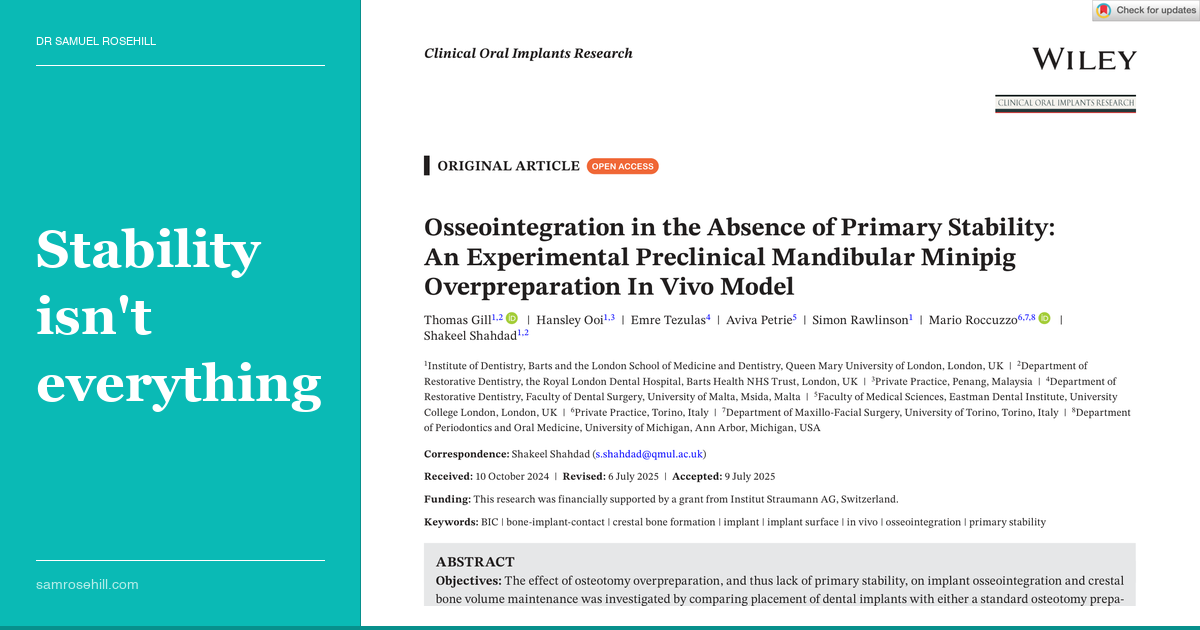
Source Paper
Osseointegration in the Absence of Primary Stability: An Experimental Preclinical Mandibular Minipig Overpreparation In Vivo Model
Primary stability has enjoyed a long career as implant dentistry’s stern parent. It stands in the doorway with an Implant Stability Quotient (ISQ) score, asking where you have been and whether you intend to load that fixture immediately. Gill and colleagues’ Osseointegration in the Absence of Primary Stability: An Experimental Preclinical Mandibular Minipig Overpreparation In Vivo Model is interesting because it does not politely nod at that parent. It asks whether the rule is really primary stability, or whether the deeper biological demand is protection from harmful movement during healing.
That distinction matters. One is a number at insertion. The other is a healing environment — and bone has always been more interested in the second one.
The Data Anchor
The investigators placed 60 bone-level implants in the mandibles of 15 minipigs, using either a normal preparation (Group 1) or an overprepared osteotomy (Group 2). The implants were 3.3 mm in diameter; the overprepared final osteotomy was 3.5 mm, deliberately larger than the implant. Healing was submerged for 2 and 8 weeks.
The stability contrast was stark. Mean insertion ISQ was 69.35 for normal preparation (95% CI, 68.02 to 70.68) and 11.95 for overpreparation (95% CI, 10.53 to 13.37; P < 0.001). In ordinary clinical language, one group had respectable mechanical confidence and the other had the social presence of a tent peg in custard.
Yet all implants survived histological assessment. Total bone-to-implant contact (tBIC) did not differ significantly at 2 or 8 weeks. In the coronal 2 mm, overprepared implants showed more coronal bone-to-implant contact (cBIC), with a 41.29% mean difference at 2 weeks (P < 0.001) and 42.86% at 8 weeks (P = 0.005). Bone area to total area (BATA) was also higher with overpreparation at both time points.
Key Findings
- Very low ISQ did not prevent osseointegration in this model. The overprepared group averaged 11.95 ISQ units at insertion yet still achieved 100% survival.
- Total integration was similar. tBIC showed no significant difference between normal and overprepared osteotomies at 2 or 8 weeks.
- Coronal bone behaviour was unexpectedly favourable. Overprepared implants had higher cBIC and more coronal bone volume measures.
- The study points at micromotion, not bravado. These implants healed submerged and unloaded in a controlled animal model.
- The caveat is enormous. This is not a clinical licence to accept a mobile implant in a human patient, especially if immediate or early loading is planned.
💡 The Clinical Bottom Line
The gold standard principle may need sharper wording. Primary stability is useful because it helps control movement during healing; it may not be the biological magic in itself.
For clinicians, this paper is less a permission slip than a conceptual tidy-up. The implant does not care whether our insertion number feels reassuring. Bone cares whether the healing interface is protected long enough to become bone.
Dr Samuel Rosehill is a general dentist with a prosthodontic focus, practising at Ethical Dental in Coffs Harbour, NSW. He holds a BDSc (Hons) from the University of Queensland, an MBA, an MMktg, and an MClinDent in Fixed & Removable Prosthodontics (Distinction) from King’s College London.
Clinical Relevance
This preclinical minipig model challenges the simple idea that primary stability itself is the biological requirement for osseointegration. Under submerged, unloaded healing, implants placed into overprepared osteotomies with very low ISQ values still osseointegrated and showed more coronal bone apposition. Clinically, the paper should refine thinking about micromotion control, not encourage deliberately unstable implant placement.
Disclosure: The author has no financial conflicts of interest related to the products or topics discussed in this review. This is an independent summary prepared for educational purposes.
Continue the conversation
This review is also published on Substack, where you can leave comments and join the discussion.
Read on Substack →