Implant Stability and Bone Contact: When the Numbers Don't Tell the Whole Story
Chang et al. find no correlation between directional ISQ values and bone-to-implant contact in a cadaver study — suggesting the reassuring beep from your Osstell is measuring implant shoulder engagement, not total osseointegration.
ISQ isn't the full story
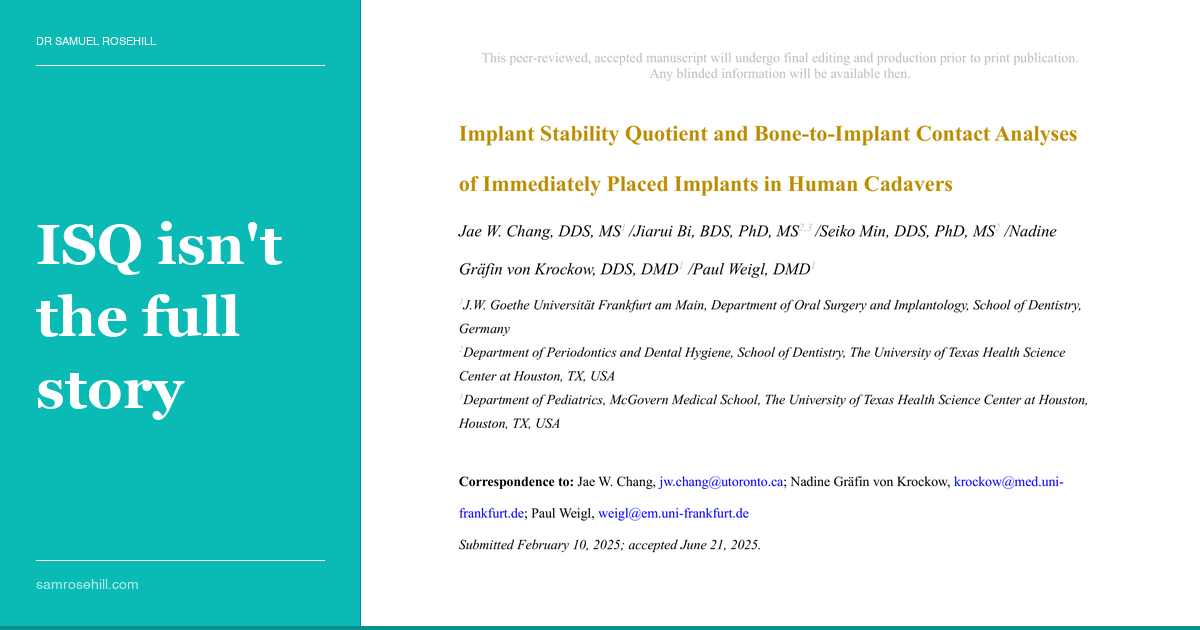
Source Paper
Implant Stability Quotient and Bone-to-Implant Contact Analyses of Immediately Placed Implants in Human Cadavers
You place an immediately loaded implant on a Thursday afternoon. The Osstell beeps reassuringly — ISQ of 68 in the buccal direction. Everything feels solid. Mechanically snug. You think: bone’s embracing this nicely, we’re good to go.
Except Chang and colleagues — in their paper Implant Stability Quotient and Bone-to-Implant Contact Analyses of Immediately Placed Implants in Human Cadavers — have just pulled the rug out from under that comfortable assumption. In their cadaver-based investigation of 28 implants, they discovered something rather awkward: there’s no correlation between directional bone-to-implant contact measurements and ISQ values taken in the same directions. That reassuring beep is measuring something real, certainly. But it’s not measuring what you thought it was.
It’s rather like discovering your house inspector gave you a glowing report on structural integrity based solely on how well the front door closes. Technically relevant. Entirely inadequate.
The Data Anchor
Seven fresh-frozen human cadaver heads, 28 Hiossen ET III SA implants (4.5 mm × 11.5 mm, all ≥ 35 Ncm torque), single board-certified periodontist. Post-placement cone-beam CT measured radiographic bone-to-implant contact (r-BIC) as linear contact length divided by total implant length in four directions — buccal, lingual, mesial, distal. ISQ was measured in those same directions via Osstell AB resonance frequency analysis. The study was methodologically tight but substantively underpowered: 80% power would have required n=121 implants, not 28.
Key Findings
- No directional correlation between BIC and ISQ — every direction, zero relationship. Primary finding. Stark.
- ISQ remained constant across maxillary and mandibular sites despite variable radiographic bone contact, suggesting the measure is indifferent to regional bone density variation.
- When solid coronal contact existed at the shoulder, ISQ stayed high regardless of apical engagement — meaning ISQ reflects shoulder stability, not total osseous contact along the implant body.
- Caveat: Cadaver bone lacks the biological remodelling and vascularity of living jaw — external validity is genuinely constrained, and an adequately powered clinical study remains the obvious next step.
💡 The Clinical Bottom Line
ISQ measures engagement at the implant shoulder — how mechanically snug that coronal interface sits. It’s a perfectly legitimate measurement. But it’s not a proxy for overall bone contact; you can have an implant reading beautifully on your device whilst apical engagement is poor or absent. For immediately placed implants where loading decisions rest partly on stability readings, this reshapes how we interpret every beep.
That Thursday afternoon reading matters. It’s telling you about the shoulder. Not the whole story.
Dr Samuel Rosehill is a general dentist with a prosthodontic focus, practising at Ethical Dental in Coffs Harbour, NSW. He holds a BDSc (Hons) from the University of Queensland, an MBA, an MMktg, and an MClinDent in Fixed & Removable Prosthodontics (Distinction) from King’s College London.
Reference: Chang JW, Bi J, Min S, Gräfin von Krockow N, Weigl P. Implant Stability Quotient and Bone-to-Implant Contact Analyses of Immediately Placed Implants in Human Cadavers. Int J Periodontics Restorative Dent. 2025. https://doi.org/10.11607/prd.7624
Clinical Relevance
ISQ reflects coronal shoulder engagement — not total bone contact along the implant body. A high ISQ reading on an immediately placed implant tells you the shoulder is mechanically snug; it does not confirm adequate apical bone contact. Loading decisions based solely on ISQ should account for this limitation, particularly in compromised or variable bone density sites.
Disclosure: The author has no financial conflicts of interest related to the products or topics discussed in this review. This is an independent summary prepared for educational purposes.
Continue the conversation
This review is also published on Substack, where you can leave comments and join the discussion.
Read on Substack →