After Ridge Preservation, 1.1 mm Might Decide the Implant
A 528-implant observational study after alveolar ridge preservation finds that pristine bone engagement below 1.1 mm roughly doubles failure risk — a useful planning threshold when regenerated socket walls look more reassuring than they are.
1.1 mm matters
Source Paper
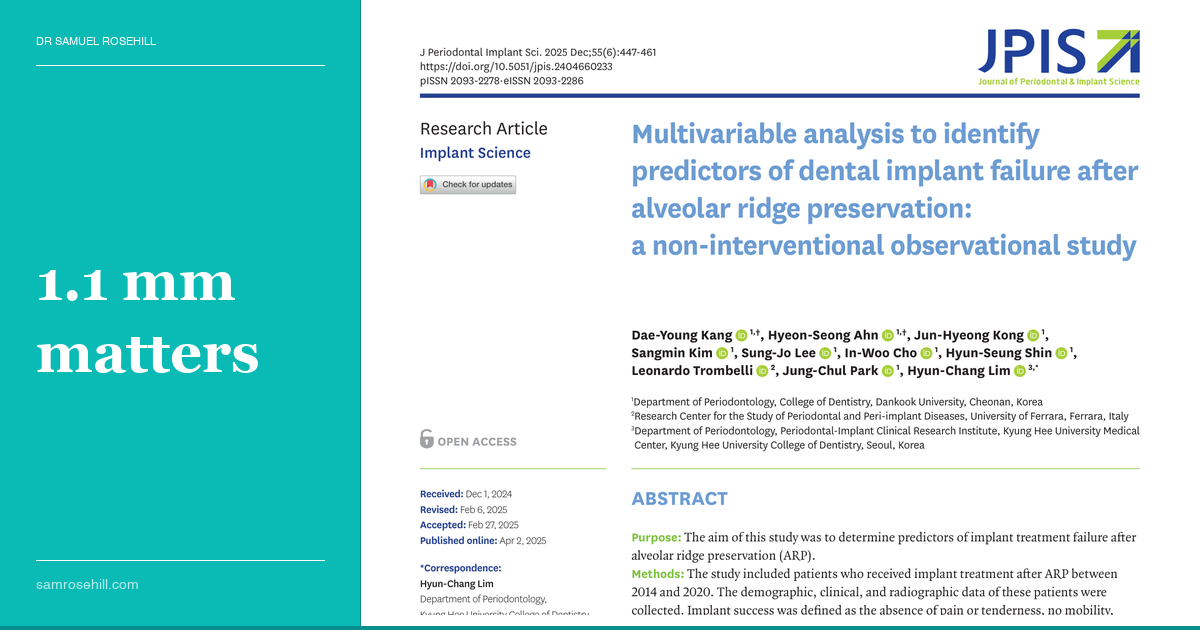
Multivariable analysis to identify predictors of dental implant failure after alveolar ridge preservation: a non-interventional observational study
Alveolar ridge preservation has sold the profession a very seductive proposition: extract the tooth, pack the socket, come back later, and find a tidy implant bed waiting for you with the good manners of a hotel room that has been turned down overnight. Kang and colleagues, in “Multivariable analysis to identify predictors of dental implant failure after alveolar ridge preservation: a non-interventional observational study,” ask the inconvenient follow-up question. How much native bone does the implant still need to engage if it is actually going to last? Their answer is admirably specific: if average pristine bone engagement falls below 1.1 mm, failure risk rises sharply.
The Data Anchor
This observational cohort included 528 implants placed in 412 patients after alveolar ridge preservation between 2014 and 2020. Mean follow-up was 3.5 ± 1.8 years. Implant success required absence of pain, mobility, exudation, and marginal bone loss beyond 2 mm. The investigators measured pristine bone engagement (PBE) mesially and distally on radiographs taken immediately after placement, then averaged the two values to estimate how much untouched native bone the implant had actually engaged beyond the regenerated socket.
The median PBE was 2.09 mm (IQR 0.84-3.72). Eighty-two implants had an average PBE below 1.1 mm; 375 had 1.1 mm or more. Over the observation period, 43 implants met the study’s failure criteria.
Key Findings
- Overall success was respectable but not trivial to lose: cumulative success reached 89.0% (95% CI 85.4-92.8%), with 43 failures among 528 implants.
- The 1.1 mm threshold mattered clinically, not just statistically. Implants with average PBE of at least 1.1 mm showed a 91.0% success rate, versus 84.5% when PBE was below 1.1 mm (P = 0.003).
- In the multivariable model, low PBE was the factor that held. Average PBE below 1.1 mm carried an adjusted hazard ratio of 2.50 (95% CI 1.34-4.67, P = 0.004) for implant failure.
- Other suspects fell away once everything competed in the same model. Socket integrity, tooth type, and longer healing time after ridge preservation did not remain independently significant after adjustment.
- The paper’s useful discomfort is this: regenerated socket bone may preserve ridge shape beautifully while still not giving the implant enough pristine anchorage to behave itself long term.
- Limitations matter. PBE was measured on plain radiographs, so buccolingual engagement could not be assessed; the study is observational; and the 1.1 mm figure is a planning threshold, not a universal law of nature.
💡 The Clinical Bottom Line
When reviewing an implant plan after ridge preservation, the question is not simply whether the ridge looks presentable. It is whether the implant will engage enough untouched bone to survive the biological untidiness that follows surgery. This paper suggests that if the average pristine bone engagement is under 1.1 mm, the case deserves a harder stare: different implant length, altered position, further augmentation, or a less optimistic loading strategy.
Ridge preservation can make a socket look ready. It cannot, by itself, negotiate with physics.
Dr Samuel Rosehill is a general dentist with a prosthodontic focus, practising at Ethical Dental in Coffs Harbour, NSW. He holds a BDSc (Hons) from the University of Queensland, an MBA, an MMktg, and an MClinDent in Fixed & Removable Prosthodontics (Distinction) from King’s College London.
Reference: Kang DY, Ahn HS, Kong JH et al. Multivariable analysis to identify predictors of dental implant failure after alveolar ridge preservation: a non-interventional observational study. Journal of Periodontal and Implant Science. 2025;55(6):447-461. DOI: 10.5051/jpis.2404660233
Clinical Relevance
After alveolar ridge preservation, the implant still needs meaningful engagement with native bone. In this cohort, average pristine bone engagement below 1.1 mm approximately doubled failure risk, which makes residual native bone support a practical planning metric rather than an academic curiosity.
Disclosure: The author has no financial conflicts of interest related to the products or topics discussed in this review. This is an independent summary prepared for educational purposes.
Continue the conversation
This review is also published on Substack, where you can leave comments and join the discussion.
Read on Substack →