Molar ARP Earns Its Grafting Costs
A 2025 systematic review of 14 studies and 571 molar extraction sites finds that alveolar ridge preservation reduces bone width loss by approximately 1–2 mm compared to spontaneous healing, and cuts the need for advanced bone augmentation from 47.7% to 20.8% — including a striking reduction in lateral window sinus lifts.
Graft now, operate less later
Source Paper
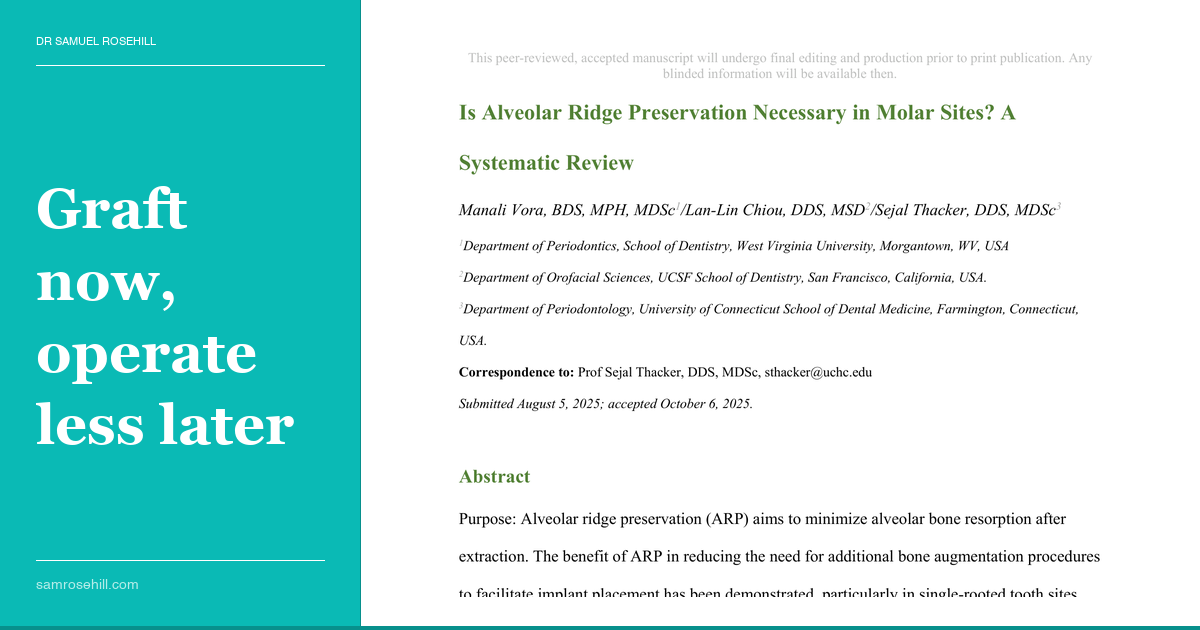
Is Alveolar Ridge Preservation Necessary in Molar Sites? A Systematic Review
The evidence base for alveolar ridge preservation has been built, almost exclusively, in the anterior region. The single-rooted anterior socket has received the lion’s share of clinical attention while the molar sits at the back of the arch, anatomically complicated and largely unreviewed. We routinely offer ridge preservation at molar sites on the same logic as a central incisor, despite the molar socket’s multiple roots, proximity to the sinus, and a resorptive trajectory anterior studies cannot simply explain.
That the evidence was thin did not slow the recommendation. “Is Alveolar Ridge Preservation Necessary in Molar Sites? A Systematic Review,” by Vora, Chiou, and Thacker, arrives with the thing molar ARP has quietly needed: a dedicated answer. The answer is yes.
The Data Anchor
This PRISMA-registered systematic review (PROSPERO ID: CRD42024521145) searched four databases through November 2024. From 3,137 screened articles, 14 studies met inclusion criteria: eight RCTs, two controlled clinical trials, three prospective cohort studies, and one retrospective cohort study. The total pool was 571 sites, all in adult patients with molar extractions planned for implant replacement and with a spontaneous healing (SH) control group.
Results were stratified by socket condition (periodontally sound, compromised, or unspecified), which is the sensible move when socket biology varies as much as it does in this population.
For periodontally sound sockets, ridge width reduction in ARP groups ranged from -1.02 ± 0.88 mm to -2.73 ± 1.68 mm, while controls lost -2.36 ± 0.91 mm to -4.44 ± 3.71 mm. Buccal bone height loss in ARP sites ran from -0.58 ± 0.53 mm to -1.55 ± 0.93 mm versus -1.30 ± 0.99 mm to -2.60 ± 2.06 mm in SH sites.
The secondary outcomes make the more persuasive argument. Across 197 ARP sites and 193 SH sites, 20.8% of ARP sites required additional bone augmentation at implant placement versus 47.7% of SH sites. For maxillary molar sites, the lateral window sinus lift (a qualitatively more demanding procedure, with higher complication rates and longer treatment timelines) was needed at only 0–7% of ARP sites, compared with 20–44.8% of SH sites.
Key Findings
- Horizontal bone loss was consistently lower with ARP. In sound sockets, grafting reduced width loss by roughly 1–2 mm; in periodontally compromised sockets, the benefit held across most studies, though variability was wider.
- Additional augmentation was more than halved. 20.8% of ARP sites required GBR or SFA at implant placement; 47.7% of SH sites did.
- The lateral window sinus lift result is clinically important. ARP-treated maxillary molar sites required this more complex approach at 0–7%, against 20–44.8% in controls — the difference between a routine implant appointment and a staged surgery.
- Long-term implant data remain scarce. Only Lim et al. reported post-loading outcomes: 100% survival and minimal marginal bone level change at one year. The review cannot speak to longer performance. That is a genuine gap.
- Limitation: heterogeneity in measurement methods, socket inclusion criteria, and ARP protocols precluded meta-analysis. The conclusions are directional and consistent, not pooled and precise.
💡 The Clinical Bottom Line
For the clinician about to close following a maxillary molar extraction, this review offers two numbers: 20.8% versus 47.7%. Graft the socket, and roughly one in five patients will need augmentation at implant time. Leave it to heal spontaneously, and it is closer to one in two.
In the posterior maxilla, where the sinus is waiting and a lateral window lift is the consequence of insufficient vertical bone, that ratio is worth a conversation at the time of extraction — not six months later when the bone has already voted.
The molar socket now has its own evidence — limited, heterogeneous, but pointing consistently in one direction. ARP does not guarantee a straightforward implant case; it makes one considerably more likely.
Dr Samuel Rosehill is a general dentist with a prosthodontic focus, practising at Ethical Dental in Coffs Harbour, NSW. He holds a BDSc (Hons) from the University of Queensland, an MBA, an MMktg, and an MClinDent in Fixed & Removable Prosthodontics (Distinction) from King’s College London.
Clinical Relevance
Across 14 studies and 571 molar extraction sites, ARP reduced horizontal bone width loss to 1.02–2.73 mm (versus 2.36–4.44 mm for spontaneous healing) and halved the need for additional bone augmentation (20.8% vs 47.7%). The lateral window sinus lift reduction was particularly pronounced: 0–7% in ARP sites versus 20–44.8% in controls. Clinicians planning implants in maxillary posterior sites have quantitative justification for routinely offering ARP at the time of molar extraction.
Disclosure: The author has no financial conflicts of interest related to the products or topics discussed in this review. This is an independent summary prepared for educational purposes.
Continue the conversation
This review is also published on Substack, where you can leave comments and join the discussion.
Read on Substack →