Your Patient's Provisional Just Survived Three Weeks of Smoking. The Colour Didn't.
Kader et al. expose 120 provisional restoration specimens to cigarette smoke and find that milled PMMA outperforms both conventional bis-acryl and 3D-printed resins for colour and translucency stability — with brushing only partially reversing the damage.
Milled PMMA resists smoke stain
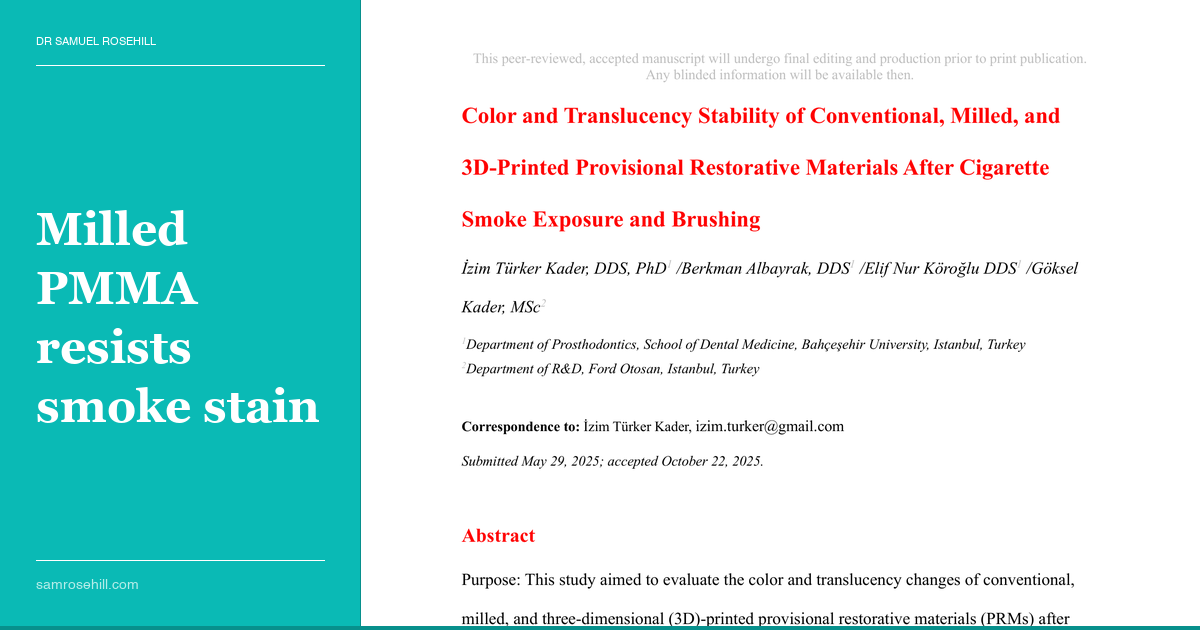
Source Paper
Color and Translucency Stability of Conventional, Milled, and 3D-Printed Provisional Restorative Materials After Cigarette Smoke Exposure and Brushing
You know the patient. They’re in a long-span provisional — three units, maybe five — and you’ve explained, with the gentle firmness of someone who has given this speech before, that the temporaries need to last a few months. They nod. They leave. They smoke a pack a day. Three weeks later they’re back in the chair, and the provisionals have taken on a colour that might generously be described as “heritage mustard.”
Kader et al.’s Color and Translucency Stability of Conventional, Milled, and 3D-Printed Provisional Restorative Materials After Cigarette Smoke Exposure and Brushing (The International Journal of Prosthodontics, 2025) finally quantifies just how bad this gets — and, more usefully, which material fights back.
The Data Anchor
The Bahçeşehir University team fabricated 120 disc-shaped specimens (shade A2) from three provisional materials: conventional bis-acryl composite resin (GC TempSmart DC), milled PMMA (FusionCeram), and 3D-printed resin (GC TempPRINT), with n = 40 per material. Half were exposed to cigarette smoke — twenty cigarettes per day for twenty consecutive days; the other half sat quietly in artificial saliva, doing nothing wrong. All specimens then underwent brushing simulation to create smoke-then-brushed and control-then-brushed subgroups. Colour change (ΔE₀₀) and translucency were measured via spectrophotometer and the CIEDE2000 formula, where the clinical acceptability threshold sits at ΔE₀₀ = 1.8.
After smoke exposure, conventional bis-acryl hit ΔE₀₀ values of 5.43 ± 0.42 (white background) and 5.76 ± 0.46 (black background) — roughly three times the acceptability threshold. The 3D-printed resin was marginally more restrained at 4.36 ± 0.27 and 4.72 ± 0.30. Milled PMMA posted significantly lower discolouration across both backgrounds (P < .001). Brushing helped — milled PMMA dropped to post-brushing values of just 1.14 ± 0.12 and 1.30 ± 0.15 — but for conventional and 3D-printed materials, values frequently remained above the acceptability threshold even after cleaning.
If your smoker is wearing a 3D-printed provisional for more than a fortnight, the colour stability conversation has already been lost. Milled PMMA buys you time — and something closer to dignity.
Key Findings
- Milled PMMA was the clear winner: significantly lower ΔE₀₀ values than both conventional and 3D-printed resins after smoke exposure (P < .001), and the best translucency retention across all conditions.
- All materials exceeded the clinical acceptability threshold after smoking: every provisional type crossed ΔE₀₀ = 1.8 — but conventional bis-acryl and 3D-printed resins did so by a factor of two to three.
- Brushing reduced but did not eliminate staining: milled PMMA responded best to post-exposure brushing (P < .05); conventional and 3D-printed materials remained visibly compromised.
- 3D-printed resin showed the greatest translucency instability: the highest ΔTP₀₀ values across groups, with a significant group-by-material interaction (P = .008) driven by its divergence from milled PMMA.
- Caveat: This is an in vitro study using a single shade (A2) and one brand per fabrication method. No thermocycling was performed, and brushing was applied cumulatively after the full exposure period rather than daily — meaning real-world staining patterns may differ.
💡 The Clinical Bottom Line
When a smoker needs an extended provisional — and you know they exist in every practice — reach for milled PMMA. The pre-polymerised, homogeneous microstructure of a milled puck resists tar deposition in a way that neither chairside bis-acryl nor the layered architecture of a 3D-printed resin can match. And while patient education about brushing remains essential, this data suggests that oral hygiene is damage limitation rather than damage reversal; the material choice you make at fabrication is the decision that echoes longest in the colour of the smile.
Dr Samuel Rosehill is a general dentist with a prosthodontic focus, practising at Ethical Dental in Coffs Harbour, NSW. He holds a BDSc (Hons) from the University of Queensland, an MBA, an MMktg, and an MClinDent in Fixed & Removable Prosthodontics (Distinction) from King’s College London.
Reference: Kader İT, Albayrak B, Köroğlu EN, Kader G. Color and translucency stability of conventional, milled, and 3D-printed provisional restorative materials after cigarette smoke exposure and brushing. Int J Prosthodont. 2025. doi: 10.11607/ijp.9494
Clinical Relevance
For patients who smoke, milled PMMA provisionals offer measurably superior colour and translucency stability compared to conventional bis-acryl or 3D-printed alternatives. When extended provisional wear is anticipated in a smoker, material selection matters — and brushing alone will not undo the damage.
Disclosure: The author has no financial conflicts of interest related to the products or topics discussed in this review. This is an independent summary prepared for educational purposes.
Continue the conversation
This review is also published on Substack, where you can leave comments and join the discussion.
Read on Substack →