The 30-Minute Sweet Spot: Post-Curing 3D-Printed Temporary Crowns
A Turkish in vitro study of 108 specimens finds that UV post-curing 3D-printed temporary crown resins for 30 minutes optimises mechanical, optical, and chemical properties simultaneously — and that extending curing to 45 minutes begins to degrade the polymer network despite producing marginally higher hardness scores.
30 minutes. Then stop.
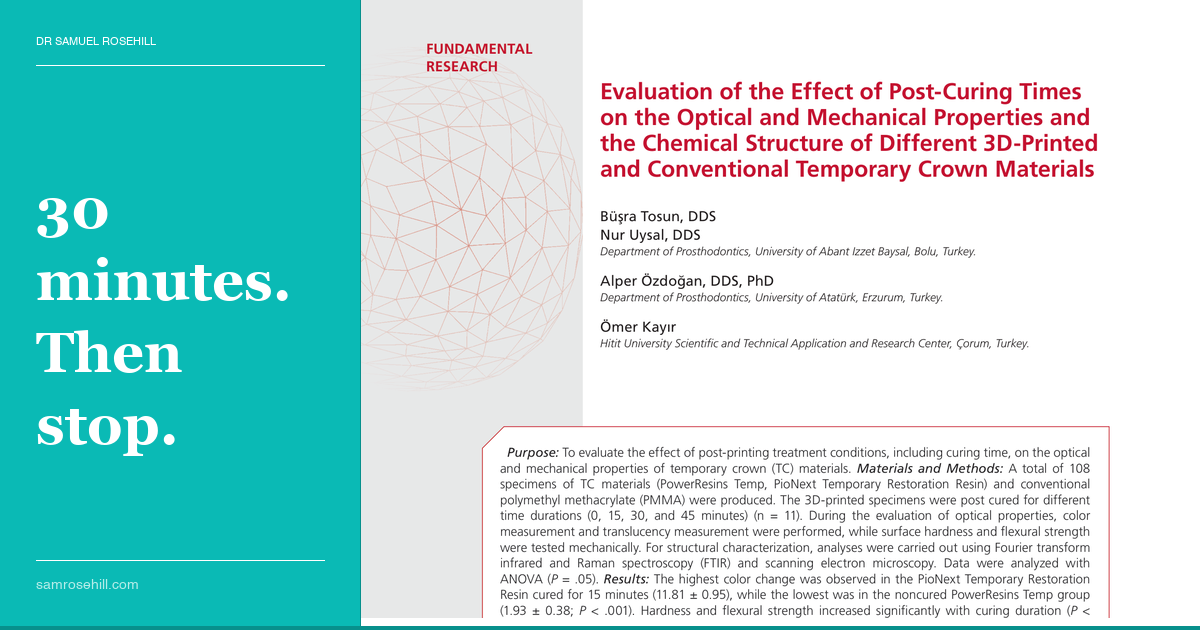
Source Paper
Evaluation of the Effect of Post-Curing Times on the Optical and Mechanical Properties and the Chemical Structure of Different 3D-Printed and Conventional Temporary Crown Materials
There is a principle in bread-making, well understood by bakers and largely ignored by everyone else, that says a loaf left too long in the oven does not become a better loaf. The Maillard reaction that builds a satisfying crust does not pause when the crust is formed; it continues, and eventually ruins the very quality it was creating. Polymer chemistry, it turns out, operates on the same logic.
The paper Evaluation of the Effect of Post-Curing Times on the Optical and Mechanical Properties and the Chemical Structure of Different 3D-Printed and Conventional Temporary Crown Materials, by Büşra Tosun and colleagues from the University of Abant Izzet Baysal and Atatürk University in Turkey, set out to determine the optimal ultraviolet (UV) post-curing duration for digital light processing (DLP) temporary crown resins. The assumption, shared by most clinicians running intraoral scanners, is that more curing produces better material. The data is more instructive.
The Data Anchor
Tosun and colleagues produced 108 bar-shaped specimens (25 × 2 × 2 mm, ISO 4049-2019) across three materials: PowerResins Temp (PR), PioNext Temporary Restoration Resin (PN), and a conventional polymethyl methacrylate (PMMA) group (CG, Integra) as the comparator. 3D-printed specimens were post-cured for 0, 15, 30, and 45 minutes using a UV polymerisation unit, n = 11 per group.
Four outcomes were assessed: colour change (ΔE₀₀, CIEDE2000), translucency, Vickers hardness (HV), and flexural strength (MPa). Fourier-transform infrared spectroscopy (FTIR) tracked carbonyl (C=O) peak intensity as the chemical index of polymerisation completeness. ANOVA with Tukey post hoc comparisons throughout (P = .05).
Key Findings
- Thirty minutes is the FTIR sweet spot. Carbonyl peak intensity stabilised at 30 minutes, confirming complete polymerisation. Beyond 30 minutes, peaks decreased, with new spectral features indicating polymer degradation, not further consolidation.
- Flexural strength gains plateau well before 45 minutes. For PowerResins, no significant difference was found between PR15 (123.87 ± 8.89 MPa), PR30 (129.69 ± 4.38 MPa), and PR45 (P > .05). PioNext gained significantly from 15 to 30 minutes (106.97 ± 17.84 to 132.96 ± 14.09 MPa, P < .05), but not from 30 to 45 minutes.
- Hardness does increase to 45 minutes (PR45: 15.79 ± 3.60 HV, comparable to conventional PMMA at 14.86 ± 2.20 HV), but this mechanical gain coincides with chemical deterioration that the hardness test cannot detect.
- Colour stability improves with curing duration. Uncured PN specimens (ΔE₀₀ = 4.12 ± 0.32) worsened dramatically at 15 minutes (11.81 ± 0.95) before gradually recovering. The 30-minute groups approached clinical acceptability thresholds, with PowerResins showing superior colour stability to PioNext at every duration.
- Limitation: In vitro, DLP printers only, standardised printing parameters. Clinical variables including washing protocol and ambient humidity will add scatter that bar specimens do not model.
💡 The Clinical Bottom Line
Post-cure your DLP temporary crown resins for 30 minutes, then remove them from the UV chamber. An extra quarter-hour produces marginally higher hardness scores on a testing machine while simultaneously disrupting the polymer network that determines long-term chemical stability.
Conventional PMMA achieves its properties in a single cycle with no timer required. The 3D-printed analogues need a post-curing step, but they also need a stop point. Thirty minutes is it.
For practices producing temporaries in-house, this translates to a simple, non-negotiable protocol note. The polymer network, like a well-made loaf, is not improved by waiting.
Dr Samuel Rosehill is a general dentist with a prosthodontic focus, practising at Ethical Dental in Coffs Harbour, NSW. He holds a BDSc (Hons) from the University of Queensland, an MBA, an MMktg, and an MClinDent in Fixed & Removable Prosthodontics (Distinction) from King’s College London.
Clinical Relevance
When post-curing 3D-printed temporary crowns, 30 minutes of UV exposure is the evidence-based optimum: sufficient to stabilise the polymer network, maximise colour stability, and achieve mechanical properties comparable to conventional PMMA. Extending to 45 minutes may modestly increase hardness on a testing machine but introduces chemical degradation that the FTIR data cannot ignore. The practical rule: 30 minutes, then stop.
Disclosure: The author has no financial conflicts of interest related to the products or topics discussed in this review. This is an independent summary prepared for educational purposes.
Continue the conversation
This review is also published on Substack, where you can leave comments and join the discussion.
Read on Substack →