The Resin-Bonded Bridge Deserves More Respect
Abduljabbar and colleagues compare single-retainer lithium disilicate RBFDPs with implant-supported single crowns in the esthetic zone across five Swedish clinics, finding 87.9% vs 96.7% five-year survival but equivalent patient satisfaction.
Don't dismiss the bonded bridge
Source Paper
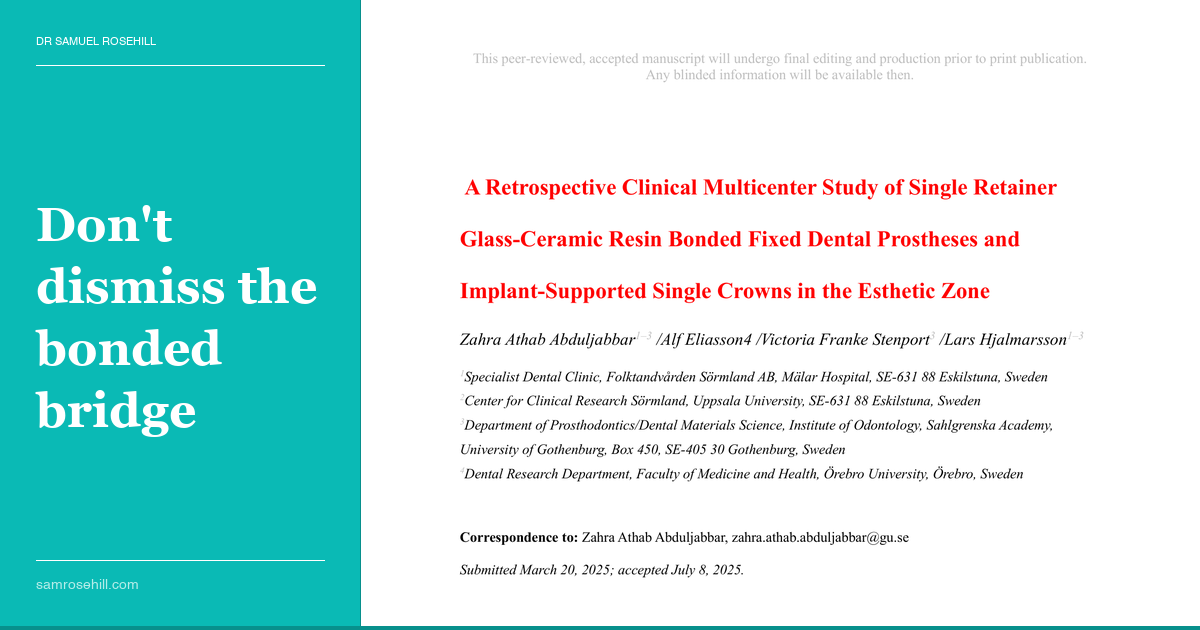
A Retrospective Clinical Multicenter Study of Single Retainer Glass-Ceramic Resin Bonded Fixed Dental Prostheses and Implant-Supported Single Crowns in the Esthetic Zone
Most of us have a colleague who regards the resin-bonded bridge as a temporary measure — a polite way of delaying the implant conversation. It is the prosthetic equivalent of a place-holder: useful for adolescents whose jaws haven’t finished growing, tolerated in patients who decline surgery, but never quite taken seriously as a long-term restoration. Abduljabbar and colleagues, in a multicentre retrospective study published in the International Journal of Prosthodontics, set out to test whether that reputation is deserved.
The Data Anchor
The study compared 66 single-retainer lithium disilicate RBFDPs (IPS e.max, Ivoclar Vivadent) in 48 patients with 53 implant-supported single crowns in 45 patients, all placed in the anterior or premolar region across five specialist clinics in Sweden. Mean follow-up was 50.8 months for RBFDPs and 73.7 months for implant crowns. All RBFDPs were adhesively bonded with one of three resin cements (Variolink Esthetic, Panavia V5, or Multilink). The implant group used Straumann, Astra Tech, and Brånemark systems. Survival was assessed via Kaplan-Meier analysis, esthetics via the White Esthetic Score (WES) and Pink Esthetic Score (PES), and patient satisfaction via OHIP-14 and VAS questionnaires.
Key Findings
- Five-year cumulative survival was 87.9% for RBFDPs and 96.7% for implant crowns (P = .012), but the headline number masks a critical design variable
- Connector area was the decisive factor: clinics B and C, which used standardised connectors of 14–16 mm², achieved 97% RBFDP survival; clinics A, D, and E, with smaller and more variable connector designs, managed only 78.8% (P = .015)
- All nine RBFDP failures were connector or retention wing fractures, not debondings; eight of nine replaced maxillary lateral incisors
- Implant crowns were not complication-free: 11.3% technical complications (ceramic fractures) and 5.7% peri-implantitis (three implants in three patients)
- RBFDPs scored higher on tooth esthetics (WES 8.9 vs 7.6, P = .002), with no difference in soft tissue appearance (PES 8.6 vs 8.4, P = .47)
- Patient satisfaction was equivalent: VAS scores of 9.2 vs 9.0 (P = .94), and OHIP-14 scores showed no significant difference (P = .063)
- No patient-level variable (age, gender, occlusion, attrition, antagonist type) was a statistically significant predictor of failure in either group
The study is retrospective and the RBFDP group had a shorter mean follow-up than the implant group, which may understate late complications in the bonded bridges. The variation in connector design across clinics, while a limitation of standardisation, is arguably the study’s most clinically useful finding.
💡 The Clinical Bottom Line
The implant single crown remains the more durable option in the esthetic zone, but a well-designed lithium disilicate RBFDP with a connector area of at least 14 mm² is not the temporary compromise it is often assumed to be. For patients who are too young for implants, who lack bone volume, or who simply prefer a less invasive pathway, the single-retainer bridge deserves a seat at the treatment-planning table rather than an apologetic footnote. The data suggest that how you design the connector matters considerably more than whether you choose to bond or screw.
Dr Samuel Rosehill is a general dentist with a prosthodontic focus, practising at Ethical Dental in Coffs Harbour, NSW. He holds a BDSc (Hons) from the University of Queensland, an MBA, an MMktg, and an MClinDent in Fixed & Removable Prosthodontics (Distinction) from King’s College London.
Reference: https://doi.org/10.11607/ijp.9427
Clinical Relevance
A well-designed lithium disilicate RBFDP with an adequate connector area (14–16 mm²) achieves 97% five-year survival, comparable to implant crowns. Connector design matters more than material choice; clinics with smaller, less standardised connectors saw significantly more fractures.
Disclosure: The author has no financial conflicts of interest related to the products or topics discussed in this review. This is an independent summary prepared for educational purposes.
Continue the conversation
This review is also published on Substack, where you can leave comments and join the discussion.
Read on Substack →